Explosive Feral Hog Growth Near San Antonio Waterways Sparks Public Safety Concerns
A surge in feral hog activity near Salado Creek highlights the escalating battle between Texas urban expansion and invasive wild pig populations.
Editorial disclaimer: Opinions and analysis on Keep TX Red are editorial content — not statements of fact. See our editorial standards.
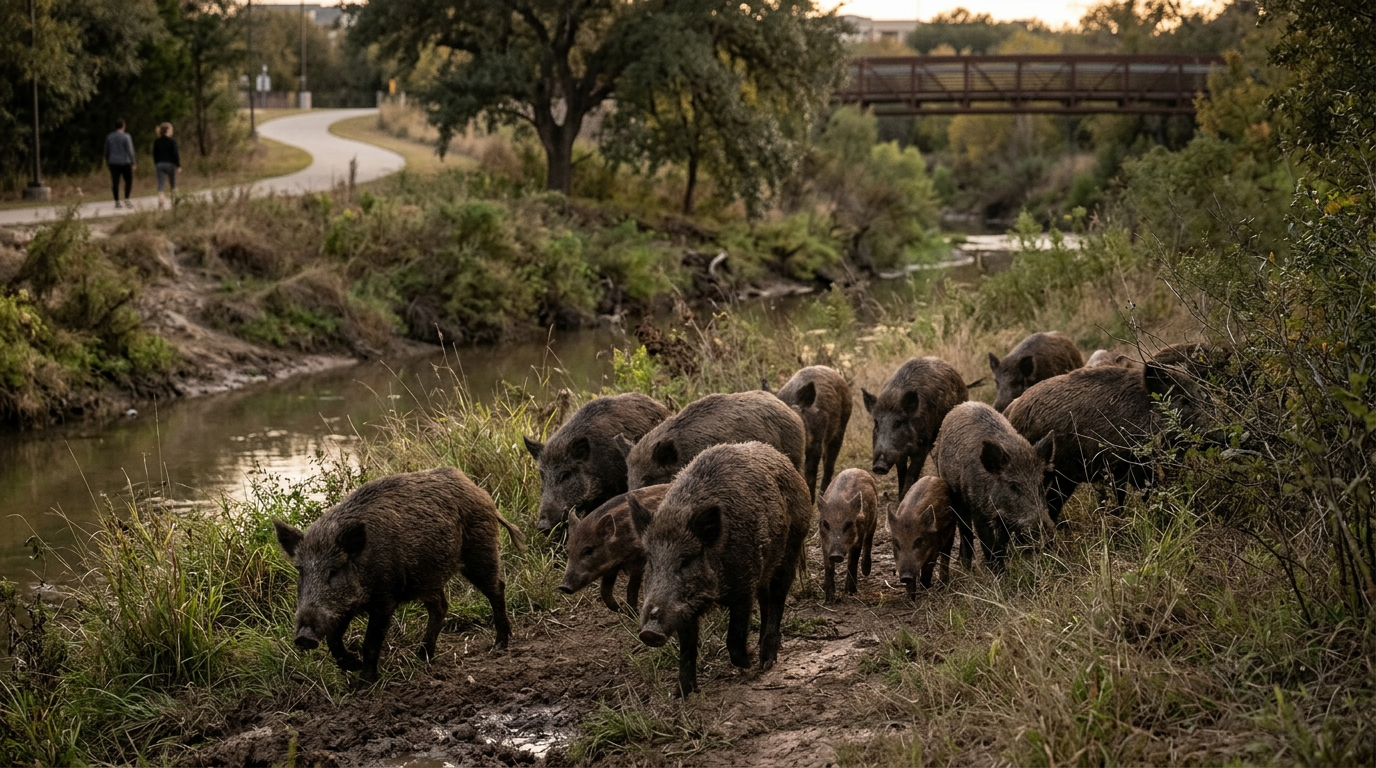
The persistent struggle against invasive species has taken a visible turn in the San Antonio area, as recent footage captures large sounders of feral hogs roaming near the Salado Creek Greenway. Historically, these animals have been a staple of rural Texan life, but current population trends show them encroaching deeper into metropolitan recreational zones. Texas has long served as the epicenter of the feral hog crisis in the United States, with a history of population management efforts dating back decades. As San Antonio continues to expand its greenway trail systems, the intersection of human recreation and wild animal habitats is becoming increasingly frequent and fraught with risk. The sighting near Salado Creek is not an isolated incident but rather a symptom of a statewide explosion in wild pig numbers that defies traditional trapping methods. Experts suggest that the resilience of these animals, coupled with their high reproductive rates, makes them a formidable foe for municipal administrators and private landowners alike. While the hogs generally avoid direct human contact during daylight hours, their nocturnal activities are leaving visible scars on the local landscape. The emergence of these animals in popular park areas has prompted a renewed discussion on how the nation’s seventh-largest city balances urban development with the realities of being in a high-density zone for invasive wildlife. This situation serves as a stark reminder that the barrier between the wild and the city is more porous than many residents realize.
Texas relevance
This issue is central to Central Texas and the Greater San Antonio region, where the Salado Creek Greenway serves as a vital artery for recreation and local transit. For years, the Texas Department of Agriculture and the Texas Parks and Wildlife Department have warned that the hog population in Bexar County and surrounding South Texas counties is reaching a tipping point. The proximity of these animals to San Antonio’s public parks poses a specific threat to the integrity of local water quality and the safety of trail users. Texas residents currently bear the brunt of over $400 million in annual damages caused by these animals statewide, making local management efforts a matter of both fiscal and environmental urgency for the Lone Star State.
The Scale of the Salado Creek Sightings
Recent captures on motion-activated cameras near the Salado Creek area have revealed sounders—groups of feral hogs—consisting of dozens of individuals. These animals are often seen foraging for food along the banks of the creek, utilizing the soft soil to dig for roots and grubs. This process, known as rooting, can destroy native vegetation and accelerate soil erosion, which eventually impacts the water clarity of the San Antonio watershed.
The visibility of these animals so close to major residential developments indicates that the local population is likely exceeding its traditional habitat limits. When resources become scarce in the wilder parts of South Texas, these intelligent scavengers follow creek lines into the heart of the city. The greenway system acts as a natural highway for the hogs, providing them with cover, water, and easy access to secondary food sources found in suburban landscapes.
Local residents have reported seeing the damage long before seeing the animals themselves. Overturned turf, damaged fences, and decimated gardens are common signs that a sounder has moved through a neighborhood. The sightings at Salado Creek provide the visual confirmation that authorities need to assess the density of the population and determine if a coordinated trapping effort is necessary to protect the public infrastructure.
Environmental and Infrastructure Impact
The environmental toll of a surging feral hog population in San Antonio is substantial. These animals do not just eat crops; they actively destroy the riparian zones that are essential for flood control and biodiversity. By disturbing the soil along Salado Creek, the hogs increase the nutrient load and bacterial count in the water, which can lead to hazardous conditions for other wildlife and even downstream human utility.
Furthermore, the structural integrity of the trail systems themselves is at risk. Feral hogs are capable of digging deep holes that can undermine the pavement of bike paths or the stability of small bridges. In a city like San Antonio, which invests heavily in park infrastructure to attract tourism and improve quality of life, the cost of repairing damage caused by invasive pigs is a growing line item that taxpayers ultimately have to cover.
Native species are also being pushed out. Wild hogs are aggressive competitors that often drive away deer and smaller mammals from food sources. They are also known to prey on the eggs of ground-nesting birds and even small fawns. For San Antonio to maintain its natural heritage along its creek systems, the dominance of the feral hog must be checked through consistent and aggressive management strategies.
Public Safety and Human Interaction
While feral hogs are generally wary of humans, they can become extremely aggressive if they feel cornered or if a sow believes her piglets are in danger. With the Salado Creek area being a high-traffic zone for hikers, joggers, and dog walkers, the potential for a dangerous encounter has increased significantly. An adult feral hog can weigh several hundred pounds and possesses sharp tusks that can cause severe injury.
Health officials also warn about the diseases these animals carry. Feral hogs are known vectors for various pathogens, including swine brucellosis and pseudorabies. While transfer to humans is rare, it is not impossible, especially if residents attempt to handle or remove the animals themselves. The presence of these pathogens in public waterways is a constant concern for San Antonio’s health department.
The city’s Parks and Recreation Department has historically advised citizens to maintain their distance and report sightings immediately. However, as the hogs become more habituated to the presence of humans and the smells of the city, they may lose their natural fear. This habituation is one of the primary reasons wildlife experts are calling for more proactive removal rather than just passive observation.
The Challenges of Urban Hog Control
Managing wild pig numbers inside city limits is significantly more difficult than in rural Texas. In the countryside, aerial gunning and night hunting are common and effective. Inside San Antonio, however, these methods are off the table due to safety regulations. Trapping remains the primary tool, but feral hogs are highly intelligent and often become 'trap shy' after seeing other members of their sounder captured.
Professional trapping services must work undercover of darkness and ensure that the traps do not pose a risk to curious pets or wandering residents. This increases the logistical cost and complexity of the operations. Additionally, the sheer size of the San Antonio greenway system means that even if one area is cleared, new hogs can move into the vacated territory within a matter of weeks.
Some advocates have suggested the use of toxic baits, but this remains a controversial topic in Texas. The risk of secondary poisoning for native species like bald eagles or family dogs makes it a difficult sell for urban wildlife management. Therefore, San Antonio remains reliant on physical removal and the hope that state-level research will eventually provide a more efficient, silver-bullet solution.
Economic Consequences for the Region
The economic footprint of feral hogs in the San Antonio area extends beyond park repairs. Nearby agricultural operations on the outskirts of Bexar County lose thousands of dollars every year to crop destruction. When these hogs move into urban areas, they also cause thousands in property damage to golf courses, school athletic fields, and private residential lawns.
For the state of Texas, the wild pig problem is a billion-dollar issue when considering the combined loss of agricultural revenue and the cost of control efforts. San Antonio’s specific struggle is a microcosm of a larger battle the state is losing. Without a more coordinated effort between the city, the county, and state agencies, the costs will continue to escalate as the population growth continues to outpace removal rates.
Business owners near Salado Creek have expressed concern that the presence of large, aggressive animals could deter visitors from using the parks. Since many local establishments rely on the foot traffic generated by the greenway, the feral hog surge isn't just an environmental issue—it's a threat to the local small-business economy that thrives on the city's outdoor appeal.
Future Outlook for San Antonio's Greenways
As San Antonio continues to be one of the fastest-growing cities in the country, the pressure on its natural spaces will only increase. The city must decide if it will dedicate more permanent funding to wildlife management or if the 'new normal' involves sharing urban parks with invasive swine. Future trail expansions will likely need to include fencing or other barriers to keep hogs out of high-density pedestrian zones.
Ongoing research at Texas A&M and other state institutions may eventually offer a breakthrough in fertility control or more effective lures. Until then, the Salado Creek sightings serve as a reminder that the wild side of Texas is never far away. Residents are encouraged to stay vigilant, keep their pets on leashes, and support local initiatives aimed at controlling the invasive population before it becomes an even more permanent fixture of the urban landscape.
The battle for Salado Creek is far from over. With every new sounder captured on camera, the urgency for a sustainable solution grows. For now, the hogs remain the kings of the creek, challenging the city's ability to maintain its vision of a safe, clean, and accessible urban wilderness for all Texans.
Analysis
The appearance of feral hogs in San Antonio’s suburban corridors represents a failure of current containment policy rather than a new phenomenon. While Texas allows for year-round, unrestricted hunting of these pests, those methods are impossible to implement in densely populated urban zones like the Salado Creek area due to discharge-of-firearm ordinances. This creates a 'safe haven' effect where hogs can flourish on public land without natural predators or human intervention. Moving forward, the state may need to consider more aggressive sterilization or professional removal programs funded by urban municipalities if they wish to keep their public parks from becoming permanent breeding grounds for an invasive species that undermines native Texan ecosystems.
Source attribution
This story was reported using a public release from the Texas Wildlife Stories (Google News). Keep TX Red rewrote the coverage independently and links to the official statement for verification.
Frequently Asked Questions
- Are feral hogs dangerous to people on the trail?
- While they typically avoid humans, feral hogs can be extremely aggressive if they feel trapped or are protecting their young. It is important to keep a safe distance and never approach them, especially when walking pets.
- Why can't the city just hunt the hogs near Salado Creek?
- City ordinances strictly prohibit the discharge of firearms with city limits for safety reasons. Wildlife officials must rely on non-lethal trapping or highly regulated professional removal services instead of public hunting.
- What should I do if I see a feral hog in San Antonio?
- Do not attempt to scare or feed the animal. Move away slowly and report the sighting to the San Antonio Parks and Recreation Department or local animal control so they can track the sounder's movement.
- How many feral hogs are there in Texas?
- Estimates suggest there are over 2.6 million feral hogs in Texas, making it the largest population in the country. They are found in nearly every one of the state's 254 counties.
Official Sources
Take the next step
Browse the Newsroom →Read more about Keep Texas Red → Our full guide to what Keep Texas Red means and why Texans support it.
Related Articles
Get Texas updates delivered weekly.
Independent Texas reporting on politics, policy, and daily life. One email a week. Unsubscribe anytime.
Keep TX Red Newsroom
The Keep Texas Red Editorial Staff produces nonpartisan explainers, policy breakdowns, and educational resources to help Texans understand how their government works. All content is reviewed for accuracy and updated regularly.
About Keep TX Red →