Battling the Invasive Surge: How Feral Hogs Threaten the Texas Ranching Economy
Texas faces a billion-dollar threat as feral hog populations disrupt livestock operations and agricultural productivity across the state.
Editorial disclaimer: Opinions and analysis on Keep TX Red are editorial content — not statements of fact. See our editorial standards.
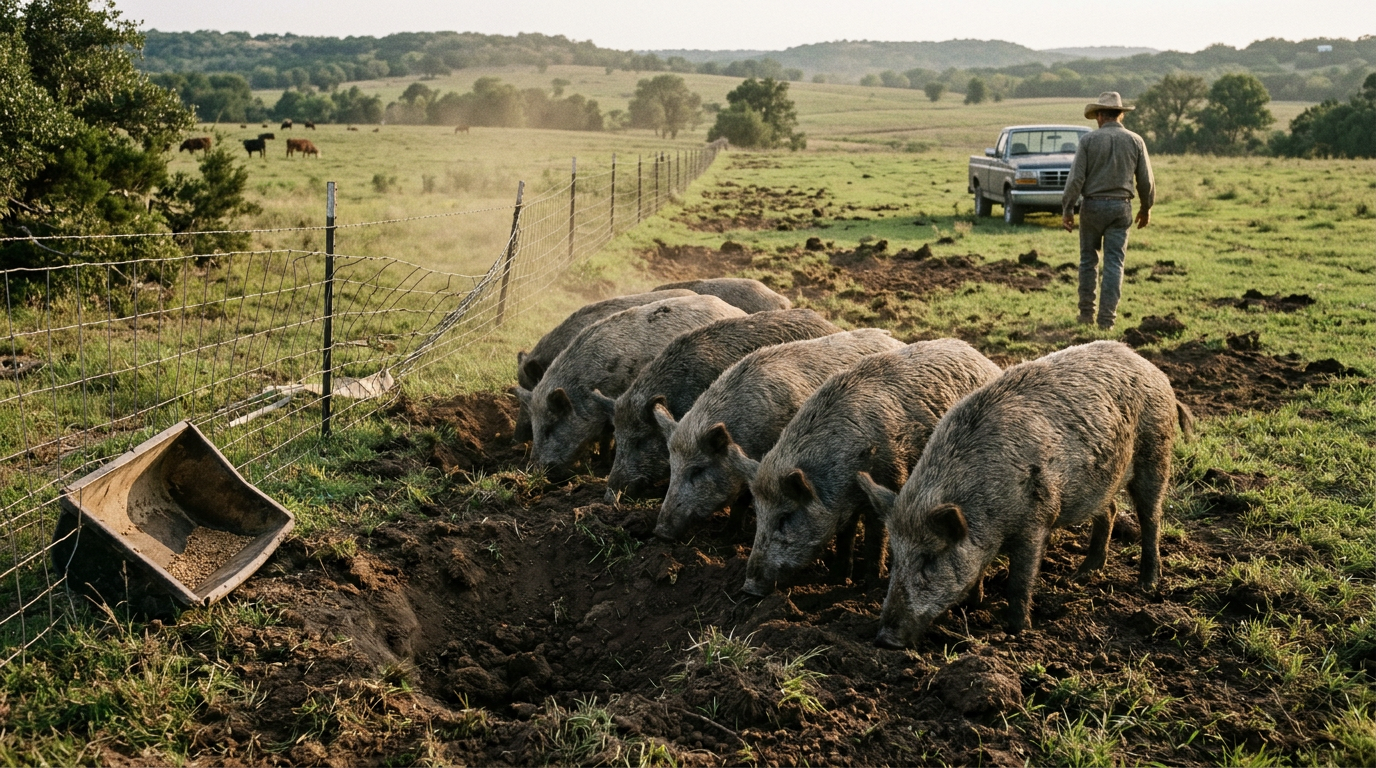
The persistent expansion of feral hog populations across the Lone Star State has reached a critical juncture for the agricultural industry. These invasive animals, which were originally brought to the Americas by early explorers and later cross-bred with escaped domestic swine, have become one of the most destructive forces facing Texas ranchers today. Historical data suggests the population has ballooned due to their high reproductive rates and lack of natural predators in the Texas ecosystem, leading to a state of emergency for rural land managers. Recent reports focus on the worsening interactions between these sounders and domestic livestock, noting that the damage extends far beyond simple property destruction. The conflict now involves direct competition for resources, the spread of zoonotic diseases, and physical threats to newborn animals. This struggle is part of a decades-long effort by the Texas Department of Agriculture and various wildlife agencies to mitigate a crisis that seems to grow more complex with each passing season. Unlike native wildlife that maintains a balance within the environment, these hogs act as biological bulldozers, fundamentally altering the landscape and the economic feasibility of traditional Texas ranching.
Texas relevance
Texas is the epicenter of the feral hog crisis in the United States, containing an estimated 2.6 million of the animals—roughly half of the entire national population. For Texas cattlemen and sheep producers, the presence of these hogs is not just a nuisance but a direct threat to their livelihood and the state's food security. Cities and rural counties from the Panhandle to the Rio Grande Valley are forced to allocate significant budgetary resources toward mitigation efforts, including trapping, aerial gunning, and fencing. The relevance to the average Texan lies in the potential for increased food prices and the environmental degradation of public lands and watersheds. This issue bridges the gap between urban and rural Texas, as the hogs increasingly move into suburban greenbelts, though their primary impact remains the systematic destruction of the state's storied agricultural heritage. Control efforts and research are frequently spearheaded by Texas A&M AgriLife Extension, making this a central issue for state policy and academic study.
Structural Damage and Pasture Destruction
The physical toll that feral hogs take on a ranch is immediate and visually striking. Using their powerful snouts, these animals engage in 'rooting,' a behavior where they overturn large swaths of soil to reach roots, grubs, and tubers. In a typical Texas pasture, this can result in the destruction of improved grasses like Coastal Bermuda, which ranchers rely on to feed their herds. The ground is often left looking like it has been tilled by machinery, creating hazardous conditions for both livestock and ranching vehicles.
Beyond the loss of forage, this rooting behavior facilitates the growth of invasive weeds and causes significant soil erosion. When heavy Texas rains hit these disturbed areas, the lack of root structure leads to sediment runoff into local creeks and rivers, further damaging the environment. Ranchers are frequently forced to spend thousands of dollars annually to regrade fields and replant decimated pastures, a recurring cost that eats into already thin profit margins. Repairing fences and water troughs damaged by the sheer force of these heavy animals adds another layer of financial burden.
Disease Transmission and Biosecurity Risks
One of the most insidious threats posed by feral hogs to the Texas livestock industry is the silent spread of disease. Hogs are known carriers of more than 30 pathogens and 37 types of parasites, many of which can jump to domestic swine, cattle, or even humans. Pseudorabies and swine brucellosis are among the most concerning, as an outbreak in a commercial livestock operation can lead to federal quarantines and catastrophic financial losses.
Biosecurity is difficult to maintain when feral hogs can easily breach standard fencing to access water sources and feed bunks used by cattle. They contaminate these communal areas with feces and urine, creating a cycle of infection that is difficult to break. As the hogs migrate across county lines, they act as mobile reservoirs for disease, making it nearly impossible for a single rancher to keep their property 'clean' if neighboring lands are not also managed for hog control.
Direct Predation and Competition for Resources
While often viewed as scavengers, feral hogs are opportunistic omnivores that can become active predators, especially during peak lambing and calving seasons. In the Texas Hill Country, where sheep and goat production is prevalent, feral hogs have been documented preying on young livestock. This direct loss of animals is a devastating blow to producers who may already be struggling with drought or fluctuating market prices.
Even when they are not actively killing livestock, hogs create a state of constant competition. A single sounder can consume massive amounts of supplemental feed intended for cattle or deer, effectively stealing nutrition from the rancher's primary assets. They also tend to congregate around water holes, driving away native wildlife and domestic animals through sheer aggression. This displacement changes the natural grazing patterns of livestock, often leading to overgrazing in some areas while other parts of the ranch are left underutilized.
The Economic Price Tag for Rural Texas
Estimates for the annual damage caused by feral hogs in Texas often exceed several hundred million dollars, and when combined with the costs of control, the total economic impact nears the billion-dollar mark. This fiscal weight is largely carried by private citizens who own the majority of the land in the state. The cost of labor, specialized equipment, and professional trapping services creates a significant drain on the rural economy, diverting funds that could otherwise be used for infrastructure or local business investment.
Furthermore, the presence of hogs can decrease the property value of Texas land. Potential buyers looking for recreational or agricultural property are often wary of tracts with high hog activity. The long-term degradation of the land—ranging from the destruction of sensitive riparian zones to the displacement of prize trophy deer—reduces the multi-use potential of Texas ranches, which are increasingly reliant on hunting leases and ecotourism for supplementary income.
Technological Advancements in Mitigation
In response to the growing crisis, Texas has become a laboratory for new hog-control technologies. Researchers are moving beyond traditional cage traps toward cellular-enabled gate systems that allow a land manager to drop a trap via a smartphone app. This 'whole-sounder' approach is more effective because it prevents younger hogs from learning to avoid traps, a problem that often plagued older methods.
There is also ongoing debate regarding the use of chemical controls. While controversial, the potential for targeted baits that only affect hogs is being explored carefully to avoid harming native species like javelinas or raccoons. Texas lawmakers and agricultural leaders are under pressure to balance the need for rapid eradication with environmental safety, but the consensus remains that a multi-tooled approach is the only way to make a dent in the population. Aerial gunning remains a popular, albeit expensive, method for clearing large open areas of the state quickly.
The Future of the Texas Sounder Control
Looking ahead, the battle against feral hogs will likely define Texas land policy for the next generation. As the state’s population grows and urban sprawl reaches further into once-wild areas, the contact between humans and invasive hogs will only increase. This necessitated a shift from thinking of the hogs as a 'hunting opportunity' to recognizing them as a biological disaster that requires professional management rather than just recreational intervention.
State agencies are expected to seek more robust funding for coordinated county-wide trapping programs, acknowledging that if one rancher clears their land but their neighbor does nothing, the hogs will simply return within weeks. Success in this area will require unprecedented cooperation between the state government, private landowners, and federal wildlife services. For the Texas rancher, the fight continues as a daily struggle to preserve the land for future generations of livestock and the families who depend on them.
Analysis
The ongoing battle against feral hogs reflects a broader challenge for Texas: the need for more aggressive and innovative land management policies. While current laws allow for year-round hunting without a license on private property, many experts argue that hunting alone cannot curb a population that requires a 66% annual reduction just to stay stable. The political and economic stakes are high, as the agricultural sector remains a cornerstone of the Texas identity. There is an increasing push for state-funded incentives and the approval of new technological interventions, such as specialized toxicants or smarter trapping systems. From a conservative standpoint, protecting the property rights of ranchers from invasive species is as much about economic liberty as it is about conservation. If the state cannot find a way to effectively thin the herds, the costs of livestock production will continue to rise, potentially forcing smaller family operations out of business and consolidating land into the hands of larger corporations that can afford the expensive mitigation measures.
Source attribution
This story was reported using a public release from the Texas Wildlife Stories (Google News). Keep TX Red rewrote the coverage independently and links to the official statement for verification.
Frequently Asked Questions
- Why are feral hogs such a unique problem for Texas?
- Texas has an ideal climate and vast amounts of private land that allow feral hogs to thrive and reproduce twice a year. Because about 95 percent of Texas land is privately owned, coordinated state-wide eradication is difficult, allowing the animals to find refuge on unmanaged properties and quickly repopulate cleared areas.
- Do feral hogs actually kill livestock?
- Yes, while they are primarily omnivores that eat plants and insects, they are known to prey on vulnerable livestock. This is most common with newborn lambs, kids (goats), and occasionally calves. Their aggressive nature also allows them to drive adult livestock away from critical resources like water and shade.
- Are there any rules against hunting feral hogs in Texas?
- Texas has some of the most relaxed hog-hunting laws in the nation. On private property, with the owner's permission, they can be taken year-round at any time of day or night with no bag limit. A hunting license is no longer required to hunt feral hogs on private land in Texas, reflecting the state's desire to encourage maximum removal.
- What diseases should ranchers be most concerned about?
- The primary concerns are swine brucellosis and pseudorabies. While pseudorabies does not affect humans, it can be fatal to dogs, cats, and various livestock. Swine brucellosis can be transmitted to humans through contact with infected blood or tissues, making it a public health concern as well as an agricultural one.
- Can the feral hog problem ever be fully solved?
- Total eradication is considered unlikely given the current population size and its wide distribution. However, experts believe the population can be managed to a level where the economic damage is minimized through consistent, large-scale trapping and the adoption of new technologies. It requires a 66% annual reduction in the population just to prevent further growth.
Official Sources
Take the next step
Browse the Newsroom →Read more about Keep Texas Red → Our full guide to what Keep Texas Red means and why Texans support it.
Related Articles
Get Texas updates delivered weekly.
Independent Texas reporting on politics, policy, and daily life. One email a week. Unsubscribe anytime.
Keep TX Red Newsroom
The Keep Texas Red Editorial Staff produces nonpartisan explainers, policy breakdowns, and educational resources to help Texans understand how their government works. All content is reviewed for accuracy and updated regularly.
About Keep TX Red →