Uncontrolled Porcine Expansion: Investigating Texas’ Position as the Nation’s Feral Hog Epicenter
Texas leads the nation in wild hog populations, causing billions in agricultural damage and threatening the Lone Star State's native ecosystems.
Editorial disclaimer: Opinions and analysis on Keep TX Red are editorial content — not statements of fact. See our editorial standards.
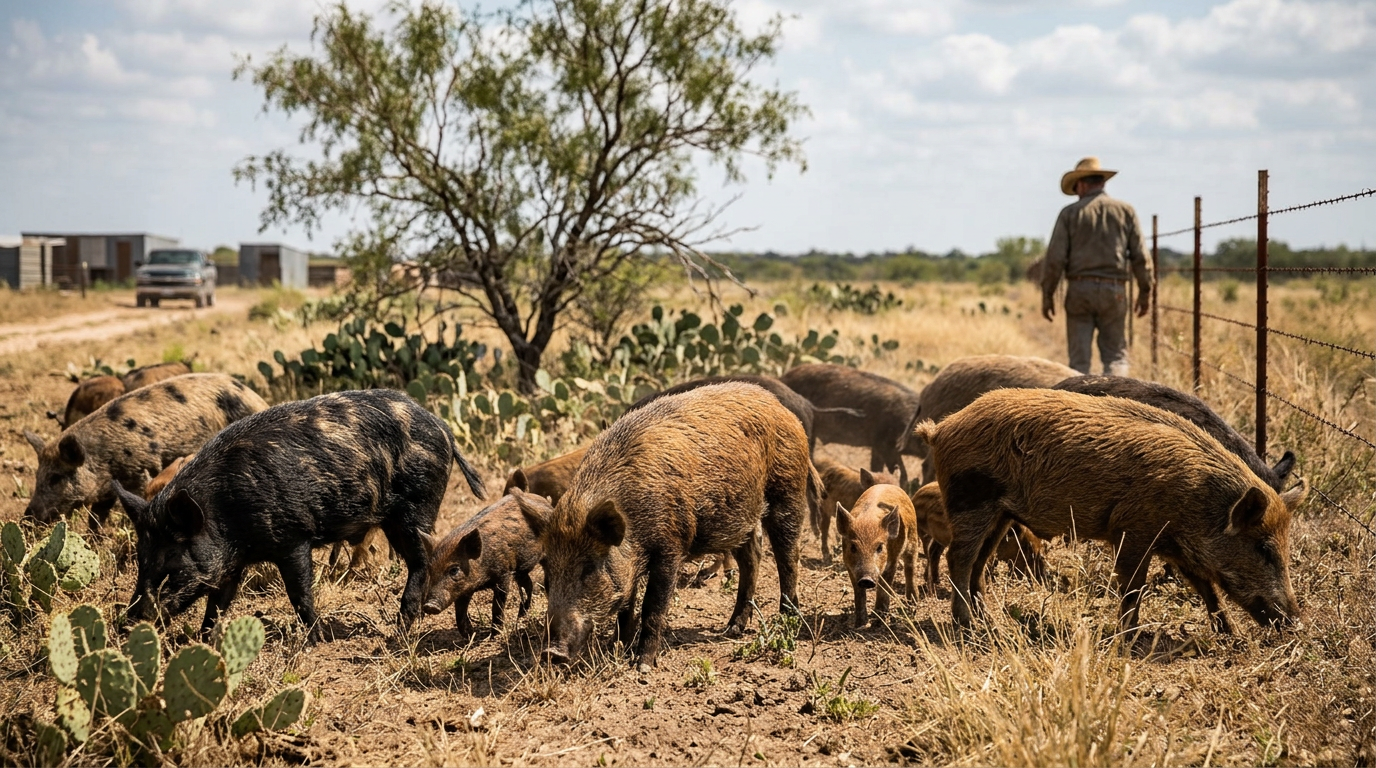
Recent ecological assessments have confirmed that Texas maintains the highest population of feral hogs in the United States, a title the state has held for decades despite aggressive mitigation efforts. These invasive animals, which are descendants of domestic swine brought by European settlers and Eurasian wild boars introduced for sport hunting, have thrived in the state's diverse climate. Historically, the population exploded in the late 20th century due to high reproductive rates and a lack of natural predators. Today, experts estimate that unless nearly 70% of the population is removed annually, the numbers will continue to climb, threatening the stability of rural economies and native biodiversity across all 254 counties. The scope of the crisis extends beyond simple nuisance; it is an ecological emergency that costs the state and private landowners hundreds of millions of dollars each year. These animals are highly intelligent, adaptable, and capable of traveling long distances to find food sources. Because they lack a distinct breeding season, a single sow can produce two litters a year, leading to an exponential growth curve that has outpaced traditional hunting and trapping methods. State agencies continue to explore legislative and biological solutions to curb a population that is increasingly encroaching on suburban neighborhoods and sensitive watersheds.
Texas relevance
The feral hog crisis is a uniquely Texan struggle, as the state is home to approximately half of the entire feral hog population in the United States. From the Piney Woods of East Texas to the arid brush of the Trans-Pecos, no region is immune to the destruction caused by these animals. For the Texas agricultural sector, which is a cornerstone of the state's identity and economy, the hogs represent a direct threat to livestock, crop yields, and soil health. Furthermore, the runoff from hog-infested areas has been linked to water quality issues in Texas rivers and streams, making this an environmental priority for state regulators and local water districts.
The Economic Toll on Texas Ranchers and Farmers
The financial impact of feral hogs in Texas is staggering, with conservative estimates placing annual agricultural damages well over $500 million. Farmers frequently report entire fields of corn, sorghum, and wheat being destroyed in a single night as sounders—the term for groups of hogs—root through the soil. This rooting behavior not only ruins current crops but also destroys the root systems of perennial grasses, leading to long-term soil erosion and the loss of valuable topsoil.
Livestock producers face a different set of challenges. Feral hogs are known to be opportunistic predators that can prey on young lambs, kids, and calves. Beyond direct predation, they compete with cattle for supplemental feed and forage, often contaminating water troughs with feces and mud. The cost of repairing fences damaged by hogs adds another layer of overhead for already struggling family farms, making the hogs a primary driver of increased operating costs in rural Texas.
Ecological Devastation and Native Species Displacement
Feral hogs are often described as 'ecological bulldozers.' Their constant rooting and wallowing disrupt the delicate balance of Texas ecosystems, particularly in riparian zones near creeks and rivers. By turning over the soil, they facilitate the spread of invasive plant species while destroying the nesting sites of ground-nesting birds like the Northern Bobwhite quail and Rio Grande turkey. The loss of these native species has a secondary effect on the state's biodiversity and its lucrative outdoor tourism industry.
Furthermore, the competition for resources impacts native white-tailed deer. Hogs often dominate feeders and natural forage areas, pushing deer populations into less favorable habitats. In the aquatic realm, hog wallowing increases turbidity in streams, which can suffocate fish eggs and degrade the habitat for rare freshwater mussels. The comprehensive nature of this environmental degradation makes the feral hog perhaps the most significant threat to the Texas natural landscape today.
Urban Encroachment: A New Frontier in the Hog War
While feral hogs were once considered a strictly rural problem, they are increasingly appearing in major Texas metropolitan areas such as Austin, San Antonio, and Dallas-Fort Worth. As urban sprawl expands into previously undeveloped land, hogs are finding that manicured suburban lawns, golf courses, and greenbelts offer a consistent source of food and water. This creates a public safety concern as the animals can be aggressive when cornered and pose a major hazard to motorists on suburban roadways.
In cities, the management of these animals is complicated by local ordinances that prohibit the discharge of firearms and the presence of high human density. Neighborhood associations are often left to foot the bill for expensive professional trapping services. This shift into the suburbs has brought the reality of the invasive species crisis to the attention of voters who may have previously viewed it as a distant agricultural issue, potentially shifting the political will toward more aggressive state-wide funding.
The Evolution of Management Techniques
The traditional method of 'spot and stalk' hunting has proven to be an ineffective population control measure because hogs are intelligent enough to become nocturnal and avoid areas where they perceive human threats. As a result, the Texas Department of Agriculture and various wildlife agencies have shifted their focus toward more advanced technological solutions. Large-scale 'drop nets' and smart-traps—which can be monitored and triggered via smartphone apps—allow for the capture of entire sounders at once, preventing 'educated' survivors from escaping and breeding.
Aerial gunning has also become a standard practice in the flatter regions of West and South Texas. By utilizing helicopters, professionals can cover vast tracts of land in a short time, removing hundreds of hogs in a single day. While effective, these operations are expensive and require significant coordination. Researchers at Texas A&M University continue to test various baits and delivery systems for toxicant-based controls, though these remain controversial due to concerns over secondary poisoning of non-target wildlife like vultures and raccoons.
Reproductive Biology: Why the Problem Persists
To understand why Texas is losing the war on hogs, one must look at the biological math. A female feral hog can begin breeding as early as six to eight months of age. With a gestation period of only 115 days, a single sow can produce two litters of six to twelve piglets every year. This means the offspring of one sow can theoretically produce their own litter within the same calendar year, leading to a population explosion that is nearly impossible to match through current removal rates.
Survival rates for these piglets are exceptionally high compared to other wildlife. Feral hogs are hardy and can survive in temperatures ranging from freezing to the triple-digit heat of a South Texas summer. Their omnivorous diet means they can find sustenance almost anywhere, from acorns and roots to carrion and trash. This biological resilience is the primary reason why despite millions of hogs being killed annually, the total population in Texas has stayed largely stagnant or continued to slowly expand into new territories.
Legislative Action and Public Policy
The Texas Legislature has taken several steps to deregulate hog hunting in an effort to encourage removal. In 2019, a law was passed that allows individuals to hunt feral hogs on private land without a hunting license, provided they have the landowner's permission. This move was intended to lower the barrier for entry for those willing to assist in removal efforts. Additionally, the state has allocated millions in grants to help counties establish bounty programs, where residents are paid a small fee for every hog tail or pair of ears they turn in.
However, many experts argue that a more centralized approach is needed. There is ongoing debate regarding the use of state funds to provide more subsidized aerial gunning for small landowners who cannot afford the service on their own. As the crisis deepens, we may see the development of a state-wide 'Hog Task Force' designed to coordinate efforts across county lines, ensuring that hogs don't simply migrate from a high-pressure area to a low-pressure neighbor.
Analysis
While the invasive hog problem is often discussed through a lens of recreational hunting, the data suggests that sporting alone is insufficient to manage the crisis. The state's approach must balance property rights with large-scale coordinated eradication efforts. Some argue that the commercialization of hog meat could provide an economic incentive for removal, while others look toward chemical contraceptives or more aggressive state-funded trapping programs. The political challenge lies in the fact that because most land in Texas is privately owned, the state cannot easily implement a top-down mandate for eradication, necessitating a cooperative model between the Texas Parks and Wildlife Department and individual ranchers.
Source attribution
This story was reported using a public release from the Texas Wildlife Stories (Google News). Keep TX Red rewrote the coverage independently and links to the official statement for verification.
Frequently Asked Questions
- Do I need a license to hunt feral hogs in Texas?
- As of 2019, Texas law does not require a hunting license to hunt feral hogs on private land with the owner's consent. However, hunting on public lands still requires a valid Texas hunting license and adherence to specific public land regulations.
- What is the most effective way to remove hogs from a property?
- While shooting individual hogs is common, wildlife experts agree that whole-sounder trapping is the most effective method. Using large traps with remote-trigger technology ensures that the entire group is captured, preventing survivors from breeding or becoming 'trap shy' and harder to catch in the future.
- Can you eat feral hog meat?
- Yes, feral hog meat is edible and often described as being leaner and more flavorful than domestic pork. However, they can carry various diseases such as swine brucellosis. It is essential to wear gloves while field dressing and to cook the meat to an internal temperature of at least 160°F to ensure it is safe for consumption.
Official Sources
Take the next step
Browse the Newsroom →Read more about Keep Texas Red → Our full guide to what Keep Texas Red means and why Texans support it.
Related Articles
Get Texas updates delivered weekly.
Independent Texas reporting on politics, policy, and daily life. One email a week. Unsubscribe anytime.
Keep TX Red Newsroom
The Keep Texas Red Editorial Staff produces nonpartisan explainers, policy breakdowns, and educational resources to help Texans understand how their government works. All content is reviewed for accuracy and updated regularly.
About Keep TX Red →