Feral Hog Expansion Into Texas Suburbs Drives New Property Management Strategies
As feral hogs migrate into Texas suburban areas, homeowners and local officials are adopting new mitigation strategies to protect private property.
Editorial disclaimer: Opinions and analysis on Keep TX Red are editorial content — not statements of fact. See our editorial standards.
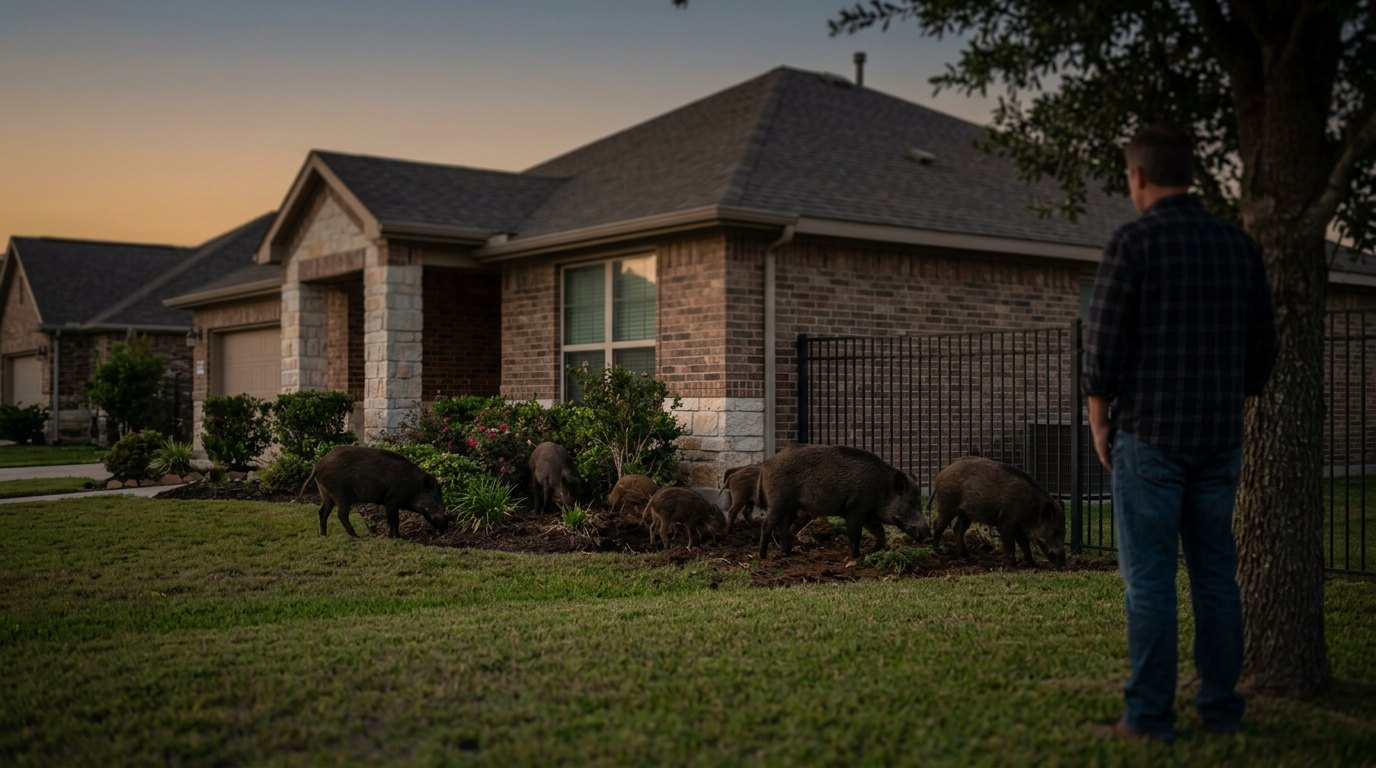
The persistent expansion of feral hogs into the residential peripheries of Texas’s major metropolitan areas has reached a critical threshold, forcing a shift in how these invasive mammals are managed outside of traditional rural settings. Historically, the battle against feral hogs was largely confined to the state's vast agricultural lands and ranches, where hunters and landowners utilized large-scale trapping and aerial gunning to keep populations in check. However, as urban sprawl continues to push deep into former timberlands and pastures, these highly adaptable animals are finding new sanctuaries in manicured lawns, golf courses, and greenbelts where traditional eradication methods are often prohibited by city ordinances. This movement into the suburbs is not merely a nuisance; it represents a significant economic threat to infrastructure and private property values across the Lone Star State. Feral hogs in Texas are descendants of escaped domestic pigs brought by early explorers and settlers, later interbreeding with Eurasian wild boars introduced for sport hunting in the 1930s. This hybridization has created a resilient, intelligent, and prolific species that lacks natural predators in the Texas ecosystem. Because females can breed as early as six months of age and produce multiple litters per year, the population has exploded to an estimated three million statewide. The demographic shift of these animals into suburban environments like those found in North Texas, the Austin-San Antonio corridor, and the Houston exurbs has necessitated a rethink of management techniques that prioritize safety in densely populated areas while remaining effective at reducing animal numbers.
Texas relevance
This issue is uniquely important to Texas because the state hosts approximately half of the entire feral hog population in the United States. While the problem was once viewed through a purely agricultural lens, the rapid urbanization of the Texas Triangle—the area between Dallas-Fort Worth, Houston, and San Antonio—has brought millions of residents into direct contact with invasive wildlife. The economic impact in Texas is staggering, with estimates suggesting that feral hogs cause over $500 million in damages annually to the state’s economy, a figure that is rising as they enter high-value residential real estate markets. Texas laws regarding hog removal are among the most flexible in the country, yet suburban residents face unique legal hurdles regarding the discharge of firearms and the use of snares in residential zones.
The Economic Toll on Texas Homeowners
In the suburban context, the damage caused by feral pigs is often devastatingly concentrated. These animals use their powerful snouts to root through the soil in search of tubers, insects, and roots, a process that can turn a meticulously landscaped yard into a moonscape of deep ruts overnight. For Texas homeowners, this damage often exceeds the deductibles on standard insurance policies, and because feral hog damage is frequently classified as an 'act of nature' or wildlife-related, many insurance providers do not cover the costs of lawn restoration or irrigation system repair.
Beyond residential lawns, the encroachment of hogs poses a threat to public infrastructure. They have been known to undermine the integrity of road embankments, damage the foundations of smaller outbuildings, and destroy community parks. In North Texas suburbs like Plano and Frisco, local governments have had to allocate significant portions of their parks and recreation budgets specifically for repairing soccer fields and trail systems that have been compromised by overnight rooting activities. This fiscal drain is becoming a recurring line item for municipal planners across the state.
Biological Adaptability and Urban Survival
Feral hogs are perhaps the most adaptable large mammals in North America. In a suburban environment, they quickly learn the schedules of human residents, often becoming almost entirely nocturnal to avoid detection. They find ample cover in the wooded riparian corridors that Texas developers often preserve as 'green space' within master-planned communities. These corridors provide the perfect highway for hogs to move between residential areas while remaining shielded from view.
Access to water and high-calorie food sources further fuels their suburban success. Many Texas neighborhoods feature artificial retention ponds and irrigation systems that provide consistent water, even during the state’s frequent droughts. Furthermore, the prevalence of unsecured trash and supplemental feeding for other wildlife, such as deer or birds, provides an easy calorie source for hogs. This environment allows for high survival rates among piglets, ensuring that a single sounder can quickly grow into a localized population crisis.
Legal Considerations for Suburban Control
Managing hogs in a suburban setting is complicated by a web of local ordinances and state laws. While Texas law generally allows for the taking of feral hogs on private property without a hunting license under certain conditions, city ordinances frequently prohibit the discharge of firearms or bows within city limits. This leaves many residents feeling defenseless as they watch their property being destroyed. In response, some municipalities are beginning to issue special permits for professional trappers or designated archery teams to cull populations in sensitive areas.
The use of poisons remains a contentious issue both at the state and local levels. While certain chemicals have been researched for hog control, concerns about secondary poisoning of pets, local wildlife, and even children have led to significant pushback in suburban communities. As a result, the primary legal and safe method for suburban control remains the use of large-scale corral traps. These traps, often equipped with cellular cameras and remote triggers, allow for the capture of entire sounders at once, which is the only way to significantly reduce the local population long-term.
The Importance of Community-Wide Action
One of the biggest hurdles to effective management in Texas suburbs is the fragmented nature of property ownership. If one homeowner invests in trapping while their neighbor provides a 'refuge' by leaving high grass or feeding the animals, the hogs will simply relocate a few yards away and continue to thrive. Experts from the Texas A&M AgriLife Extension Service emphasize that 'spot control' is rarely effective. Instead, neighborhoods must work collectively to implement deterrents and removal programs.
Education is a key component of these community efforts. Many new residents moving to Texas from other states are unaware of the scale of the hog problem. Local HOAs are increasingly hosting seminars on how to harden properties against hogs, such as by installing reinforced fencing or reducing the use of certain types of fertilizers that attract the animals. By coordinating efforts across multiple properties, communities can create a less hospitable environment for invasive sounders, pushing them back toward more rural habitats where they can be managed more easily.
Technological Advancements in Trapping
The old method of using simple box traps is largely ineffective for suburban hogs, as the animals are often too intelligent to enter a small, confined space after seeing a peer captured. The current gold standard is the remote-activated circular gate system. These traps use live-feed cameras that send alerts to a user’s smartphone. This allows the operator to wait until the entire group of hogs is inside the enclosure before dropping the gate, preventing 'trap-shy' survivors from learning to avoid the area.
Additionally, thermal imaging technology has become a game-changer for suburban management. Professional hog removal services often use thermal optics to track animal movements through neighborhoods at night. This data helps identify the primary routes hogs use to enter a community, allowing for more strategic trap placement. While these technologies are expensive, many Texas neighborhoods are finding that the cost of hiring a professional service is lower than the aggregate cost of repeated landscape repairs.
Future Outlook for Texas Wildlife Policy
As the human population of Texas continues to soar, the interaction between people and feral hogs will only intensify. The state legislature has periodically addressed the issue by making it easier for citizens to hunt the animals, but future policy may need to focus more on suburban-specific mitigation. There is growing interest in state-funded grants for municipalities to hire full-time wildlife biologists or dedicated hog control officers to manage regional watersheds that serve as hog highways.
In the coming years, we may see more aggressive efforts to utilize contraceptive baits or species-specific toxins if they can be proven safe for a suburban environment. For now, the focus remains on physical removal and exclusion. The battle against feral hogs in the Texas suburbs is a war of attrition, requiring constant vigilance and a coordinated effort between the state, local governments, and individual property owners to protect the Texas landscape.
Analysis
The transition of the feral hog crisis from 'rural nuisance' to 'suburban emergency' reflects a failure of traditional containment strategies and highlights the unintended consequences of Texas’s rapid development. From a policy perspective, the state is increasingly leaning toward more aggressive technological solutions and community-wide trapping initiatives, as individual homeowner efforts often fail to make a dent in the roving 'sounders' that occupy neighborhood creek beds. There is an emerging debate between state officials, who view the hogs as a biological menace that should be eradicated by any means necessary, and local municipalities that must balance public safety with the need for aggressive animal control. The political reality is that as more suburban voters see their property values threatened by these animals, we can expect increased state funding for regional control programs and potential relaxation of certain hunting restrictions near municipal boundaries.
Source attribution
This story was reported using a public release from the Texas Wildlife Stories (Google News). Keep TX Red rewrote the coverage independently and links to the official statement for verification.
Frequently Asked Questions
- Can I shoot a feral hog on my property if I live in a Texas suburb?
- While state law generally allows the removal of hogs on private property, most Texas cities have ordinances prohibiting the discharge of firearms within city limits. You must check your specific municipal codes or hire a professional who has the proper permits for suburban wildlife control.
- What is the most effective way to keep hogs out of my yard?
- Physical barriers are the most reliable deterrent. Strong, reinforced fencing that is buried several inches underground can prevent hogs from rooting underneath. Removing food sources like fallen fruit, outdoor pet food, and over-watered soil can also make your property less attractive.
- Why are feral hogs considered such a significant threat in Texas?
- They are a 'triple threat': they cause massive property and agricultural damage, they outcompete native Texas wildlife for resources, and they can carry various diseases that affect both humans and livestock. Their high reproductive rate makes them nearly impossible to eradicate without constant effort.
Official Sources
Take the next step
Browse the Newsroom →Read more about Keep Texas Red → Our full guide to what Keep Texas Red means and why Texans support it.
Related Articles
Get Texas updates delivered weekly.
Independent Texas reporting on politics, policy, and daily life. One email a week. Unsubscribe anytime.
Keep TX Red Newsroom
The Keep Texas Red Editorial Staff produces nonpartisan explainers, policy breakdowns, and educational resources to help Texans understand how their government works. All content is reviewed for accuracy and updated regularly.
About Keep TX Red →