Suburban Nightmare: How 3 Million Feral Hogs are Reshaping the Texas Landscape
Texas faces a massive feral hog population of nearly 3 million, causing severe damages to suburbs and agricultural lands across the state.
Editorial disclaimer: Opinions and analysis on Keep TX Red are editorial content — not statements of fact. See our editorial standards.
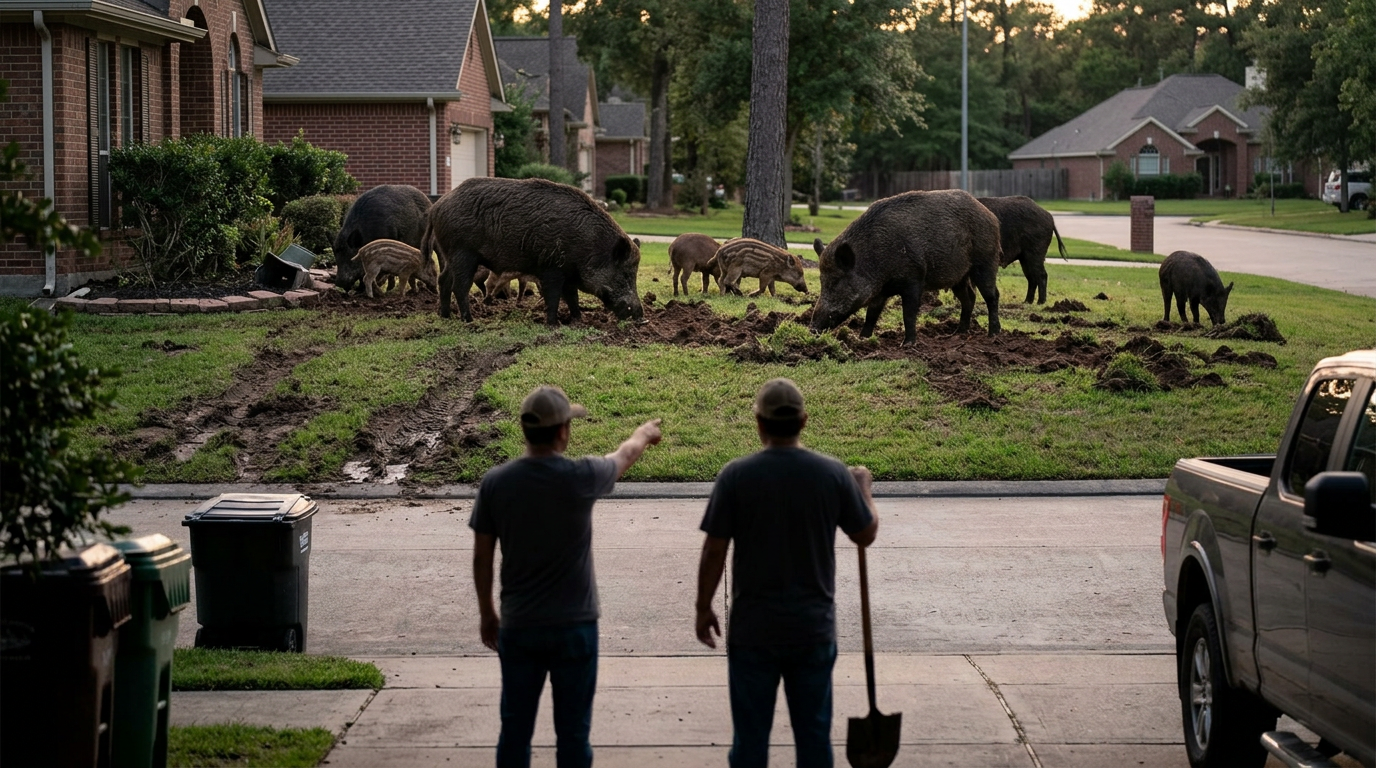
Texas is currently locked in an escalating battle against a massive population of feral hogs, which has now officially swelled to an estimated 3 million individuals. Historically, these animals were introduced by early explorers for food, but through decades of crossbreeding with escaped domestic swine and lack of natural predators, they have become the most significant invasive species threat in the Lone Star State. This population boom is no longer contained within rural pasture lands or deep brush country; instead, the animals are increasingly encroaching upon suburban neighborhoods, high-end golf courses, and manicured parklands. The sheer scale of the population is unprecedented, representing nearly half of the entire feral hog population in the United States. This biological explosion is creating a multi-front crisis that touches on public safety, private property rights, and environmental conservation. Current estimates suggest that the population must be reduced by roughly 66% annually just to keep current numbers stable, a feat that has remained elusive despite aggressive state efforts. As residential development pushes further into previously wild areas, the friction between human habitation and these destructive mammals continues to intensify, leaving many homeowners and local governments searching for long-term solutions.
Texas relevance
The feral hog crisis is a uniquely Texas problem, as the state hosts the highest concentration of these invasive animals in the nation. From the Piney Woods of East Texas to the arid South Texas brush, no region is entirely immune to the economic and ecological fallout. For Texas taxpayers and property owners, the relevance is measured in the hundreds of millions of dollars in damages to crops, fences, and landscaping each year. Cities like Houston, Austin, and San Antonio are seeing hogs move into drainage canals and suburban greenbelts, turning local parks into muddy wastelands overnight. This issue strikes at the heart of Texas land ownership values, necessitating a statewide response that involves the Texas Department of Agriculture, Texas Parks and Wildlife (TPWD), and countless private land managers who are forced to act as the primary line of defense.
The Evolution of a Biological Menace
The story of feral hogs in Texas dates back centuries, beginning with Spanish explorers who brought pigs as a mobile food source. Over time, these animals escaped into the wild, adapted to the harsh Texas climate, and eventually interbred with European wild boars released for sport hunting in the 1930s. This crossbreeding created a 'super-pig' that possesses the intelligence of a domestic hog and the physical resilience of a wild boar. They are remarkably prolific, with sows capable of producing two litters a year, often containing six to twelve piglets each.
Because feral hogs reach reproductive maturity as early as six months of age, their population growth is exponential. In the Texas landscape, they lack significant natural predators. While coyotes or mountain lions may take an occasional piglet, adult hogs are large, aggressive, and well-equipped for defense. This lack of a biological check has allowed them to colonize 253 of Texas's 254 counties, making them one of the most successful and destructive invasive species in North American history.
The movement of these animals into suburban zones is a relatively recent phenomenon spurred by rapid urban sprawl. As new housing developments replace traditional farm and ranch land, the hogs do not simply disappear; they adapt. They find shelter in creek beds and wooded strips behind residential fences and forage on highly fertilized lawns, gardens, and trash bins that provide a surplus of calories compared to the wild. This adaptation has turned a rural nuisance into a primary concern for suburban municipal governments.
Economic Toll on Infrastructure and Agriculture
The financial impact of the 3 million hogs in Texas is staggering, with conservative estimates placing annual damages at over $500 million. In the agricultural sector, they decimate fields of corn, sorghum, and wheat, often destroying more than they actually consume by rooting through the soil. They also cause structural damage by undermining farm equipment, destroying fences, and contaminating water sources used for livestock. For the Texas rancher, every feral hog on the property represents a direct drain on the bottom line.
In suburban environments, the costs are more localized but equally severe. A single sounder—the term for a group of hogs—can destroy an entire neighborhood's worth of landscaping in a single evening. Their rooting behavior, which involves digging deep into the soil to find tubers and grubs, can rupture shallow irrigation lines and destabilize sidewalk foundations. Homeowners' associations frequently find themselves spending thousands of dollars to repair public green spaces, only for the hogs to return the following week.
Beyond property damage, the hogs pose a risk to the state's transport infrastructure. Vehicle collisions with feral hogs are on the rise, particularly on rural highways and expansion roads near growing metros. Unlike smaller wildlife, a 200-pound hog can cause catastrophic damage to a vehicle and serious injury to passengers. The cost of these accidents, while difficult to aggregate perfectly, adds another layer to the economic burden these animals place on the Texas public.
Environmental Consequences for Native Texas Species
The environmental footprint of feral hogs extends far beyond the soil they disturb. As opportunistic omnivores, they compete directly with native Texas wildlife for resources. White-tailed deer and wild turkeys often find themselves pushed out of their natural habitats as hogs claim the best foraging grounds. Furthermore, hogs are known to consume the eggs of ground-nesting birds, such as the northern bobwhite quail, and have even been observed preying on small fawns and livestock like lambs and kids.
Water quality is another major victim of the hog invasion. Hogs prefer to stay near water sources, where they wallow in the mud to cool down. This behavior leads to excessive sedimentation and fecal contamination in Texas creeks and rivers. Such pollution can lead to the proliferation of E. coli and other bacteria, making these water bodies unsafe for recreation and harming native aquatic life. The long-term degradation of riparian zones is a primary concern for Texas conservationists.
The flora of Texas also suffers under the hog's presence. By rooting up native plants and grazing on seedlings, they alter the natural succession of forests and prairies. This often paves the way for other invasive plant species to take root, further diminishing the biodiversity of the state. The cumulative effect is a landscape that is less resilient, less diverse, and increasingly dominated by a single destructive species.
Legal and Management Challenges
Managing a population of 3 million animals requires a diverse array of tactics, ranging from traditional trapping to more controversial methods. In Texas, feral hogs are classified as unprotected, non-game animals, which provides landowners with significant leeway in how they manage them. Residents can hunt or trap them year-round without a license on private property with owner consent. However, despite these relaxed regulations, the population continues to outpace human intervention.
Professional trapping remains the most effective large-scale management tool. Modern 'smart traps' utilize cellular technology and motion sensors, allowing trappers to drop gates remotely via smartphone apps once an entire sounder is inside. This 'whole-sounder removal' is critical because if even one or two hogs escape, they become 'trap-shy,' making them nearly impossible to catch again and ensuring they will continue to breed in the area.
State and federal agencies have also explored chemical interventions, though these remain mired in regulatory and environmental concerns. The use of toxic baits, such as those containing warfarin or sodium nitrite, is periodically debated. Proponents argue they are the only way to achieve the 66% reduction needed, while opponents worry about secondary poisoning of native scavengers like eagles and caracaras. For now, the state relies primarily on physical removal and public education.
Impact on Public Health and Safety
Feral hogs are known carriers of at least 30 different diseases and nearly 40 types of parasites. Some of these, such as swine brucellosis and pseudorabies, pose a direct threat to the domestic livestock industry, potentially leading to costly quarantines or loss of 'disease-free' status for Texas producers. Of more immediate concern to the general public is the risk of zoonotic diseases—those that can jump from animals to humans.
While direct attacks on humans are rare, they are not unheard of, particularly when a hog feels cornered or is protecting its young. Given their size and tusks, such encounters can be life-threatening. The threat is amplified in suburban settings where residents may inadvertently stumble upon a sounder while walking pets or exercising in local parks. The presence of these large, unpredictable animals in densely populated areas is a significant public safety liability.
The psychological impact on Texans living in 'hog-prone' areas is also worth noting. Residents describe a sense of helplessness as they watch their property value decline or their outdoor spaces become unusable. Constant vigilance is required, and the persistent nature of the invasion can lead to community-wide frustration. As long as the population thrives, the tension between human safety and wildlife encroachment will remain a central theme in the Texas suburban experience.
Source attribution
This story was reported using a public release from the Texas Wildlife Stories (Google News). Keep TX Red rewrote the coverage independently and links to the official statement for verification.
Frequently Asked Questions
- What is the best way for a Texas homeowner to protect their yard?
- The only truly effective physical barrier is a heavy-duty fence, preferably one with a buried footer to prevent hogs from rooting underneath. Some homeowners use motion-activated lights or sprinklers, but these often only provide a temporary deterrent as the hogs quickly acclimate to them.
- Is a hunting license required to kill feral hogs in Texas?
- As of 2019, Texas law (SB 317) allows any person to hunt feral hogs on private land with the landowner's consent without a hunting license. This was intended to remove barriers for residents trying to mitigate damage on their own property.
- Why can't the state just eradicate them entirely?
- Eradication is nearly impossible due to the hogs' high reproductive rate, their ability to live in diverse habitats, and their high intelligence. They are experts at avoiding human contact and can quickly move to safer areas if they sense high pressure in one location.
- Are feral hogs safe to eat?
- While many people do eat feral hog meat, it is important to handle the carcass with extreme care due to the risk of disease. Meat should always be cooked to an internal temperature of at least 160°F to ensure it is safe for consumption.
Official Sources
Take the next step
Browse the Newsroom →Read more about Keep Texas Red → Our full guide to what Keep Texas Red means and why Texans support it.
Related Articles
Get Texas updates delivered weekly.
Independent Texas reporting on politics, policy, and daily life. One email a week. Unsubscribe anytime.
Keep TX Red Newsroom
The Keep Texas Red Editorial Staff produces nonpartisan explainers, policy breakdowns, and educational resources to help Texans understand how their government works. All content is reviewed for accuracy and updated regularly.
About Keep TX Red →