New Screwworm Threat Emerges in Texas Feral Hog Population Raising Agricultural Alarm
Texas livestock officials monitor screwworm risks as feral hog populations potentially carry the invasive pest across state lines.
Editorial disclaimer: Opinions and analysis on Keep TX Red are editorial content — not statements of fact. See our editorial standards.
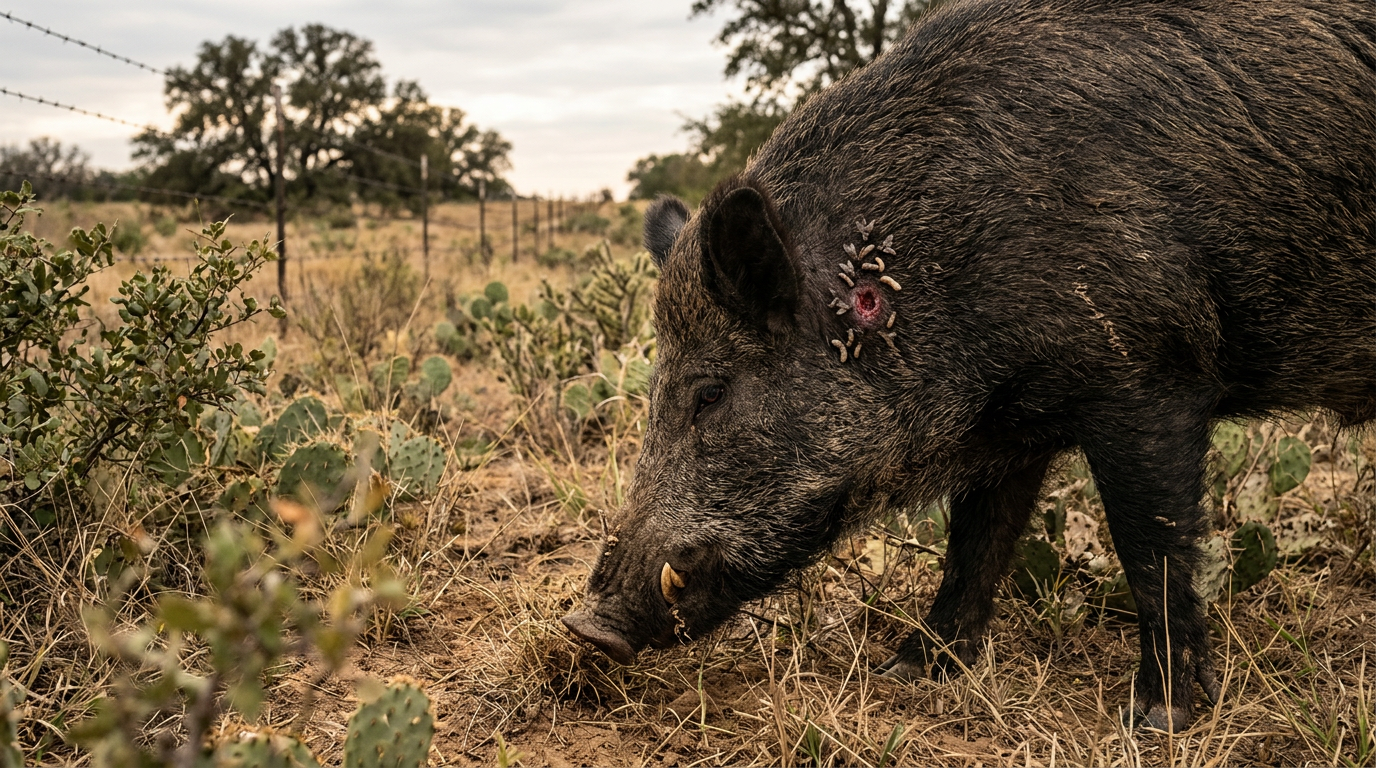
Agricultural authorities in Texas are sounding a new alarm regarding the state's massive feral hog population, focusing on the potential return of the screwworm. This parasitic insect, which was largely eradicated from the United States decades ago, poses a significant threat to livestock, wildlife, and domestic pets. Historically, screwworms were a devastating force in the American South until a sterile insect technique program successfully pushed the primary population down to a biological barrier in Panama. However, recent detections and the unrestricted movement of feral hogs have created a vulnerability in the state's biosecurity layers. The current situation involves heightened surveillance as officials track how these hogs, acting as mobile hosts, could facilitate the reintroduction of the pest from southern borders. Contextually, Texas has fought multiple battles against invasive species, but the screwworm represents a biological threat that directly impacts the economic viability of the cattle industry. In the mid-20th century, screwworms cost American ranchers hundreds of millions of dollars annually before the successful eradication campaigns of the 1960s. The revival of this concern stems from the fact that feral hogs are nearly impossible to contain within traditional fencing, and their rising numbers—estimated at over 3 million in Texas alone—provide a continuous chain of hosts for parasites to migrate across vast distances without detection until an outbreak occurs in managed herds.
Texas relevance
This issue is central to Texas because the state maintains the largest cattle inventory in the United States and the highest population of feral hogs. Geographic proximity to international trade routes and southern borders makes Texas the frontline for potential re-infestation. Ranchers in South and Central Texas are particularly at risk, as the climate in these regions is conducive to screwworm lifecycle development. If the pest becomes established in the Texas feral hog population, the financial burden of mandatory inspections, chemical treatments, and livestock losses could destabilize the state's multi-billion dollar agricultural economy.
The Biological Mechanism of the Screwworm
The New World screwworm is the larvae of the fly Cochliomyia hominivorax. Unlike most blowflies that feed on dead tissue, screwworm flies lay their eggs in the open wounds of warm-blooded animals. Once the larvae hatch, they begin to consume the living flesh of the host. This process is not only excruciatingly painful for the animal but is often fatal if left untreated. Even minor injuries, such as those from ear tagging, branding, or natural scrapes in the brush, provide an entry point for the parasite.
Feral hogs are particularly susceptible to these infestations due to their aggressive nature and frequent fighting, which results in constant open wounds. Because these animals live in the wild without veterinary oversight, an infestation can go unnoticed for weeks, allowing multiple generations of flies to hatch and spread. This cycle creates a self-sustaining population of pests that can eventually jump from wild swine to managed cattle, sheep, and goats.
Historical Context of Eradication Efforts
The United States was declared free of screwworms in 1966, following a massive effort by the USDA and state agencies. The primary tool was the Sterile Insect Technique (SIT), which involved releasing millions of sterilized male flies into the wild. Since female flies only mate once in their lifetime, mating with sterile males resulted in no offspring, eventually causing the population to collapse. This remains one of the greatest triumphs in the history of veterinary entomology.
Maintenance of this success requires a permanent 'buffer zone' in the Darien Gap between Panama and Colombia. Constant releases of sterile flies prevent the pest from migrating north from South America, where it remains endemic. However, any breach in this barrier or accidental transport of larvae through moving animals can reintroduce the threat. With feral hogs moving freely across the Rio Grande, the risk to Texas is higher than it has been in half a century.
Economic Implications for the Texas Cattle Industry
Texas leads the nation in cattle production, contributing significantly to the state’s GDP. The return of the screwworm would necessitate a total overhaul of livestock management practices. Ranchers would be forced to return to labor-intensive daily 'doctoring' of herds, checking every calf and cow for wounds. In the pre-eradication era, it was common for ranchers to spend a large portion of their operating budget solely on screwworm prevention and wound salves.
Beyond the labor costs, the export market would likely face immediate restrictions. International trade partners often place embargoes on meat and live animal exports from regions known to have screwworm infestations. For Texas, which relies heavily on global markets, the discovery of even a single infested animal could trigger a crisis that affects everything from local auction barns to international shipping hubs.
The Challenges of Feral Hog Management
The Texas Parks and Wildlife Department and the Texas Department of Agriculture have struggled for decades to mitigate the damage caused by feral hogs. These animals are highly intelligent, prolific breeders, and adaptable to almost any environment. Traditional methods like trapping and hunting have proven insufficient to reduce the population significantly. The added threat of screwworm transport makes the failure to control hog numbers a much more dangerous prospect.
New technologies, including sodium nitrite toxicant baits and aerial gunning, are being deployed with varying degrees of success. However, the sheer scale of the Texas landscape provides ample cover for hogs to thrive. If these animals become the primary host for a screwworm resurgence, the state may need to consider more drastic measures, including larger-scale biological controls or expanded state-funded eradication programs.
Surveillance and Detection Protocols
The Texas Animal Health Commission (TAHC) works in coordination with federal partners to monitor for signs of the parasite. This includes inspecting animals at border crossings and educating hunters and landowners on how to identify screwworm larvae. Unlike common maggots, which are usually found on the surface of decaying tissue, screwworm larvae burrow deep into the living muscle, creating a characteristic 'pocket' in the wound.
Experts urge anyone who finds suspicious larvae to contact their veterinarian or state animal health officials immediately. Early detection is clinical to preventing a full-scale outbreak. The state is also looking into environmental DNA (eDNA) sampling and advanced trapping to monitor fly populations in high-risk areas along the border and in regions with dense feral hog populations.
The Role of Climate and Environment
Environmental factors play a critical role in the potential spread of screwworms. The flies thrive in warm, humid conditions, which are abundant in South Texas and the Gulf Coast. As winters become milder, the geographic range where the flies can survive year-round expands northward. This allows the parasite to persist through seasons that would have historically killed off the adults, providing a longer window for the hogs to transport them.
Recent weather patterns have also influenced hog movement. During droughts, hogs congregate around limited water sources, increasing the density of the population and the likelihood of cross-contamination. Conversely, during wet years, the expansion of lush vegetation allows hogs to migrate into new territories, potentially carrying pests into previously 'clean' counties.
Public Awareness and Citizen Response
Educating the public, especially the hunting community, is a cornerstone of the current defense strategy. Because feral hogs are a popular game species in Texas, hunters are often the first people to come into close contact with wild swine. Training hunters to recognize the signs of infestation and discouraging the transport of untreated carcasses across county lines is vital to containment.
Landowners are also being encouraged to report unusual wildlife deaths or clusters of injured animals. While the focus is on agriculture, the screwworm does not discriminate and will readily infest deer, feral cats, and even humans. Maintaining a vigilant 'eyes on the ground' approach is the most effective way to supplement official state surveillance programs.
Analysis
While feral hogs have long been despised for their physical destruction of crops and property, their role as a biological vector for the screwworm shifts the conversation from nuisance management to a national security priority for the food supply. The reliance on the 'sterile fly' barrier in Central America is a robust defense, but it is not infallible. If the hog population acts as a reservoir, the cost of re-eradication would far exceed current state spending on hog control. This development may finally provide the political leverage needed for more aggressive, large-scale federally funded hog depopulation efforts, as the protection of the domestic beef industry remains a non-negotiable priority for Texas legislators.
Source attribution
This story was reported using a public release from the Texas Wildlife Stories (Google News). Keep TX Red rewrote the coverage independently and links to the official statement for verification.
Frequently Asked Questions
- What makes screwworms different from regular flies?
- Unlike common flies that feed on dead or decaying matter, the New World screwworm fly lays eggs in the wounds of live animals. The larvae then eat the living flesh of the host, which can cause severe infection and death if not treated.
- How did the U.S. get rid of them the first time?
- The U.S. used the Sterile Insect Technique, releasing millions of lab-sterilized male flies. Because females only mate once, the population could not reproduce and eventually died out in the domestic environment.
- Can humans get screwworms?
- Yes. Screwworms are warm-blooded parasites and can infest any mammal, including humans. While rare in developed areas, those working closely with livestock or in infested wilderness areas are at risk if they have open wounds.
- Why are feral hogs such a concern for this specific pest?
- Feral hogs are mobile, numerous, and frequently injured through fighting or navigating rough terrain. Since they receive no medical care, they can carry and spread the larvae across large distances, bypassing traditional agricultural checkpoints.
Official Sources
Take the next step
Browse the Newsroom →Read more about Keep Texas Red → Our full guide to what Keep Texas Red means and why Texans support it.
Related Articles


Get Texas updates delivered weekly.
Independent Texas reporting on politics, policy, and daily life. One email a week. Unsubscribe anytime.
Keep TX Red Newsroom
The Keep Texas Red Editorial Staff produces nonpartisan explainers, policy breakdowns, and educational resources to help Texans understand how their government works. All content is reviewed for accuracy and updated regularly.
About Keep TX Red →