Texas Feral Hog Crisis: Mitigation Strategies for Ranchers Against Growing Nuisance Populations
Texas faces a massive feral hog crisis causing billions in damage. Learn how state ranchers and officials are fighting back against the surge.
Editorial disclaimer: Opinions and analysis on Keep TX Red are editorial content — not statements of fact. See our editorial standards.
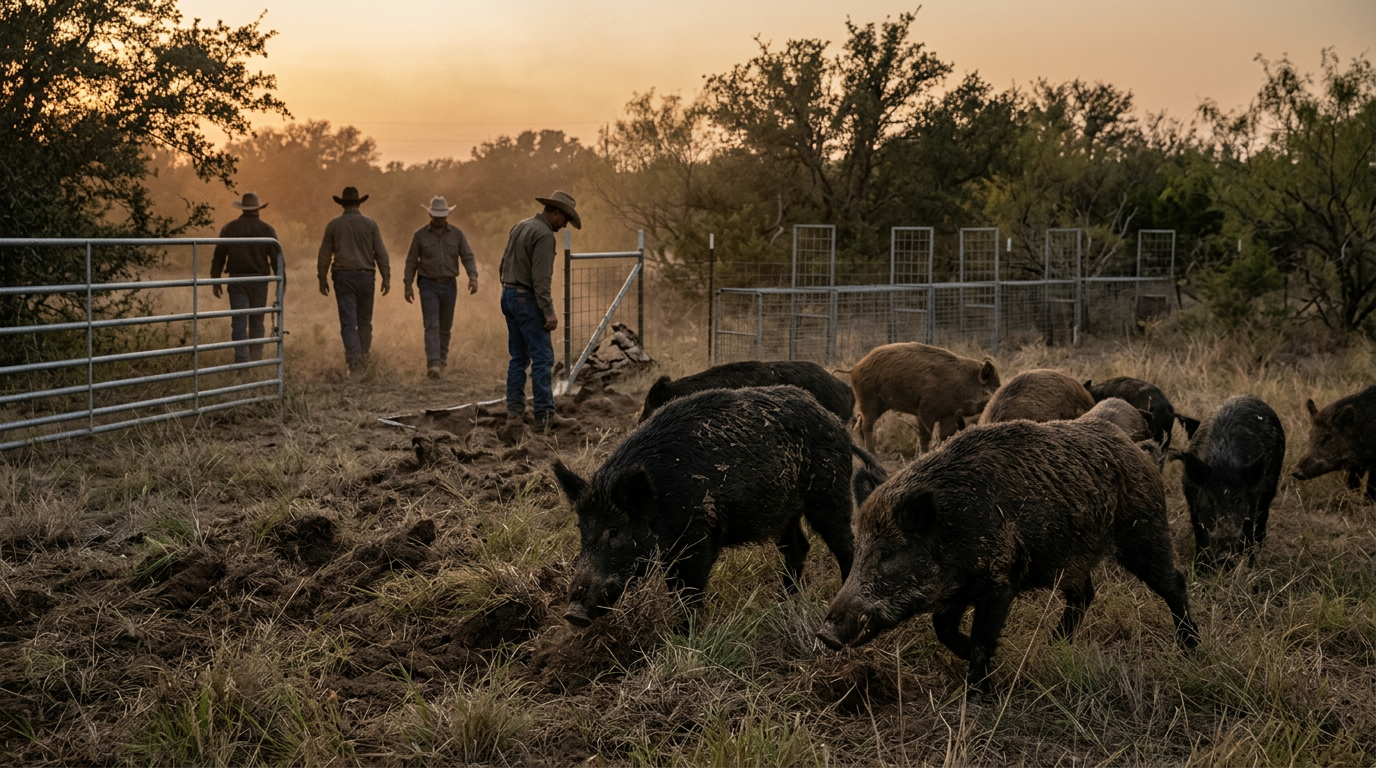
The battle against invasive feral hogs in Texas has reached a critical stage as the population continues to expand beyond rural landscapes into suburban fringes. Historically, these animals were introduced to Texas centuries ago by Spanish explorers and later supplemented by escaped domestic stock and intentional releases for hunting. Over time, their rapid reproductive rates and lack of natural predators have allowed them to overrun almost every county in the state. Current estimates suggest that Texas is home to several million feral hogs, representing nearly half of the total population in the United States. This biological explosion has created a permanent state of emergency for the Texas agricultural sector, which bears the brunt of the financial and physical impacts caused by these highly intelligent and destructive mammals. Feral hogs are not merely a nuisance; they are a direct threat to the ecological balance and economic stability of the Lone Star State. They are known for their opportunistic feeding habits, which involve rooting through soil to find tubers, insects, and small vertebrates. This behavior destroys pasture land, damages sensitive root systems of native vegetation, and leads to significant soil erosion. Furthermore, their presence in and around water sources has raised concerns regarding water quality, as they frequently wallow in creeks and ponds, increasing fecal coliform levels. The state has responded with various legislative and regulatory shifts, but the sheer volume of the population requires a coordinated effort between private landowners and state agencies to prevent total landscape degradation.
Texas relevance
Texas serves as the epicenter for the feral hog crisis in North America. With approximately 79 percent of the state’s land mass considered suitable habitat for these animals, the economic impact on Texas agriculture exceeds $500 million annually in direct damages. From the brush country of South Texas to the Piney Woods of the East, every region of the state faces unique challenges in controlling these populations. As a state with strong private property rights, the responsibility for management often falls on local ranchers, yet the mobile nature of hog sounders means that if one neighbor fails to act, the entire community suffers. Texas law has evolved to allow for aggressive removal methods, including aerial gunning and the removal of hunting license requirements for hogs on private land, reflecting the severity of the issue within state borders.
The Biological Advantage of the Feral Swine
One of the primary reasons Texas has struggled to contain the hog population is the sheer reproductive capacity of the species. A single sow can reach sexual maturity in as little as six to eight months and can produce two litters per year. With average litter sizes ranging from six to twelve piglets, the math quickly becomes overwhelming for wildlife managers. To maintain a static population—meaning a population that does not grow—experts suggest that roughly 66% to 70% of the total hog population must be removed every single year.
Beyond their reproduction, hogs possess a high degree of biological plasticity. They can survive in almost any climate, from the freezing winters of the Panhandle to the sweltering humidity of the Gulf Coast. Their intelligence is also a factor; hogs have been observed learning how to avoid certain types of traps and recognizing the sound of specific vehicles or machinery associated with hunting. This adaptability necessitates a constantly evolving strategy for ranchers who are trying to protect their livelihoods from constant incursions.
Economic Destruction on Texas Ranchlands
The financial toll on Texas agriculture is multifaceted, often beginning with the destruction of crops such as corn, grain sorghum, and wheat. Hogs are known to follow planting rigs to consume seeds directly from the furrow and later return to destroy mature stalks just before harvest. This loss of yield is compounded by the damage to equipment; tractors and harvesters are frequently damaged when they strike deep ruts and wallows created by rooting hogs in the middle of cultivated fields.
Livestock producers also face significant threats that go beyond property damage. Feral hogs are known predators of neonate livestock, including lambs, kids, and even young calves. In addition to direct predation, they compete with domestic cattle for supplemental feed and water resources. The risk of disease transmission is another looming concern for the beef industry, as feral hogs can carry over 30 different diseases and 37 types of parasites, some of which—like pseudorabies or swine brucellosis—could theoretically devastate commercial livestock operations if an outbreak occurred.
Technological Advances in Trapping and Tracking
To combat the high intelligence of these animals, Texas landowners have increasingly turned to high-tech solutions. Smart traps equipped with cellular cameras and remote-triggered gates are becoming the gold standard for management. Unlike traditional box traps that might catch one or two hogs, these large-scale corral traps allow a manager to monitor a whole 'sounder' (a social group of hogs) via a smartphone app. Once the entire group is inside the enclosure, the gate is dropped remotely, ensuring that no animals are left behind to learn from the experience and become 'trap-wise.'
Another emerging tool in the arsenal is the use of thermal imaging and night vision optics. Since hogs are primarily nocturnal, especially in areas with high human activity, these technologies allow for effective culling during the hours when the animals are most active. Some regions have even experimented with 'Judas pigs'—sterilized hogs fitted with GPS collars that lead hunters back to the larger sounder. These innovative approaches demonstrate the necessity of using data and technology to stay one step ahead of a species that is remarkably adept at evasion.
Legal Framework and Hunting Regulations
Texas has some of the most permissive hog control laws in the United States. In recent years, the Texas Legislature has removed the requirement for a hunting license when a person is hunting feral hogs on private land with the landowner's consent. This was a strategic move to lower the barrier for entry for those willing to assist in eradication efforts. Additionally, the state allows for 'helicopter hunting,' a practice where professional services or licensed individuals use aerial platforms to cover large swaths of territory in a short amount of time.
While these regulations provide maximum flexibility, officials emphasize that permission is always required from landowners. The state also regulates the transport of live feral hogs to prevent the intentional spread of the animals to new areas by unscrupulous individuals looking to establish new hunting populations. The Texas Animal Health Commission maintains strict guidelines on the movement of these animals to ensure that the problem remains a management issue rather than a vectors-of-disease issue for the broader agricultural community.
Environmental Impact on Native Wildlife
The impact of feral hogs extends into the realm of conservation and native wildlife management. Texas is home to many ground-nesting birds, such as Northern Bobwhite quail and Rio Grande wild turkeys, whose eggs are easily found and consumed by hogs. By destroying the nesting sites and consuming the offspring of these native species, feral hogs are contributing to the decline of traditional Texas game birds. This creates a secondary economic loss for rural communities that rely on seasonal bird hunting for tourism revenue.
Furthermore, the competition for resources affects native ungulates like White-tailed deer. In times of drought, which are common in Texas, hogs will dominate water holes and deplete hard mast crops like acorns that deer depend on for winter survival. The ecological footprint of the feral hog is essentially an erasure of the native landscape, replacing a diverse ecosystem with a monoculture of invasive swine. Restoration of these habitats is often impossible until the hog population is significantly reduced or eradicated from a specific area.
Future Outlook: Can the Tide Be Turned?
Looking ahead, the consensus among Texas experts is that the 'hog problem' is a permanent fixture of Texas land management that requires constant vigilance. There is ongoing research into species-specific toxicants—poisons that would only affect hogs without harming non-target species like raccoons or deer. While this research is promising, it often faces regulatory hurdles and public concerns regarding the safety of the food chain and the environment. Until such a 'silver bullet' is found, the strategy remains a combination of trapping, shooting, and exclusion through high-fencing.
The success of current efforts depends largely on collaboration. Programs through the Texas A&M AgriLife Extension and the USDA's Wildlife Services offer technical assistance to landowners, helping them implement integrated pest management strategies. As urban sprawl continues to push into previously wild areas, the conflict between humans and hogs will likely intensify. The hope is that through continued technological innovation and aggressive state-backed programs, Texas can move from a state of crisis to one of manageable control, protecting the state’s agricultural heritage for the next generation.
Analysis
While the state has deregulated hog hunting to an extreme degree, many wildlife experts argue that recreational hunting alone is insufficient to solve the problem. In fact, some analysts suggest that uncoordinated hunting can make hogs more nocturnal and 'trap-shy,' making professional eradication efforts more difficult. The debate in Texas is shifting from seeing hogs as a game animal to treating them strictly as a biological pollutant. Moving forward, the state may need to explore more aggressive biological controls or state-funded trapping incentives to move the needle on population numbers, as current culling rates are estimated to only offset the annual birth rate rather than reducing the total biomass of the species.
Source attribution
This story was reported using a public release from the Texas Wildlife Stories (Google News). Keep TX Red rewrote the coverage independently and links to the official statement for verification.
Frequently Asked Questions
- Do I need a hunting license to kill feral hogs in Texas?
- As of recent legislative changes, you do not need a hunting license to hunt feral hogs on private land in Texas, provided you have the landowner's permission. This was enacted to encourage more aggressive population control.
- What is the most effective way to remove hogs from a large property?
- While individual hunting is common, wildlife experts recommend 'whole-sounder removal' using large, remotely triggered corral traps. This method captures the entire group at once, preventing survivors from becoming educated and harder to catch in the future.
- Are feral hogs safe to eat?
- Many people harvest feral hogs for meat, but it is critical to use caution. They can carry diseases like swine brucellosis which can be transmitted to humans during field dressing. Always wear gloves and cook the meat to an internal temperature of at least 160°F.
- Why is the hog population growing so fast in Texas?
- Hogs have no significant natural predators in Texas and take advantage of the state's mild climate and abundant agricultural food sources. Their ability to produce two large litters per year allows them to outbreed most removal efforts.
Official Sources
Take the next step
Browse the Newsroom →Read more about Keep Texas Red → Our full guide to what Keep Texas Red means and why Texans support it.
Related Articles
Get Texas updates delivered weekly.
Independent Texas reporting on politics, policy, and daily life. One email a week. Unsubscribe anytime.
Keep TX Red Newsroom
The Keep Texas Red Editorial Staff produces nonpartisan explainers, policy breakdowns, and educational resources to help Texans understand how their government works. All content is reviewed for accuracy and updated regularly.
About Keep TX Red →