Debunking the Biggest Myths in Texas Law and Local Ordinances
Separate fact from fiction as we explore 16 of the strangest legal myths and actual statutes still impacting the Great State of Texas today.
Editorial disclaimer: Opinions and analysis on Keep TX Red are editorial content — not statements of fact. See our editorial standards.
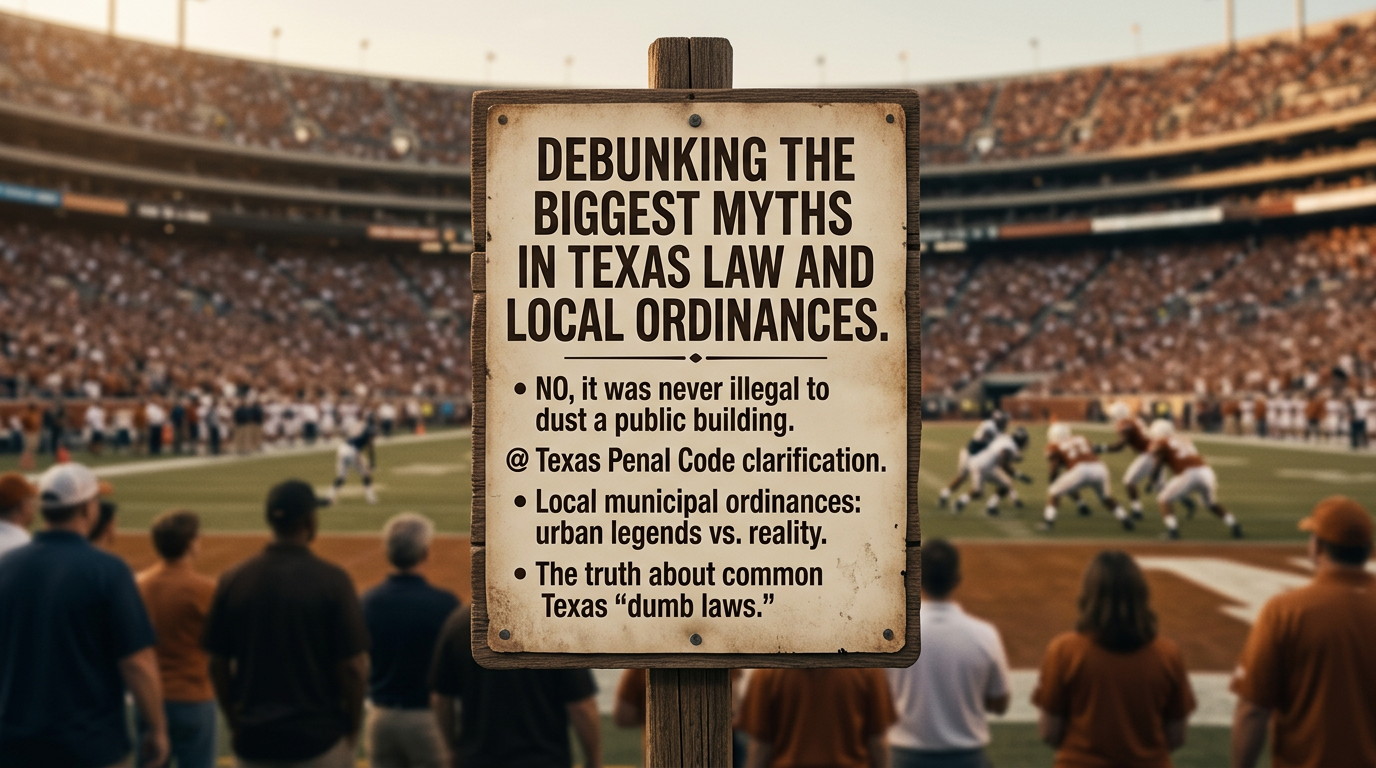
For decades, Texas has been the subject of numerous legal myths that range from the humorous to the downright bizarre. Many of these stories involve supposed prohibitions on everything from dusting a public building to the specific way one must consume beverages. However, a close examination of the Texas Penal Code and various municipal ordinances reveals that while Texas does have some unique traditions and outdated statutes, many of the most popular 'dumb laws' are actually fictional. Historically, these myths often stem from misinterpretations of older laws or local ordinances that were repealed long ago. Understanding the distinction between a viral internet myth and a true criminal statute is essential for residents who want to navigate the state's legal landscape without fear of accidental violations. This investigation dives deep into 16 specific claims, verifying which ones hold legal weight and which are merely tall tales told around a campfire or shared on social media. Historically, Texas law has evolved through periods of heavy deregulation and specific social restrictions, such as the famous 'Blue Laws' that once limited Sunday commerce. While many of those restrictions were lifted in 1985, the memory of strict, sometimes odd, regulations persists in the public consciousness. This environment has created a fertile ground for myths to grow, as people are often willing to believe that the Lone Star State maintains the same rugged and idiosyncratic legal framework it did during the frontier era. Today, the Texas Legislature focuses more on modernization, but the ghosts of former policies continue to influence how the state's legal code is perceived globally.
Texas relevance
Texas residents are often the primary targets of these legal misconceptions, which can influence how people interact with law enforcement or manage their personal affairs. From the Panhandle to the Rio Grande Valley, local law enforcement agencies frequently receive questions about these non-existent rules. Knowing the truth about these statutes ensures that Texans are not misled by misinformation that could impact their understanding of civil liberties and property rights. For example, myths regarding the legality of certain self-defense measures or vehicle modifications in cities like San Antonio or Dallas can lead to unnecessary confusion. By clarifying these points, we uphold the integrity of the Texas justice system and provide citizens with the accurate information they need to be informed voters and law-abiding neighbors.
The Truth About Property and Grazing Rights
One of the most enduring myths in the Lone Star State is that it is illegal to milk another person's cow. While this sounds like a vestige of a bygone era, it actually touches on a very real legal concept: property theft. While there may not be a specific 'milking statute' in the modern penal code, taking any resource from another person's livestock without permission would fall under general theft or criminal trespass laws. This myth persists because it encapsulates the very real Texas value of respecting a neighbor's agricultural property.
Furthermore, myths surrounding the 'right of way' for cattle and livestock continue to circulate in rural counties. While Texas is an 'open range' state in specific contexts, many counties have adopted local options that require livestock owners to fence their animals in. This creates a legal patchwork across the state where the responsibilities of a driver versus a rancher can change just by crossing a county line. Understanding these nuances is far more important for residents than worrying about fictional bans on dusting buildings.
Alcohol Restrictions and the Legacy of Blue Laws
A common area for legal confusion involves the sale and consumption of alcohol. Many people mistakenly believe that strange laws dictate how many sips of beer can be taken while standing up or sitting down. These are absolute fabrications. However, the reality of Texas liquor laws—often referred to as Blue Laws—is still quite restrictive compared to other states. For example, the prohibition of liquor sales on Sundays and the specific hours for beer and wine sales are very real and reflect the state's historical legislative leanings toward temperance.
The evolution of these laws shows a slow move toward modernization. In recent years, the Texas Legislature has allowed for expanded pick-up and delivery services and changed the start times for Sunday alcohol sales in restaurants. These real-world legislative shifts affect millions of Texans and billions in economic activity, yet they rarely receive as much viral attention as the fake law claiming it's illegal to have an Encyclopedia Britannica because one volume contains a recipe for homemade beer.
Urban Legends of the Texas Courtroom
There are several myths regarding the Texas judicial system and how trials are conducted. One popular claim is that it is illegal to carry a wirecutter in your pocket in certain cities. While this may have had some historical basis during the era of 'fence cutting wars' in the late 19th century, carrying common hand tools is perfectly legal today. These stories often survive because they are rooted in actual historical conflicts that once shaped the state's development.
Another judicial myth involves the supposed requirement for a person to announce they are carrying a concealed weapon even when not asked. Under current Texas law, specifically following the passage of constitutional carry, the rules for disclosure have become a point of frequent discussion. Clarifying these legal requirements is vital for law-abiding gun owners who wish to comply with the actual statutes rather than following outdated or invented advice found on the internet.
Wildlife and Environmental Misconceptions
Texas takes its wildlife and natural beauty seriously, which has led to several myths regarding indigenous plants and animals. A perennial favorite is the idea that it is illegal to pick a bluebonnet, the state flower. In reality, there is no law prohibiting the picking of bluebonnets on private property or even on public land, provided you are not damaging the land or trespassing. However, law enforcement does discourage stopping on busy highways to take photos, as it creates a significant safety hazard.
Similarly, myths about the protection of horned lizards (often called 'horny toads') are partially true but often exaggerated. While it is illegal to capture, harm, or sell them under state environmental protections, they are not 'federal fugitives' as some stories suggest. Understanding the balance between environmental stewardship and actual criminal statutes allows Texans to enjoy the state's natural resources responsibly without fear of imaginary legal repercussions.
Marriage and Common Law Reality
Texas is one of the few states that recognizes 'informal marriage,' commonly referred to as common law marriage. This has given rise to a slew of myths regarding how long a couple must live together before they are legally wed. Many believe the magic number is six months or three years. In truth, the Texas Family Code does not specify a duration of time. Instead, it requires three elements: an agreement to be married, living together in Texas as spouses, and representing themselves to others as married.
This legal reality is much more significant than myths about 'shotgun weddings' or strange divorce requirements. Because the law recognizes these unions, the legal implications for property division and child custody are the same as those for a formal marriage. Misunderstanding these actual laws can lead to significant legal complications for residents who assume they are 'just roommates' when the state may view them as legally bonded.
The Evolution of Texas Road Rules
Traffic laws are another magnet for misinformation. One prevalent myth is that it is illegal to drive barefoot in Texas. This is entirely false; there is no state law requiring footwear while operating a motor vehicle. However, safety experts and the Department of Public Safety generally recommend shoes for better pedal control. This is a classic example of a safety recommendation being misinterpreted as a binding legal requirement over several generations.
On the other hand, Texas has very specific laws regarding the use of turn signals and the 'Move Over' law that requires drivers to change lanes for emergency vehicles. While these don't sound as 'weird' as a barefoot driving ban, they carry heavy fines and are strictly enforced. Focusing on these actual requirements helps keep Texas roads safer than worrying about whether a passenger is allowed to have their feet on the dashboard, which is also generally legal, albeit dangerous.
Analysis
The persistence of these legal myths reflects a broader cultural fascination with the 'Old West' identity of Texas. While modern Texas is a hub of technological innovation and corporate growth, the legendary status of its laws serves as a form of cultural shorthand for its perceived independence and eccentricity. From an editorial perspective, it is interesting to note that the state's actual laws are often more complex and consequential than the silly myths often cited. For instance, while it is not illegal to milk someone else’s cow, the state's actual property and agricultural laws are some of the strictest in the country. This highlights a gap between public perception and legal reality, where the 'quirky' myths distract from substantive legislative debates regarding individual liberty and governmental overreach.
Source attribution
This story was reported using a public release from the Unusual Texas / Only In Texas (Google News). Keep TX Red rewrote the coverage independently and links to the official statement for verification.
Frequently Asked Questions
- Is it actually illegal to drive barefoot in Texas?
- No, there is no law in the Texas Transportation Code that prohibits driving a vehicle without shoes. While it is legally permissible, safety officials suggest wearing shoes to ensure you have the best grip and leverage on the brake and accelerator pedals.
- Can you really be arrested for picking a bluebonnet?
- No, picking bluebonnets is not a crime under Texas law. However, you can be charged with other offenses while picking them, such as trespassing on private property, obstructing a roadway, or damaging government property if you uproot entire areas of parkland.
- Does Texas have a 'weird law' about Encyclopedia Britannica?
- This is a myth. There is no law in Texas that bans the Encyclopedia Britannica. The rumor claimed it was banned because it contained a recipe for beer, but this has been thoroughly debunked by legal scholars and librarians alike.
- What are the actual requirements for common law marriage in Texas?
- Unlike popular myths that cite a specific number of years, Texas law requires three things: you must agree to be married, live together in the state as a married couple, and tell other people (represent yourself) that you are married.
Official Sources
Take the next step
Browse the Newsroom →Read more about Keep Texas Red → Our full guide to what Keep Texas Red means and why Texans support it.
Related Articles

Get Texas updates delivered weekly.
Independent Texas reporting on politics, policy, and daily life. One email a week. Unsubscribe anytime.
Keep TX Red Newsroom
The Keep Texas Red Editorial Staff produces nonpartisan explainers, policy breakdowns, and educational resources to help Texans understand how their government works. All content is reviewed for accuracy and updated regularly.
About Keep TX Red →