Loose Cattle Wander Through Southeast Houston Residential Streets During Early Morning Hours
A herd of cows was caught on camera wandering through a Houston neighborhood, highlighting the intersection of urban growth and Texas ranching history.
Editorial disclaimer: Opinions and analysis on Keep TX Red are editorial content — not statements of fact. See our editorial standards.
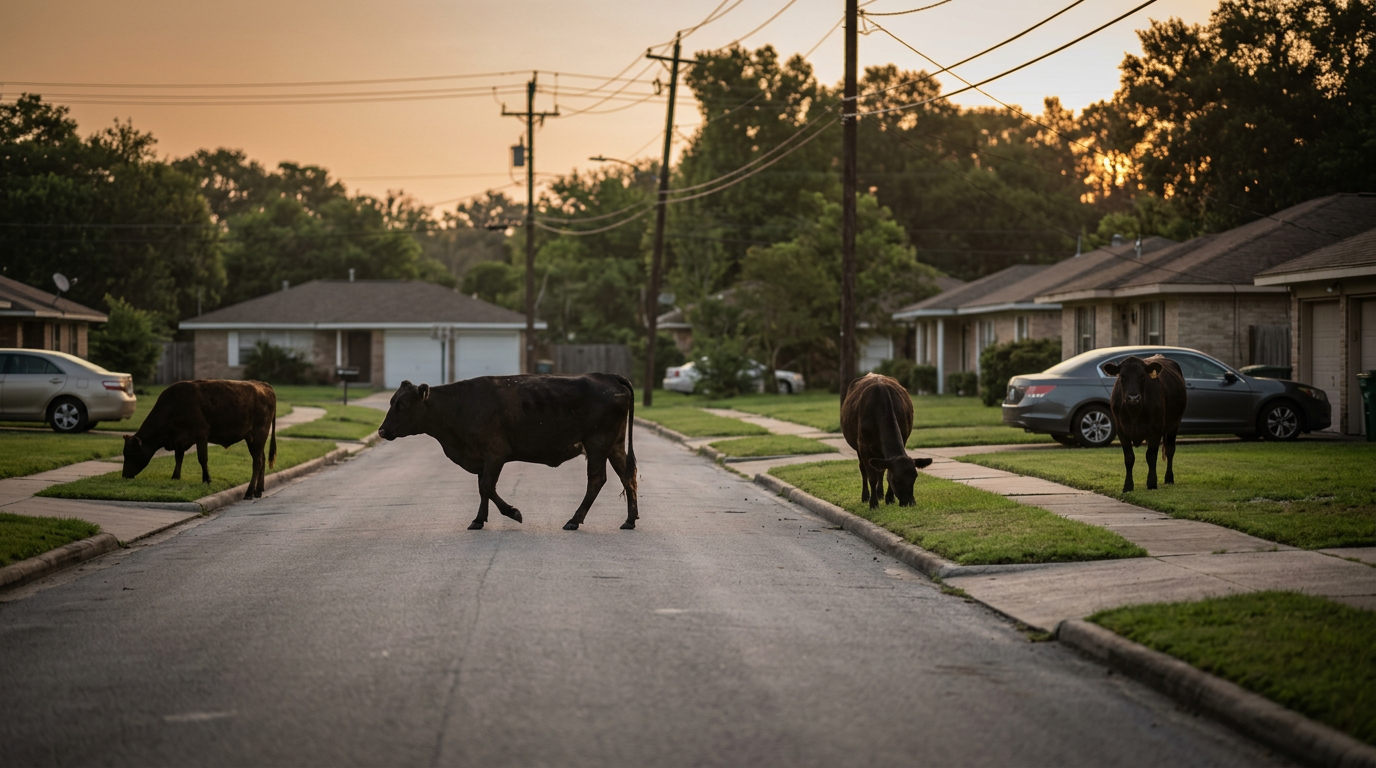
Residents in a southeast Houston neighborhood were met with an unexpected sight during the early morning hours when a small herd of cattle was spotted wandering through residential streets. The incident, captured by local security cameras, showed the animals casually strolling past driveways and lawns in a suburban setting far removed from traditional pasture land. Historically, Texas has a long-standing relationship with the cattle industry, and even as cities like Houston expand, the proximity of rural land to modern developments often leads to such unusual encounters. This event serves as a reminder of the state’s agricultural roots and the unique challenges faced by animal control in high-growth corridors where fences occasionally fail or gates are left unsecured.
Texas relevance
This event took place in a specific Southeast Houston neighborhood, underscoring the ongoing urban sprawl in Harris County where residential subdivisions frequently border active agricultural zones. In Texas, livestock laws are governed by a complex mix of state statutes and local ordinances, and Houston’s massive geographic footprint often swallows up former ranch lands while maintaining a close proximity to existing farms. For Houstonians, this highlights the necessity of knowing how to interact with large livestock on public roadways and the importance of reporting roaming animals to prevent traffic accidents or property damage within the city limits.
The Morning Discovery along Pearland-Houston Borders
Homeowners in the southeast quadrant of the city first noticed the visitors when motion-activated doorbell cameras began fluttering with alerts long before sunrise. The footage showed several cows leisurely exploring the asphalt, seemingly unbothered by the streetlights or the parked vehicles lining the curbs. The specific area, which sits near the transition point between Houston proper and the outlying Pearland region, still features pockets of undeveloped land that have been used for grazing for decades.
Local witnesses reported that the cattle appeared healthy and were not acting aggressively, though their presence on the street created a potential hazard for early commuters. Because cattle are heavy and unpredictable, their movement into a residential zone requires a coordinated response to ensure they are returned to their enclosure without causing a multi-car collision or damaging expensive landscaping and private property.
Texas Estray Laws and Urban Cattle Management
In the state of Texas, the legal term for livestock that has roamed from its owner’s property is 'estray.' Under the Texas Agriculture Code, the local sheriff's department typically has the authority to handle such incidents. In a major city like Houston, the responsibilities may fall between the Houston Police Department and Harris County animal control services. These agencies are tasked with identifying the owner and ensuring the public remains safe while the animals are being rounded up.
The process of recovering loose cattle involves checking for brands, ear tags, or other identification markers. If an owner cannot be immediately located, the animals are sometimes transported to a holding facility or a local livestock auction house until the rightful owner can claim them and pay any associated fines or boarding fees. This system ensures that the burden of the animals' care does not fall permanently on the taxpayers.
The Hazards of Livestock on Public Roadways
One of the primary concerns for city officials when cattle escape is the risk to motorists. A full-grown cow can weigh anywhere from 1,000 to 1,500 pounds, making a collision with a passenger vehicle potentially fatal. In the dark hours of the early morning, cattle can be difficult to see on unlit residential streets or near feeder roads, increasing the likelihood of a dangerous high-impact encounter.
Beyond the risk to drivers, the cattle themselves are at risk from city infrastructure. Concrete surfaces are not the natural habitat for hooved animals, and they can easily slip and injure themselves. There is also the danger of the animals wandering into high-traffic areas like the Sam Houston Tollway or Interstate 45, which would necessitate a major emergency response and the temporary closure of critical transit veins.
Public Reaction and Viral Social Media Presence
As the footage of the Houston cows spread online, it sparked a wave of quintessentially Texan reactions. Neighborhood Facebook groups and Nextdoor threads were filled with jokes about Cattle Drives coming to the suburbs and neighbors offering to 'fire up the grill.' This lighthearted response reflects a cultural comfort with livestock that might not exist in other major American metropolises like New York or Chicago.
However, beneath the jokes, more experienced residents utilized the platforms to coordinate with local ranchers to see if anyone was missing part of their herd. The digital age has actually improved the speed at which stray livestock can be reunited with their owners, as photos can be shared across thousands of local accounts within minutes of a sighting, often reaching the owner before official law enforcement arrives.
Mitigating Future Suburban Cattle Escapes
As the city limits continue to push into rural territory, urban planners and developers are increasingly looking at ways to separate residential zones from agricultural ones. This includes more robust fencing requirements for developers who build adjacent to existing ranches. Many newer subdivisions are required to install perimeter walls that serve the dual purpose of providing privacy and acting as a barrier against wandering wildlife or livestock.
Ranchers are also feeling the pressure to modernize their containment systems. With more people living nearby, the cost of a gate left open can be much higher than it was in the past. GPS ear tags and improved electronic monitoring are becoming more common tools for Texas cattlemen to keep track of their animals in real-time, preventing these types of suburban excursions before they begin.
The Logistics of a Neighborhood Roundup
Rounding up cattle in a neighborhood setting is vastly different from a typical pasture roundup. On the street, there are no fences to funnel the animals, and the noise of sirens or curious onlookers can cause the cattle to spook. HPD and Harris County officers often have to rely on experienced livestock handlers who can use trailers and quiet herding techniques to move the animals into a contained space without causing a stampede.
The success of these operations depends heavily on the patience of the officers involved. In most cases, the goal is to lead the cows into a fenced backyard or a cul-de-sac where they can be safely loaded into a trailer. Residents are always advised to stay inside their homes and keep their pets away from the area, as a frightened cow can easily trample a small dog or damage a fence in an attempt to escape what it perceives as a threat.
A Legacy of the Bayou City's Agricultural Past
Houston’s identity is inextricably linked to the cattle industry. For years, the city was a major hub for rail shipments of beef, and the Houston Livestock Show and Rodeo remains the largest event of its kind in the world. While the 'Concrete Jungle' image of Houston is prominent today, sightings like the one in Southeast Houston remind residents that the city is built on top of vast prairies that supported millions of head of cattle for nearly two centuries.
This incident is a small glimpse into a larger trend of 'urban ranching' that persists throughout Texas. Even as high-rises go up, small patches of land are often kept under agricultural exemptions for tax purposes, meaning that the city's 'wild side' is never truly gone. It is a unique aspect of Texas life that requires a blend of modern vigilance and old-school agricultural knowledge from both citizens and local government.
Analysis
While the sight of cows in a neighborhood is often treated as a humorous 'Only in Texas' moment, it points to a serious logistical reality regarding land use. As Houston continues its outward expansion, the displacement of traditional grazing fields means these types of sightings are likely to become more frequent rather than less. Local law enforcement and animal control departments must maintain the equipment and training necessary to handle large mammals that do not fit into the standard 'domestic pet' category. Furthermore, these incidents raise questions about liability and the responsibility of property owners to maintain secure boundaries in an increasingly crowded metropolitan environment.
Source attribution
This story was reported using a public release from the Unusual Texas / Only In Texas (Google News). Keep TX Red rewrote the coverage independently and links to the official statement for verification.
Frequently Asked Questions
- What should I do if I see a cow in my neighborhood?
- The first step is to maintain a safe distance and do not try to herd the animal yourself. Contact local non-emergency law enforcement or animal control immediately. Cattle can be unpredictable when stressed, and an untrained person could inadvertently drive the animal into a more dangerous area like a high-speed road.
- Who is liable if a loose cow causes damage in Texas?
- Liability often depends on whether the county is a 'closed range' or 'open range' county and if the owner was negligent in maintaining their fences. In most modern urban areas of Texas, owners are expected to keep their livestock secured, and they can be held responsible for damages if it is proven they failed to do so.
- How do authorities find the owners of stray cattle?
- Authorities look for identifying marks such as ear tags, brands, or microchips. They also cross-reference report of reports of missing livestock from local ranchers. In Texas, brands are registered at the county level, making the Harris County Clerk’s office a vital resource for tracing an animal back to its specific ranch.
Official Sources
Take the next step
Browse the Newsroom →Read more about Keep Texas Red → Our full guide to what Keep Texas Red means and why Texans support it.
Related Articles
Get Texas updates delivered weekly.
Independent Texas reporting on politics, policy, and daily life. One email a week. Unsubscribe anytime.
Keep TX Red Newsroom
The Keep Texas Red Editorial Staff produces nonpartisan explainers, policy breakdowns, and educational resources to help Texans understand how their government works. All content is reviewed for accuracy and updated regularly.
About Keep TX Red →