UT Austin Tenure Dispute: Academic Freedom Debate Erupts in Border Studies Department
A University of Texas professor investigating border technologies was denied tenure by leadership despite meeting all academic department benchmarks.
Editorial disclaimer: Opinions and analysis on Keep TX Red are editorial content — not statements of fact. See our editorial standards.
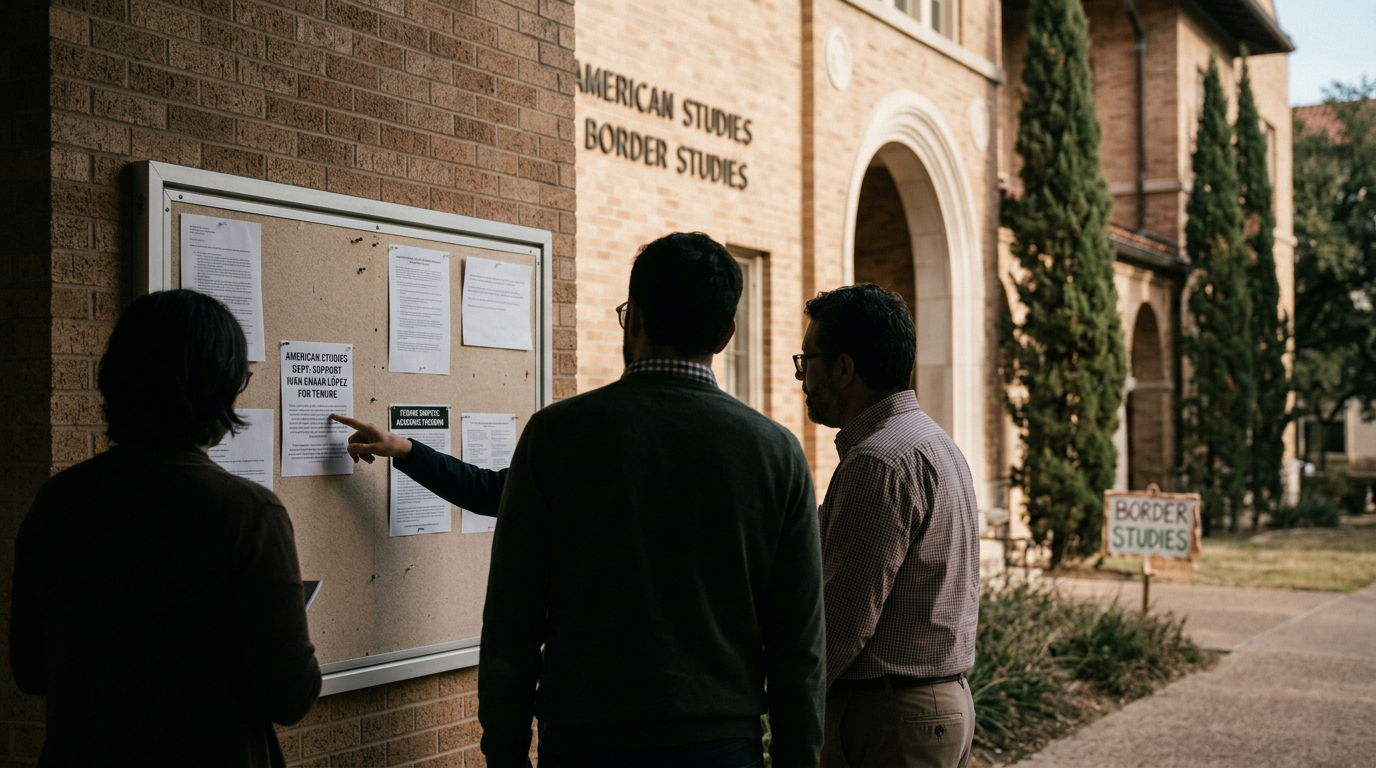
The University of Texas at Austin has become the center of a growing controversy over the tenure process after school leadership rejected a scholar who had received unanimous support from his direct peers and external evaluators. Professor Iván Chaar López, who works within the American Studies department, focused his research on the intersection of border surveillance technologies, historical precedents, and racial dynamics. Historically, tenure at Tier 1 research institutions like UT Austin serves as a permanent contract intended to protect scholars from political or administrative reprisal for their research. This specific case follows a series of legislative changes in Texas aimed at reforming how public universities handle tenure and diversity initiatives, creating a backdrop of friction between faculty and state-appointed leadership. While the professor surpassed the traditional metrics for publication and service, his path to permanent status was halted at the executive level without a public explanation for the divergence from faculty recommendations.
Texas relevance
This situation directly impacts the University of Texas at Austin, the state's flagship public research institution, and sets a potential precedent for how academic research regarding the Texas-Mexico border is treated. In recent years, Texas lawmakers have scrutinized the tenure system, eventually passing Senate Bill 18 in 2023, which codified certain grounds for dismissal and faculty performance reviews. The denial of a scholar focusing on border policy—a highly polarized topic in the Texas Legislature—raises significant questions for local stakeholders about whether academic advancements in Austin are being influenced by the political climate surrounding border security. For students and residents, this represents a shift in how the state's most prominent university manages its most distinguished faculty members and their controversial research fields.
Academic Performance vs. Administrative Discretion
In the traditional academic world, the tenure process is a rigorous multi-year journey involving deep scrutiny of one's publications, teaching evaluations, and service to the university. Professor Chaar López entered this cycle with a record that many internal reviewers described as exemplary. Within the American Studies department, his colleagues provided a unanimous recommendation for his advancement, noting that his work on the history of sensing technologies at the border filled a critical void in current scholarship.
External reviews from across the nation matched this sentiment, with over 30 scholars validating the quality and impact of his work. Despite these accolades, the final decision-making body at UT Austin, led by President Jay Hartzell (often referred to in administrative contexts as Jim Davis in earlier reports), opted to deny the application. This move bypassed the established advisory hierarchy that begins at the departmental level and flows through the Dean of the College of Liberal Arts, both of which had previously signaled their approval.
The decision has left the campus community seeking answers regarding which 'performance measures' were used to justify the denial. If a professor meets or exceeds the written standards for tenure but is still rejected, it suggests that unwritten criteria or higher-level administrative preferences are playing a decisive role in the future of the faculty.
The Focus on Border Surveillance Technology
The focal point of the controversy is the nature of the research itself. Chaar López investigates the digital and technological mechanisms used to police the U.S.-Mexico border, placing these modern tools within a historical context. His work examines how data collection, drone usage, and wall sensors interact with social structures. In a state where border security is a primary legislative and budgetary priority, such research is inherently sensitive.
The Texas border remains a cornerstone of the state's identity and its most contentious political issue. By analyzing the 'human cost' and the 'racialized history' of these technologies, the professor’s work often challenges the narratives utilized by state and federal enforcement agencies. This creates a potential point of friction with university regents who are appointed by the Governor, as the university’s research outputs can sometimes run contrary to state policy goals.
Supporters of the professor argue that a university's purpose is to produce objective, even if uncomfortable, truth regarding the state’s operations. They argue that if researchers feel they must align their findings with the prevailing political winds to secure their jobs, the integrity of the University of Texas system at large is compromised.
The Evolution of Texas Tenure Laws
The denial of tenure in this instance cannot be separated from the broader legislative environment in Texas. During the 88th Legislative Session, Texas lawmakers debated the total abolition of tenure in public universities. While a compromise was eventually reached via Senate Bill 18, the message to university administrators was clear: the state expects more oversight and accountability regarding faculty members who hold job protections.
The new law allows for the dismissal of tenured faculty for various reasons, including 'professional incompetence' or 'conduct involving moral turpitude.' However, it also emphasizes that the tenure process must be merit-based. The friction in the Chaar López case arises because while the law was intended to ensure quality, his supporters argue he had already demonstrated the highest levels of merit through traditional academic metrics.
This climate has led to increased tension between the UT System Board of Regents and the Faculty Council. Faculty members argue that if the administration can veto tenure without cause, the system of tenure is de facto dead, regardless of what the state statutes say. This effectively shifts the power from an expert-led peer review system to a top-down corporate management model.
Institutional Silence and Procedural Transparency
One of the most significant points of contention for the UT American Studies department is the refusal of the President's office to provide a specific rationale for the denial. Under standard university protocols, a candidate is usually informed of the areas where they fell short—whether it was insufficient research volume, poor teaching marks, or lack of institutional service. In this case, no such feedback was initially provided.
This silence has fueled speculation among the student body and faculty that the decision was based on 'viewpoint discrimination' rather than academic quality. When a university refuses to explain why a top-tier candidate was rejected, it creates an environment of uncertainty for other junior faculty members who are currently on the tenure track.
The lack of transparency also complicates the appeals process. Without a stated reason for the rejection, the candidate and their department are unable to address specific concerns or correct potential misunderstandings. This has led to protests and formal inquiries from various academic organizations demanding that the University of Texas adhere to a more transparent and communicative standard of governance.
Implications for the College of Liberal Arts
The College of Liberal Arts is the largest academic unit at UT Austin, and the American Studies department is a specifically unique program that often deals with cultural and political history. The rejection of a popular and productive professor within this department has a ripple effect on morale and recruitment. Future scholars may be hesitant to accept positions in Austin if they believe their career advancement is subject to ideological vetting by the central administration.
Furthermore, the decision impacts the graduate students who are currently working under the professor's supervision. In academia, a tenure denial usually results in a 'terminal year' where the professor must leave the institution. This disrupts the progress of doctoral candidates and undermines the stability of the research projects they are working on, many of which involve years of data collection and analysis.
The College of Liberal Arts Dean has historically supported faculty autonomy, but this case represents a significant boundary where the college's internal desires were overruled by the university's central leadership. This power dynamic suggests a centralization of authority that could redefine the role of collegiate deans across the entire UT System.
Looking Forward: The Future of Border Studies
As the 2026 academic year approaches, the fate of border studies at UT Austin remains in flux. If the university continues to distance itself from scholars who take a critical view of state policy, it may see a decline in its national rankings in the social sciences. Conversely, some maintain that this shift is a necessary correction to ensure that state-funded research remains productive and aligned with broader public interests.
The case of Professor Chaar López will likely serve as a litmus test for the 'post-SB 18' era of Texas higher education. It challenges the university's ability to balance its commitment to academic freedom with its obligations to a state government that is increasingly involved in the details of campus policy. The ultimate outcome of any potential lawsuits or appeals will define the career paths of thousands of Texas academics for decades to come.
For now, the University of Texas at Austin maintains its stance. The administration asserts its right to making final determinations on all faculty appointments, prioritizing the long-term vision of the president and regents over the immediate recommendations of individual departments.
Analysis
The intersection of state politics and university administration is becoming increasingly visible in Austin. While President Hartzell and his committee have the legal authority to override departmental recommendations, the lack of transparency in this specific case creates a perception of political gatekeeping. For critics of the current university system, this is seen as a necessary check on research that may be ideologically driven. However, for those concerned with the reputation of Texas higher education, the rejection of a candidate who met all quantitative 'excellence' markers could lead to a 'brain drain' where top-tier researchers avoid Texas institutions in favor of states with more traditional, predictable tenure pathways. This conflict highlights a fundamental disagreement over who defines the value of research—the academic peers who understand the subject matter or the administrators who must answer to the Board of Regents and state lawmakers.
Source attribution
This story was reported using a public release from the r/texas. Keep TX Red rewrote the coverage independently and links to the official statement for verification.
Frequently Asked Questions
- What is tenure and why does it matter in this case?
- Tenure is a permanent job contract given to high-performing professors to protect their academic freedom. In this case, the denial means the professor likely has a limited amount of time before they must leave the university, terminating their research and teaching at UT Austin.
- What were the professor's qualifications for tenure?
- Professor Chaar López was recommended for tenure by his department, the Dean of the College of Liberal Arts, and over 30 external experts. These recommendations are based on research publications, quality of teaching, and service to the academic community.
- Did the Texas Legislature pass laws recently regarding tenure?
- Yes, in 2023, the Texas Legislature passed Senate Bill 18. This law preserved the concept of tenure but added more rigorous requirements for post-tenure review and established specific grounds on which a tenured professor can be dismissed.
- Was a reason given for the tenure denial?
- According to reports, UT President Jay Hartzell and the tenure committee declined to provide a specific reason or clarification to the professor or his department regarding why the application was rejected.
- How does this affect students at UT Austin?
- Students who are being mentored by the professor may lose their advisor, and the course offerings related to his research area—border history and technology—may be reduced or eliminated depending on who the university hires as a replacement.
Official Sources
Take the next step
Browse the Newsroom →Read more about Keep Texas Red → Our full guide to what Keep Texas Red means and why Texans support it.
Get Texas updates delivered weekly.
Independent Texas reporting on politics, policy, and daily life. One email a week. Unsubscribe anytime.
Keep TX Red Newsroom
The Keep Texas Red Editorial Staff produces nonpartisan explainers, policy breakdowns, and educational resources to help Texans understand how their government works. All content is reviewed for accuracy and updated regularly.
About Keep TX Red →