Transparency Concerns Cloud Impending Dallas City Hall Relocation and Renovation Plans
Critics and advocates for fiscal responsibility raise alarms over data accuracy as Dallas leaders weigh the future of the iconic City Hall building.
Editorial disclaimer: Opinions and analysis on Keep TX Red are editorial content — not statements of fact. See our editorial standards.
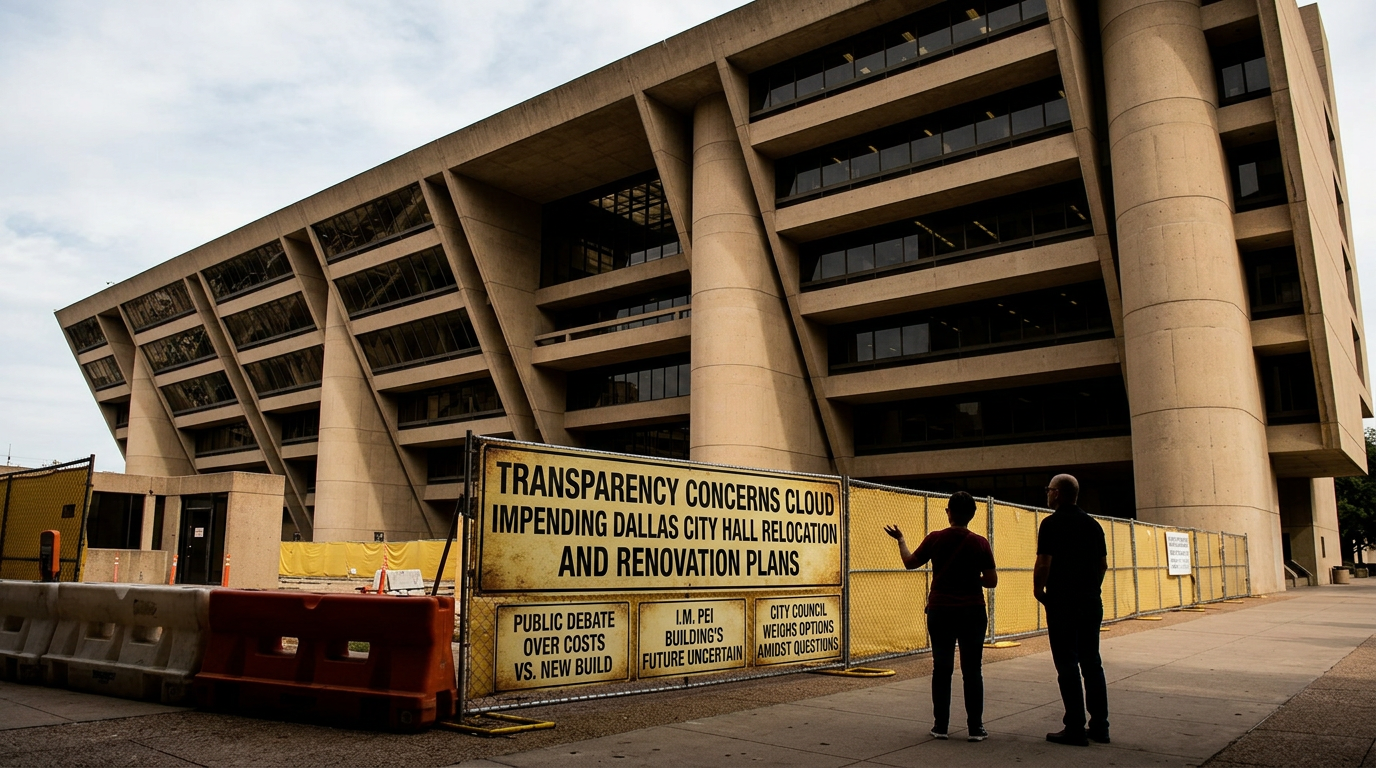
The City of Dallas is currently grappling with a monumental decision regarding the future of its seat of government. For years, the brutalist architectural masterpiece designed by I.M. Pei has served as the operational hub for municipal affairs, yet the structure has faced mounting criticism due to escalating maintenance costs and aging infrastructure. As the Dallas City Council weighs the possibility of a massive renovation versus the construction of a entirely new facility, local observers like David Voss have stepped forward to challenge the integrity of the data being used to drive this decision. Historically, Dallas has a complex relationship with its iconic public spaces, often balancing the desire for modern efficiency against the preservation of mid-century architectural legacies. This current debate mirrors past controversies over the Kay Bailey Hutchison Convention Center expansion, where long-term financial commitments were scrutinized against the backdrop of immediate regional needs. The looming decision is not merely about a building; it is a testament to how Texas's third-largest city manages its credit, its heritage, and its taxpayers' trust. The controversy centers on allegations that the fiscal projections presented to the council are fundamentally flawed, potentially leading to a multi-hundred-million-dollar error in judgment that could burden Dallas residents for decades. As the vote approaches, the demand for an independent audit of the facility's assessment data has become a focal point for those seeking greater accountability in City Hall's internal processes.
Texas relevance
This issue is central to the governance of a major Texas metropolitan hub. Dallas serves as a primary economic engine for the state, and its fiscal health directly impacts North Texas's overall stability. How the city chooses to allocate funds for its primary administrative building sets a precedent for other Texas cities facing aging infrastructure from the 1970s and 1980s. Historically, Texas local governments have struggled with transparency in major capital improvement projects, making the Dallas situation a bellwether for municipal accountability across the Lone Star State. If the city moves forward with a plan based on inaccurate maintenance or construction estimates, it could trigger a deficit that necessitates property tax hikes, affecting every homeowner and business owner in the Dallas area.
The Architectural Legacy of 1500 Marilla Street
Completed in 1978, the Dallas City Hall building at 1500 Marilla Street is one of the most recognizable examples of brutalist architecture in the United States. Designed by the world-renowned architect I.M. Pei, the building was intended to reflect the scale and ambition of a city that was rapidly expanding. Its inverted pyramid design and vast concrete plaza were meant to create a sense of public connection, though in practice, the building has often been criticized for its stark appearance and the difficulty of maintaining its massive exposed surfaces.
Over the decades, the structure has suffered from significant deferred maintenance. The cost of upgrading the mechanical systems, improving energy efficiency, and remediating issues common to aging concrete structures has ballooned. This has led city staff to present various options to the council, including a full retrofit that could cost millions or a move to a new site that would allow for a more modern, efficient workspace. However, the legacy of the building makes any decision to leave it a politically and culturally sensitive topic for the Dallas community.
Questions Surrounding the Financial Projections
The core of the current controversy lies in the methodology used to calculate the 'delta' between repairing the current hall and building a new one. Critics argue that the estimates provided to the City Council have been manipulated or poorly researched, leading to a distorted view of the most cost-effective path forward. When 'faulty information' is introduced into the municipal legislative process, it compromises the ability of elected officials to act as the final check on administrative spending.
Discrepancies often arise in how 'soft costs'—such as architectural fees, permitting, and temporary relocation expenses—are factored into the new construction budgets. If the costs to renovate the existing building are artificially inflated while the costs of new construction are low-balled, the council may be steered toward a decision that appears fiscally prudent on paper but proves ruinous in reality. This lack of data clarity has prompted calls for a third-party review of the city's internal assessments.
The Potential Impact on Dallas Taxpayers
In a state like Texas, where property taxes are a primary source of municipal revenue and a major concern for residents, the mismanagement of a capital project this size can have lasting consequences. If Dallas takes on excessive debt to fund a new city hall based on inaccurate projections, the interest payments alone could divert funds from essential services like the Dallas Police Department or the city's struggling street repair initiatives.
Taxpayers are increasingly wary of 'vanity projects' that prioritize government comfort over public utility. The relocation of the city's central operations is a once-in-a-generation expense. If the decision-making process is tainted by inaccurate data, it undermines the trust between the city government and the people it serves. Transparency is not just a buzzword in this context; it is a financial necessity to ensure the city remains solvent and competitive with surrounding suburbs like Plano and Frisco.
Operational Challenges at the Current Facility
Beyond the fiscal debate, the daily operational reality of the current City Hall is a factor that cannot be ignored. Staff members have reported issues with HVAC performance, elevator reliability, and general workspace layout that does not accommodate 21st-century technology. These 'hidden costs' of staying in an aging building include lost productivity and the high price of piecemeal repairs that do not solve underlying systemic failures.
However, proponents of staying at the current site argue that the building’s central location and symbolic importance are worth the investment. They contend that with a smarter, more targeted renovation plan—one based on accurate, verifiable data—the city could save the 'greenest' building: the one that is already standing. The tension between operational efficiency and historic preservation remains a central theme in the council’s deliberations.
Comparative Analysis of Texas Municipal Projects
Dallas is not alone in facing these challenges. Across Texas, cities like Austin and San Antonio have had to navigate the modernization of their civic centers. In Austin, the development of a New City Hall involved years of debate over cost overruns and environmental standards. San Antonio, conversely, successfully repurposed historic buildings for municipal use, providing a potential roadmap for how Dallas could integrate its existing assets into a modern framework.
By looking at these state peers, Dallas leaders can see the risks of ignoring data discrepancies. In past Texas municipal projects where initial estimates were ignored in favor of political momentum, the eventual cost to the public often doubled. The warnings being issued today regarding the 'faulty information' in Dallas are a safeguard against repeating the mistakes seen in other large-scale Texas infrastructure projects over the last twenty years.
The Path Toward a Resolution
As the City Council prepares to move toward a final vote, the pressure is mounting for a pause in the proceedings. Strategic planners have suggested that a delay to verify the numbers would be far less expensive than a rush to judgment that results in a decade of litigation or construction delays. The focus must shift from 'if' the city needs a better functional space to 'how' it can achieve that goal without compromising its long-term financial health.
The coming weeks will likely see a series of public hearings and briefings where the data in question will be subjected to higher scrutiny. Whether the city chooses to stay and revitalize I.M. Pei's vision or embark on a new chapter at a different location, the process must be beyond reproach. For the city of Dallas to continue its upward trajectory as a Texas powerhouse, its leaders must demonstrate that they prioritize factual accuracy over political expediency.
Analysis
The tension between preservation and progress often exposes the internal friction of municipal bureaucracy. In this instance, the warning from David Voss suggests a systemic problem within the city's reporting mechanisms. If a historic decision is indeed being based on 'faulty information,' it points to a collapse in the due diligence process that should precede any project of this magnitude. From a fiscal conservative perspective, the priority must be a transparent, line-by-line accounting of the costs associated with the current building versus a new build. Moving too quickly to abandon a landmark based on inflated repair costs, or conversely, staying in a money pit due to undercounted expenses, are both recipes for disaster. The City Council must resist the urge to favor 'shiny' new projects over the tedious but necessary work of verifying data integrity if they wish to remain responsible stewards of the public purse.
Source attribution
This story was reported using a public release from the r/dallas. Keep TX Red rewrote the coverage independently and links to the official statement for verification.
Frequently Asked Questions
- Why is the current Dallas City Hall considered historic?
- Designed by the famous architect I.M. Pei and completed in 1978, the building is a landmark of brutalist architecture. Its unique cantilevered design and iconic status make it a centerpiece of the city's architectural identity.
- What according to critics is wrong with the data being used?
- Critics like David Voss argue that the cost estimates for repairing the current building are inflated while the costs for a new facility are potentially underestimated, creating a false narrative about which option is more affordable.
- How would a new City Hall be funded?
- Large capital projects in Dallas are typically funded through city-issued bonds, which are repaid using taxpayer money over several decades.
Official Sources
Take the next step
Browse the Newsroom →Read more about Keep Texas Red → Our full guide to what Keep Texas Red means and why Texans support it.
Get Texas updates delivered weekly.
Independent Texas reporting on politics, policy, and daily life. One email a week. Unsubscribe anytime.
Keep TX Red Newsroom
The Keep Texas Red Editorial Staff produces nonpartisan explainers, policy breakdowns, and educational resources to help Texans understand how their government works. All content is reviewed for accuracy and updated regularly.
About Keep TX Red →