Texas Senate Race Financial Totals Emerge in Paxton vs. Talarico Battle
New campaign finance data shows fundraising and Super PAC activity in the high-stakes 2026 U.S. Senate contest between Paxton and Talarico.
Editorial disclaimer: Opinions and analysis on Keep TX Red are editorial content — not statements of fact. See our editorial standards.
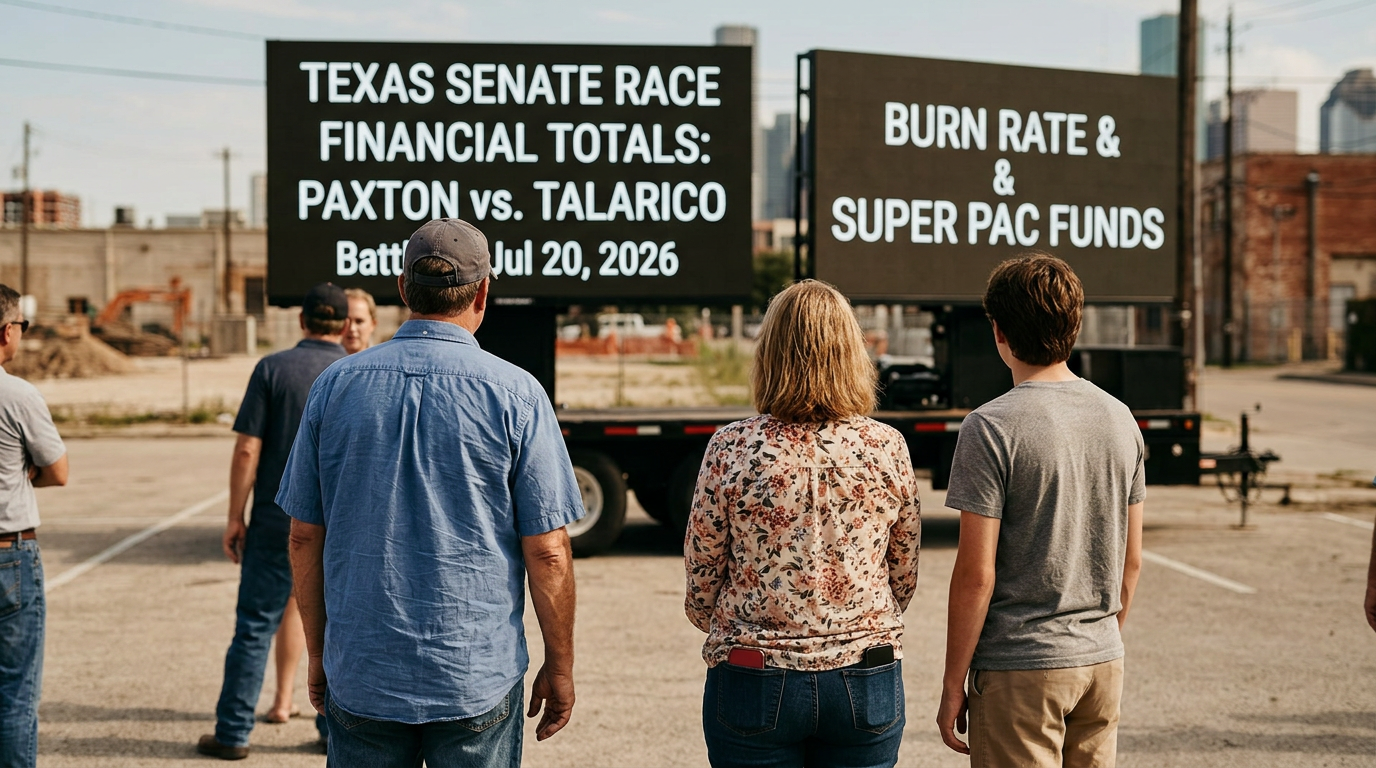
Official campaign finance disclosures released on July 20, 2026, provide a detailed look at the financial landscape of the U.S. Senate race between Republican Ken Paxton and Democrat James Talarico. The reports filed with federal regulators outline how much each candidate has raised from individual donors, the Burn Rate of their current operations, and the involvement of outside Super PACs. As both candidates transition from their current state-level roles in Austin to a federal stage, the flow of capital suggests this contest is trending toward becoming the most expensive legislative race in Texas history. Historically, Texas Senate races have drawn astronomical sums, but the entry of two high-profile state officials has accelerated the pace of contributions early in the cycle. Contextually, this race follows a decade of increasing costs for statewide Texas campaigns. In 2018 and 2020, previous Senate contests broke national records for total spending, driven by both grassroots small-dollar donations and massive independent expenditures. The current matchup between Paxton, the sitting Attorney General, and Talarico, a State Representative, marks a significant shift in political dynamics, as both candidates have established bases within the state. The financial data serves as a barometer for internal party enthusiasm and the level of national interest in flipping or defending this critical seat in the upper chamber of Congress.
Texas relevance
This financial reporting is critical for Texas voters because it reveals who is funding the potential representatives of the Lone Star State in Washington D.C. Within Texas, the Attorney General’s office and the State Legislature serve as the primary training grounds for federal candidates, and the mobilization of Texas-based capital versus out-of-state influence remains a central theme in the political discourse. The outcomes of these fundraising efforts dictate which regions of Texas—from the energy sector in Houston to the tech hubs in Austin—are most actively invested in the constitutional direction of the country. Furthermore, the volume of spending in cities like Dallas and San Antonio for media buys directly impacts the local economies and the saturation of political messaging across the state.
The Role of Independent Expenditure Committees
Super PACs have become the dominant force in the 2026 Texas Senate race, often outspending the candidates' own authorized committees. Because these organizations can raise unlimited sums from corporations and individuals, they are responsible for much of the negative advertising appearing on Texas television screens. The disclosures show that multiple committees are now active, focusing on deep-dive research and early media placement.
These groups are legally prohibited from coordinating directly with the Paxton or Talarico campaigns, yet their strategic spending aligns closely with each candidate’s broader themes. For Paxton, these groups often highlight his legal battles to protect state sovereignty. For Talarico, the focus tends to be on social issues and changing the leadership structure in the state. The sheer volume of this 'dark money' or outside spending is a primary reason this race is projected to break previous cost records.
Comparing Individual Donor Bases
A key factor in the recent FEC filings is the breakdown of individual contributions. Ken Paxton continues to draw significant support from large-scale donors within the Texas business community, particularly those concerned with regulatory overreach and border security. These high-dollar contributions provide a stable foundation for his campaign's infrastructure and logistical needs.
James Talarico's filing indicates a reliance on a high volume of small-dollar donations, a strategy often seen in modern campaigns to demonstrate broad-based grassroots support. This method, while labor-intensive, create a larger list of potential volunteers and activists. The tension between these two fundraising models—the deep-pocketed traditional base versus the wide-ranging small-donor network—will be a defining feature of the financial contest.
Geographic Distribution of Contributions
The heat map of contributions shows that the majority of funds are circulating within the Texas 'Texas Triangle'—the region bounded by the DFW metroplex, Houston, and San Antonio. Paxton holds a strong financial grip on the Midland-Odessa energy corridor and established suburban strongholds, where his message of fiscal conservatism resonates most deeply with local industry leaders.
Talarico has seen a surge in contributions from the urban centers of Austin and parts of Houston, reflecting his background as a representative from Central Texas. However, for both candidates, the challenge remains engaging donors in the vast rural stretches of the Panhandle and South Texas. The current financial reports indicate that both campaigns are beginning to allocate more resources toward multi-lingual outreach and rural radio spots to bridge this geographic divide.
Spending Priorities and Campaign Operations
Effective fundraising is only half of the equation; how the money is spent determines the viability of the campaign. Ken Paxton’s expenditures are currently focused on legal defense, statewide travel, and digital infrastructure. As a sitting official, he maintains a certain level of visibility, but his campaign funds are being used to amplify his platform to a national audience of conservative supporters.
James Talarico is focusing his spending on staff recruitment and data analytics. Building an organization that can compete with an incumbent’s name recognition requires a massive upfront investment in canvassing technology and digital outreach. The reports show that a significant portion of his early funds has gone into building a modern campaign apparatus designed to mobilize voters who do not typically participate in mid-cycle elections.
Historical Context of Texas Senate Spending
In the past, Texas was considered a relatively predictable state for Senate elections, but the last three cycles have seen a transformation. The 2018 race between Ted Cruz and Beto O'Rourke set a new ceiling for what a Texas race could cost, and the 2026 cycle is already pacing to exceed those benchmarks. The increased cost is a reflection of Texas’s growing population and the rising price of advertising in major markets like DFW and Houston.
Critics of current campaign finance laws often point to these Texas races as evidence of the need for reform, while proponents argue that the high spending is a sign of a healthy, competitive democracy where ideas are vigorously debated. Regardless of the viewpoint, the financial data confirms that Texas remains the most important political battlefield in the southern United States.
Analysis
OPINION: The financial trajectory of the Paxton-Talarico race indicates a broader nationalization of Texas politics. While Paxton relies on his established statewide conservative network and high-frequency donor base, Talarico appears to be leveraging his background in education and his role as a rising voice in the opposition to attract younger, diverse donors. The proliferation of Super PAC spending is a double-edged sword; while it provides the necessary capital for statewide reach in a massive geographic area like Texas, it also distances the candidates from the direct control of their messaging. Conservative donors are likely focusing on Paxton's proven track record of litigation against the federal government, while Talarico’s fundraising emphasizes a shift in the state’s legislative priorities. Ultimately, the candidate who manages their 'burn rate' most effectively while maintaining a presence in all 254 Texas counties will likely hold the advantage going into the final months of the campaign.
Source attribution
This story was reported using a public release from the Texas Tribune. Keep TX Red rewrote the coverage independently and links to the official statement for verification.
Frequently Asked Questions
- Why is the 2026 Texas Senate race receiving so much money?
- Texas is a pivotal state in the balance of power in the U.S. Senate. With two high-profile state officials—Attorney General Ken Paxton and Representative James Talarico—vying for the seat, both national parties and various interest groups see the race as a priority, leading to record-breaking donations.
- What is the difference between a campaign committee and a Super PAC?
- A campaign committee is the official organization run by the candidate, which has strict limits on how much an individual can donate. A Super PAC is an independent organization that can raise unlimited funds but is legally prohibited from coordinating directly with the candidate's campaign staff.
- How can I see where these candidates get their money?
- All candidates for federal office must file regular reports with the Federal Election Commission (FEC). These reports are public documents that list the names of donors who give over a certain amount, as well as every expenditure the campaign makes.
Official Sources
Take the next step
Browse the Newsroom →Read more about Keep Texas Red → Our full guide to what Keep Texas Red means and why Texans support it.
Get Texas updates delivered weekly.
Independent Texas reporting on politics, policy, and daily life. One email a week. Unsubscribe anytime.
Keep TX Red Newsroom
The Keep Texas Red Editorial Staff produces nonpartisan explainers, policy breakdowns, and educational resources to help Texans understand how their government works. All content is reviewed for accuracy and updated regularly.
About Keep TX Red →