Talarico Targets $25 Million for Minority Outreach After Tense Houston Meeting
Texas Senate candidate James Talarico faces pressure in Houston, pledging record funds for minority voter engagement following pointed voter questions.
Editorial disclaimer: Opinions and analysis on Keep TX Red are editorial content — not statements of fact. See our editorial standards.
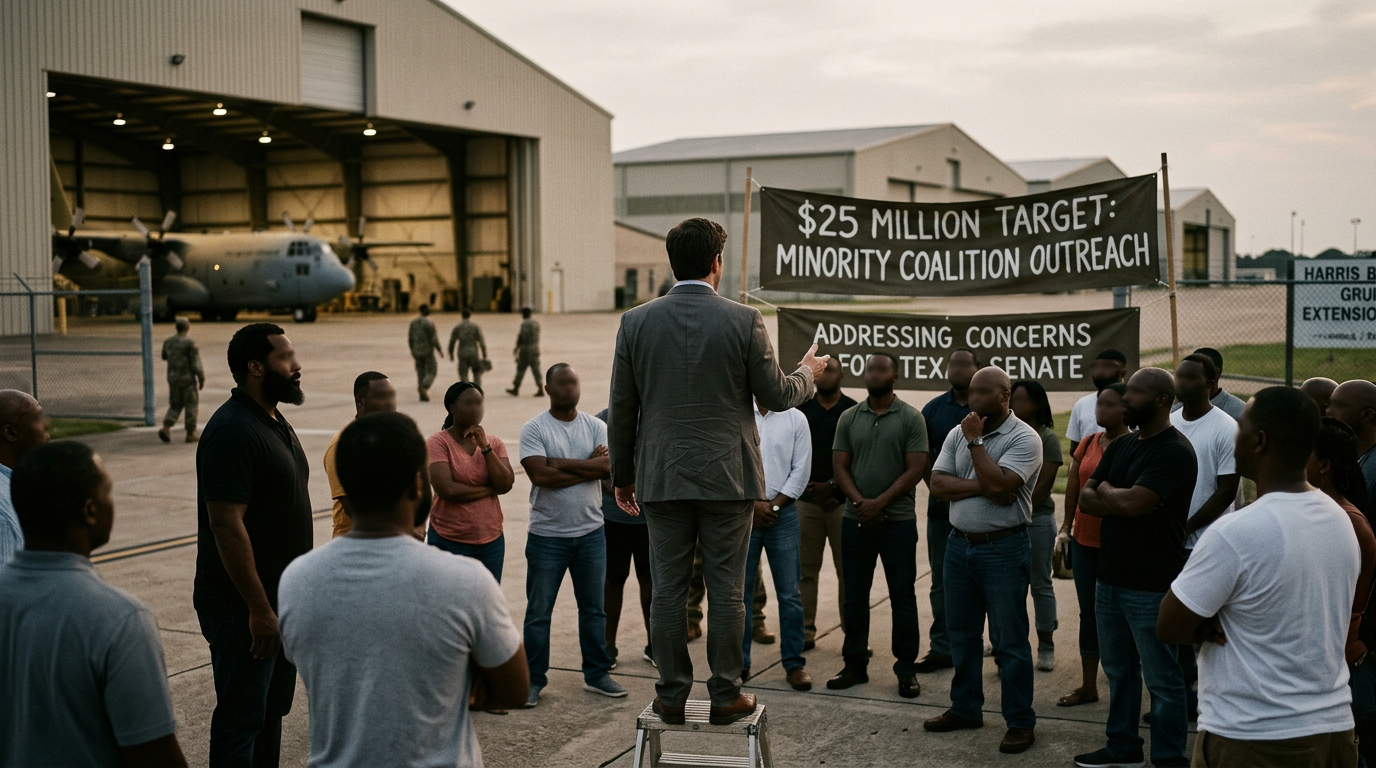
State Representative James Talarico, the 2026 Democratic nominee for the United States Senate, announced a massive $25 million financial commitment toward engaging Black voters during a public gathering in Houston. The event, held in late July 2026, highlighted internal friction within the party's coalition as voters expressed skepticism regarding the candidate's strategy and historical presence in their communities. Talarico’s pledge serves as a direct response to suggestions that his campaign has not yet done enough to earn the loyalty of essential voting blocs in urban centers like Harris County. The town hall event took an unexpected turn when local participants and political influencers addressed the candidate directly regarding the necessity of their support. Advocacy for specific policy outcomes and more visible representation dominated the discussion, forcing the campaign to pivot from general messaging to a specific budgetary promise. This commitment represents one of the largest single-demographic outreach investments ever recorded for a statewide Democratic campaign in the Lone Star State. Historically, Texas candidates have often prioritized broad media buys over targeted neighborhood-level field operations, a trend Talarico now seeks to reverse with this eight-figure allocation.
Texas relevance
This development is central to the political landscape of Texas because Houston remains the largest source of Democratic votes in the state. For any candidate seeking to win a statewide office in Texas—a feat no Democrat has achieved since 1994—the engagement of the state's diverse urban population is a mathematical necessity. The friction witnessed in Houston reflects a broader debate within Texas politics regarding how much candidates should focus on swing voters versus solidifying their existing base in metropolitan areas like the Third Ward and surrounding Harris County communities.
Direct Confrontations at the Houston Forum
The Houston town hall served as a flashpoint for long-simmering frustrations among community organizers who feel overlooked by high-level statewide campaigns. One notable exchange featured Alana Flowers, a political content creator, who explicitly told the candidate that the Democratic path to victory is non-existent without intensive and respectful engagement of the Black community. This sentiment was echoed by several other attendees who questioned why major resource commitments were only surfacing now that the general election cycle is in full swing.
Talarico’s platform, which generally focuses on public education and economic reform, was momentarily sidelined as the candidate had to defend his campaign’s internal structure. Voters inquired about the diversity of his management team and his past performance in the Texas Legislature. The audience demanded more than just talking points, leading to the specific $25 million promise. This money is reportedly intended for localized grassroots organizing, canvassing, and targeted advertising within minority-majority districts.
Breaking Down the $25 Million Commitment
The proposed $25 million expenditure marks a significant portion of Talarico’s projected campaign budget for the 2026 cycle. While statewide races in Texas often cost upwards of $100 million total, directing a quarter of that toward a single outreach initiative is a bold and potentially risky move. The campaign has not yet released a line-item breakdown, but the commitment involves staffing local field offices that will operate year-round rather than just in the weeks leading up to November.
By focusing on 'voter outreach' specifically, the Talarico campaign is acknowledging that their biggest hurdle in Texas is not necessarily persuasion, but turnout. The Democratic party has historically struggled with low voter participation in Texas compared to other large states. The $25 million is designed to build a infrastructure that can physically reach voters at their doorsteps in Houston, Dallas, San Antonio, and Austin, ensuring that the candidate’s message survives the noise of a crowded election cycle.
The Importance of the Harris County Vote
Harris County is the primary engine for the Democratic party in Texas, and any sign of weakness here could be fatal for Talarico’s Senate aspirations. During the town hall, speakers reminded the candidate that Harris County voters are tired of being treated as a reliable 'bank' of votes that receives little in the way of legislative attention. The criticism focused on the perception that the campaign has spent more time courting rural voters than listening to the concerns of urban residents.
Talarico responded by emphasizing his commitment to civil rights and economic equity, but the audience remained focused on the tangible benefits his election would bring to their specific neighborhoods. The $25 million pledge was the most concrete response provided to these concerns, though some attendees noted that spending money is not the same as spending time. The campaign now faces the challenge of following through on these promises before the registration deadlines arrive.
Historical Context of Texas Senate Races
The last several Senate cycles in Texas have seen Democratic candidates come within single digits of their Republican counterparts, most notably in 2018. However, stagnating growth in urban turnout has often been cited as the reason these campaigns fell short in the final tally. Talarico’s strategy appears to be a direct attempt to fix the 'turnout gap' that hindered previous nominees. By investing early and heavily in Houston, he is attempting to secure his base before moving to capture independent voters.
Comparatively, Republican statewide campaigns in Texas have long benefited from a highly disciplined and well-funded turnout machine in rural counties. Talarico’s $25 million plan is an effort to replicate that level of organizational saturation in the cities. If successful, it could set a new standard for how Texas Democrats allocate their funds, moving away from high-priced television consultants toward local ground operations.
Addressing Representation and Diversity
Beyond the financial commitment, the Houston meeting focused heavily on representation within the Talarico campaign itself. Voters asked specifically about who would be managing the $25 million and whether the vendors hired would be from the communities they are meant to target. Talarico assured the crowd that his team reflects the diversity of the state, though he did not provide specific names or titles during the open forum.
The conversation highlighted a growing trend in Texas politics where voters are no longer satisfied with being the target of ads; they want to be part of the decision-making process. This shift in expectation is forcing candidates to be more transparent about their internal operations. Talarico’s performance in Houston will likely be seen as a test case for how future statewide candidates handle increasingly vocal and demanding constituent bases.
Analysis
OPINION: The $25 million pledge by James Talarico is a clear signaling mechanism intended to quell a burgeoning rebellion within his own ranks. By putting a hard number on outreach efforts, the campaign is attempting to commodify 'trust' through financial resource allocation. However, the tension displayed during the Houston event suggests that the challenge for the nominee is not merely a lack of funding, but a perceived lack of authentic connection. The reality of Texas politics is that the 'big tent' often struggles with the weight of competing priorities; Talarico is betting that a record-breaking financial investment can bridge the gap between policy goals and community presence.
Source attribution
This story was reported using a public release from the Texas Tribune. Keep TX Red rewrote the coverage independently and links to the official statement for verification.
Frequently Asked Questions
- What prompted James Talarico to pledge $25 million for voter outreach?
- The pledge was made during a town hall in Houston's Third Ward after voters and influencers confronted Talarico about his campaign strategy. The attendees expressed concern that his campaign was not doing enough to engage or invest in the communities whose votes are essential for a Democratic victory in Texas.
- How does this spending compare to previous Texas campaigns?
- A $25 million commitment to a specific demographic outreach program is considered record-breaking for a Texas Democratic statewide candidate. Usually, such large sums are reserved for general market television and digital advertising rather than localized field work and community engagement.
- Was the Houston town hall considered a success for the candidate?
- While the event allowed Talarico to announce a major funding initiative, it was characterized by 'tense' moments and direct challenges from the audience. The long-term success will depend on whether the candidate successfully deploys the promised funds and improves his standing with Houston voters before the 2026 election.
Official Sources
Take the next step
Browse the Newsroom →Read more about Keep Texas Red → Our full guide to what Keep Texas Red means and why Texans support it.
Get Texas updates delivered weekly.
Independent Texas reporting on politics, policy, and daily life. One email a week. Unsubscribe anytime.
Keep TX Red Newsroom
The Keep Texas Red Editorial Staff produces nonpartisan explainers, policy breakdowns, and educational resources to help Texans understand how their government works. All content is reviewed for accuracy and updated regularly.
About Keep TX Red →