Suburban Migration Trends Reshape North Texas as Dallas Faces Economic Flight
Dallas faces a significant shift as residents, professional sports teams, and corporations move to suburbs like Frisco and Arlington.
Editorial disclaimer: Opinions and analysis on Keep TX Red are editorial content — not statements of fact. See our editorial standards.
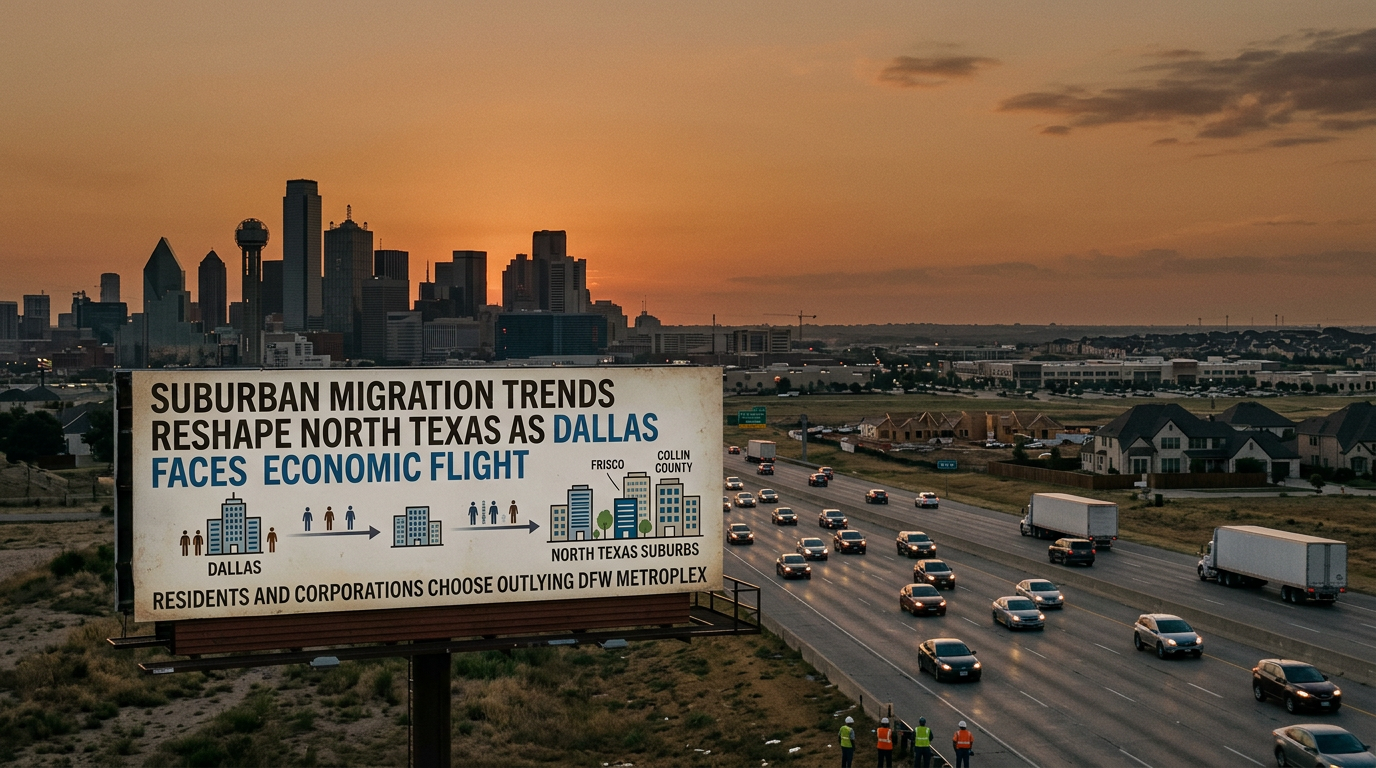
The historical heart of North Texas is experiencing a period of significant demographic and corporate transition. For decades, the City of Dallas served as the undisputed engine of the DFW Metroplex, centralizing industry, culture, and residential density. However, recent data and shifting local trends indicate that the city is now seeing a steady departure of its traditional assets. Residents are Increasingly choosing the outlying suburbs for perceived safety and school quality, while major corporations are finding more favorable tax environments and infrastructure in the satellite cities that once relied on Dallas for their own growth. This phenomenon reflects a broader national trend but is uniquely amplified by the rapid expansion of the Texas population and the aggressive competitiveness of local municipalities. Historically, Dallas grew by annexing adjacent land and serving as the primary commercial hub, but the finite boundaries of the city limits now force it to compete on quality of life and municipal efficiency against younger, well-funded suburban rivals. This migration is not merely limited to individuals; it encompasses major institutional fixtures, including professional sports entities and Fortune 500 headquarters, which are relocating their operations to more modern facilities just outside the city proper. As these entities depart, the tax base faces new pressures, forcing city leadership to reconsider how Dallas can remain a viable anchor in a region that is becoming increasingly decentralized.
Texas relevance
This shift is a critical focal point for the Texas economy, as the Dallas-Fort Worth area is one of the fastest-growing metropolitan regions in the United States. In the context of the Texas 'miracle' of economic growth, the internal movement from urban cores to suburban rings like Collin and Denton counties reshapes local governance and infrastructure priorities. For Texas residents, this means a shift in where property tax revenue is generated and where the state must allocate transportation funding to accommodate commuting patterns that no longer exclusively lead to a single downtown center. The movement highlights a competitive brand of localism within the Lone Star State, where cities like Frisco, Plano, and Irving are actively bidding against their larger neighbor for economic dominance.
The Corporate Exodus to the Suburbs
One of the most visible indicators of the shift is the departure of major corporate headquarters and office hubs. For years, the skyscrapers of downtown and uptown Dallas were the gold standard for Texas business. Today, however, the trend has shifted toward the 'Platinum Corridor' and sprawling corporate campuses in cities like Frisco and Plano. These suburban hubs offer massive tracts of land that allow for horizontal, campus-style developments which are more popular with modern workforce requirements than traditional vertical office towers.
Companies are often lured away by significant tax incentives and a more cooperative regulatory environment. These moves are not just about finding a cheaper place to do business; they are about positioning companies closer to where their executive talent and professional staff prefer to live. As more high-income earners move north of the city limits, companies are following them to reduce commute times and improve employee retention in a highly competitive Texas labor market.
The impact of these moves on the city’s tax revenue cannot be overstated. When a Fortune 500 company leaves Dallas for an outlying suburb, it takes with it thousands of high-paying jobs and the secondary economic activity that supports local small businesses. This creates a vacuum in the urban core that is difficult to fill, especially as telecommuting further reduces the necessity for traditional office presence in the heart of the city.
The Relocation of Professional Sports and Entertainment
Dallas has traditionally been the cultural and sporting center of the region, but that status is being challenged by the movement of iconic franchises and facilities. The relocation of the Texas Rangers and the Dallas Cowboys' headquarters to Arlington and Frisco, respectively, served as early warnings of this trend. Now, discussions surrounding the future of the Dallas Mavericks and the Stars suggest that even the remaining downtown staples are considering their options in the more spacious and modern suburbs.
The suburbs offer more than just land; they offer specific entertainment districts designed to keep visitors on-site long after the game ends. Developments like The Star in Frisco and Texas Live! in Arlington provide a blueprint for how sports can anchor a wider commercial ecosystem. These projects attract tourism and sales tax revenue that Dallas is finding increasingly hard to capture with its older stadium infrastructure and land-locked downtown areas.
Losing these teams is a blow to the city's identity and its branding. While the teams often keep the 'Dallas' name for international recognition, the actual economic benefits—such as property taxes, job creation in hospitality, and local spending—flow into the coffers of suburban municipalities. This creates a scenario where Dallas provides the brand, but its neighbors reap the fiscal rewards.
Public Safety and Education as Primary Drivers
The decision for families to leave Dallas often centers on two fundamental issues: public safety and the quality of local schools. While the Dallas Independent School District has made strides in recent years, it continues to compete with highly-rated suburban districts that are a major draw for young families. In Texas, where school choice and district reputation are paramount to property values, the perceived superiority of suburban schools acts as a powerful magnet pulling taxpayers out of the city.
Safety concerns likewise play a role in the residential migration. Despite varied efforts to increase police presence, perceptions of rising crime in urban centers compared to the relatively quiet suburban streets of North Texas drive many to seek housing elsewhere. Families are looking for environments where they feel their children are safe and where their investment in a home is protected by stable or improving neighborhood conditions.
This demographic shift has led to a 'doughnut effect' where the wealth is concentrated in a ring around a more economically challenged center. To combat this, Dallas has attempted to revitalize inner-city neighborhoods through gentrification and high-density luxury apartments, but these efforts have not yet been enough to offset the volume of residents moving to the single-family suburban sprawl.
Infrastructure Challenges and Transportation Shifts
The sprawling nature of the DFW region has necessitated a massive investment in highways and tollways, which paradoxically has made it easier for people to live further away from Dallas. The expansion of the North Texas Tollway Authority's network has opened up northern Collin County for development, allowing for a commute that, while long, is facilitated by high-quality road infrastructure.
Dallas itself struggles with an aging internal infrastructure that was built for a different era. Rebuilding city streets and maintaining complex water and sewage systems in a densely packed environment is significantly more expensive than building new systems on greenfield land in the suburbs. This cost disparity puts the city at a constant disadvantage when attempting to modernize and compete for new residents.
Furthermore, the decentralization of work means that traditional transit models, like the DART rail system which radiates from the center of Dallas, are becoming less efficient for the modern commuter. Many North Texans now work and shop entirely within the suburban ring, rarely needing to enter the Dallas city limits. This bypasses the city's economy entirely and places more pressure on the state to fund bypasses and outer loops rather than inner-city transit.
Looking to the Future: The Fight for Revitalization
To reverse the trend, Dallas must leverage its unique assets that the suburbs cannot easily replicate. This includes a robust arts district, a central historical identity, and the density required for a vibrant, walkable nightlife. However, creating an environment that appeals to more than just young professionals requires a holistic approach to city management that prioritizes basic services and affordability for middle-class families.
The city is currently at a crossroads. It can either accept a role as just one of many commercial nodes in a vast North Texas megacity, or it can reform its regulatory and safety environment to win back the trust of the business community. This will likely require significant changes in municipal policy, including streamlining development codes and focusing on core competencies like crime reduction and street maintenance.
If Dallas fails to adapt, the region will continue to grow, but Dallas's influence within that region will continue to wane. The 'bleeding' described by observers is a symptom of a broader shift in the American South, where the new 'cities' are often collections of suburbs rather than a single urban core. The next decade will determine if Dallas can reclaim its position as the undisputed leader of the Metroplex.
Analysis
From a fiscal conservative perspective, the migration away from Dallas serves as a market-driven critique of urban governance. While suburban cities often offer streamlined permitting processes and lower crime rates, the core of Dallas has struggled with aging infrastructure and public safety concerns. The 'bleeding' of companies and residents is a clear signal that the prestige of a Dallas address is no longer sufficient to outweigh the functional benefits of the surrounding municipalities. It is incumbent upon Dallas leadership to address systemic efficiency if they wish to stem the tide. If the city continues to lose its most productive residents and businesses, the burden of maintaining city services will fall on a shrinking population, potentially leading to the very cycle of tax increases and service cuts that accelerated the decline of other major American urban centers in the late 20th century.
Source attribution
This story was reported using a public release from the r/texas. Keep TX Red rewrote the coverage independently and links to the official statement for verification.
Frequently Asked Questions
- Which cities are gaining the most from the movement out of Dallas?
- Cities in Collin and Denton counties, such as Frisco, Plano, McKinney, and Prosper, have seen the most significant gains in population and corporate investment. Additionally, Arlington continues to grow as a regional entertainment and sports hub.
- Why are professional sports teams leaving the city limits?
- Suburban municipalities often offer more land for multi-use 'entertainment districts' and lucrative tax incentives. These locations also place the teams closer to their primary season-ticket-holding demographics in the wealthier northern suburbs.
- How does this migration impact property taxes for Texas residents?
- As wealth and business activity move to the suburbs, those municipalities see an increase in their tax base, which can lead to better services or lower rates for their residents. Conversely, Dallas faces the challenge of maintaining older infrastructure with a potentially stagnating or declining tax base.
Official Sources
Take the next step
Browse the Newsroom →Read more about Keep Texas Red → Our full guide to what Keep Texas Red means and why Texans support it.
Get Texas updates delivered weekly.
Independent Texas reporting on politics, policy, and daily life. One email a week. Unsubscribe anytime.
Keep TX Red Newsroom
The Keep Texas Red Editorial Staff produces nonpartisan explainers, policy breakdowns, and educational resources to help Texans understand how their government works. All content is reviewed for accuracy and updated regularly.
About Keep TX Red →