Austin Pride Crosswalks Removed Under New State Safety Directives
Austin's rainbow crosswalks at Fourth and Colorado Streets are removed following a statewide TxDOT directive requiring uniform roadway markings.
Editorial disclaimer: Opinions and analysis on Keep TX Red are editorial content — not statements of fact. See our editorial standards.
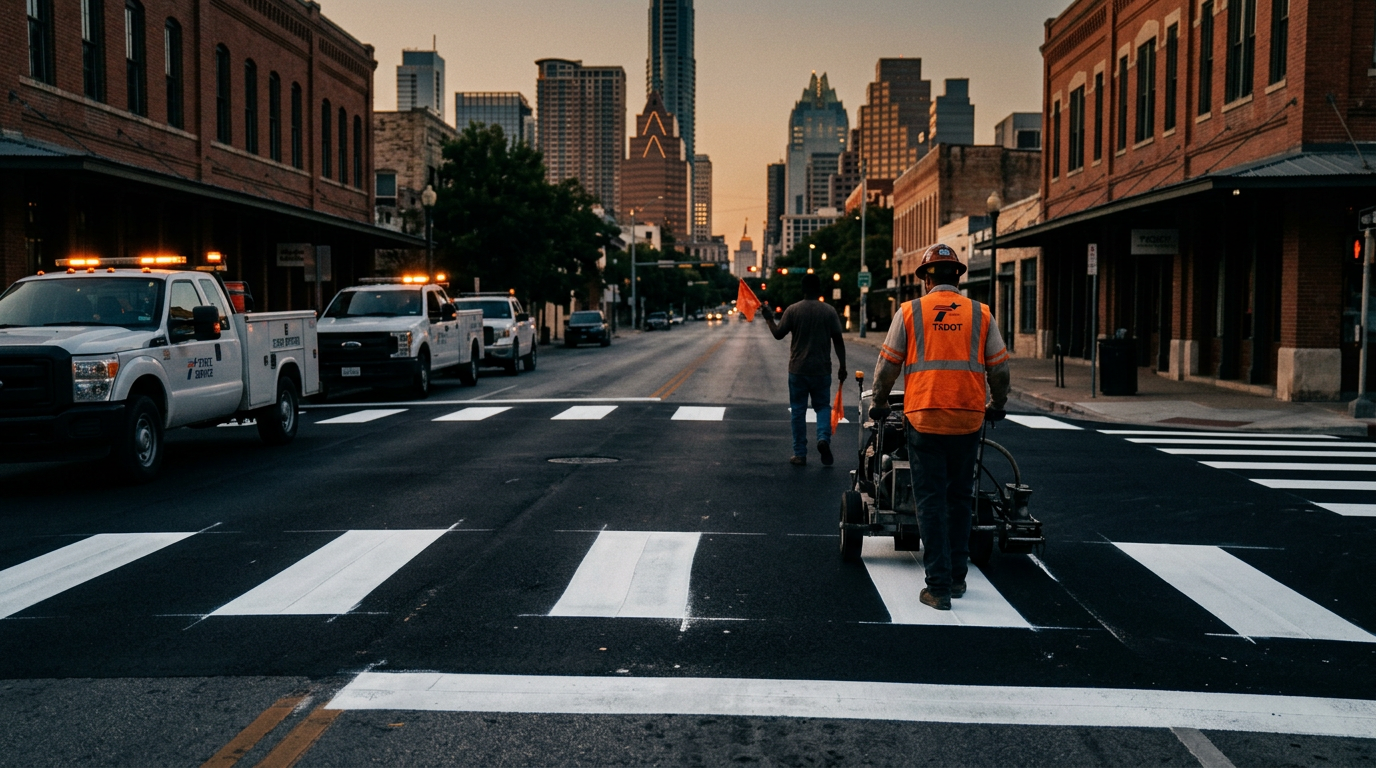
The familiar colorful aesthetic of Fourth and Colorado Streets in downtown Austin has been replaced by standard asphalt and regulatory white stripes. The Texas Department of Transportation (TxDOT) recently finalized the removal of the city's Pride crosswalks, an installation that had served as a landmark for the local LGBTQ+ community for several years. This action follows a systematic review of non-standard road markings across the state, initiated to ensure that all public thoroughfares adhere strictly to federal and state safety guidelines. Historically, Texas cities have occasionally integrated artistic elements into infrastructure, but recent administrative shifts have prioritized uniformity to prevent legal liability and driver confusion. The removal in Austin marks the final stage of a broad enforcement action targeting decorative pavement markings that do not conform to the Manual on Uniform Traffic Control Devices (MUTCD). While the city had previously maintained these markings as a symbol of inclusivity, state authority over designated routes took precedence, leading to the work crews arriving to resurface the intersection in mid-July.
Texas relevance
This development is a significant moment for Texas municipal governance, as it highlights the jurisdictional tension between city-led cultural initiatives and state-level safety regulations. Austin, often seen as a progressive hub within the state, has frequently clashed with state agencies over the use of public space. The removal of these specific crosswalks at Fourth and Colorado is particularly impactful because this intersection serves as the gateway to the city’s warehouse district, a core economic and social zone for Austin residents. Beyond the cultural aspect, the enforcement by TxDOT signals a broader trend across Texas where state agencies are reasserting control over infrastructure that was previously subject to local creative discretion. For Texans in other major metros like Dallas or Houston, this sets a firm precedent regarding the longevity of 'street art' installations on state-maintained roadways.
Standardization and Federal Compliance
The primary justification provided for the removal of the decorative crosswalks centers on the Manual on Uniform Traffic Control Devices. This manual serves as the national standard for all traffic control devices, including signs, signals, and pavement markings. Texas, through TxDOT, adopts these standards to ensure that a driver from any part of the country can safely navigate Texas roads without encountering unexpected or confusing visual stimuli.
Non-standard markings, such as the rainbow stripes in Austin, are often cited by safety experts as potential hazards. The concern is twofold: first, that vibrant colors may distract drivers or pedestrians; and second, that they may not provide the necessary reflectivity at night compared to standard white or yellow thermal plastic markings. By reverting to the standard design, the state argues it is mitigating risks that could lead to accidents or legal challenges against the department.
Furthermore, the rise of Advanced Driver Assistance Systems (ADAS) in modern vehicles has changed the landscape of road maintenance. These systems are programmed to recognize specific patterns. When a city introduces artistic variations, it can potentially interfere with the sensors used by vehicles for lane-keeping and emergency braking. TxDOT’s insistence on uniformity is partly a proactive measure to accommodate these technological shifts in the Texas transportation network.
Local Jurisdiction vs. State Authority
A recurring theme in Texas politics is the friction between the state government and the local municipalities that govern the big cities. In the case of the Austin crosswalks, the city originally installed the art with the intention of fostering a sense of place and supporting its vibrant tourism industry. However, because Fourth Street and Colorado Street intersect in a manner that falls under certain state-controlled classifications or funding streams, TxDOT maintained the ultimate right of way.
The directive for removal was not exclusive to Austin. Several other Texas cities have faced similar orders to remove 'creative' crosswalks or decorative signage that strayed too far from the black-and-white letter of the law. This reflects a broader philosophy currently held in the Texas Capitol: that infrastructure should remain neutral ground, focused entirely on the utility of transportation rather than social expression.
Local officials in Austin have expressed disappointment, noting that the crosswalks had become part of the city's unique charm and a draw for visitors. Despite this, the city was forced to comply or risk losing state funding for future infrastructure projects. The removal process was swift, with contractors grinding down the existing paint and applying fresh asphalt to create a blank canvas for the new, standardized markings.
Historical Context of the Installation
The Pride crosswalks were first installed in the mid-2010s during a period of rapid expansion in Austin’s downtown district. At the time, the project was seen as a collaborative effort between the city’s transportation department and local community groups. It was meant to celebrate the history of the warehouse district, which has long served as a safe haven and cultural center for the LGBTQ+ community in Texas.
For nearly a decade, these crosswalks were a staple of Austin’s visual identity, frequently appearing in tourism brochures and social media posts. The durability of the paint was often a topic of maintenance discussions, but the symbolic value of the installation remained high. As Austin grew into a major tech hub, the crosswalks served as a reminder of the city's roots in social advocacy and diverse community building.
The decision to remove them now marks the end of an era for that specific intersection. While the city may look for alternative ways to honor its diverse population—perhaps through murals on private buildings or plaques—the roadway itself has been reclaimed as a purely functional space. This transition reflects the changing priorities of state administrators who are increasingly focused on rigid adherence to bureaucratic standards over local historical markers.
Impact on the Warehouse District
The Warehouse District is one of the most economically active parts of Austin, hosting dozens of bars, restaurants, and tech offices. The intersection of Fourth and Colorado is a high-traffic area, particularly on weekends. Residents and business owners in the area have voiced concerns that the removal of the landmarks may detract from the district’s aesthetic appeal, which is a major factor in its commercial success.
Some business owners worry that the homogenization of downtown Austin will make it harder to differentiate the city from other metropolitan areas. They argue that the 'Keep Austin Weird' spirit is being eroded by state mandates. Conversely, other stakeholders have expressed relief that the intersection will now have more visible and traditional markings, which they believe will improve pedestrian safety during late-night hours when foot traffic is at its peak.
The logistical impact of the removal was felt immediately, as crews blocked off sections of the street to perform the work. The cost of the removal and the re-application of standard markings is being handled through state-allocated maintenance budgets. As the dust settles, the district is adjusting to a more conventional appearance, focusing on the future of development in the area rather than the artistic legacy of its pavement.
Future of Public Art on Texas Roads
This event serves as a warning for other Texas cities currently considering similar public art projects. The message from TxDOT is clear: if an art project is placed directly on the driving surface of a road, it is subject to removal if it does not meet strict federal guidelines. Moving forward, cities are likely to pivot toward 'sidewalk art' or 'vertical art' (such as sculptures or light pole banners) to avoid the jurisdiction of state transportation regulators.
In cities like San Antonio and El Paso, there have been discussions about creating cultural corridors using pavement markings. The Austin precedent likely puts those plans on hold. Experts suggest that for public art to survive in Texas, it must be integrated into the surrounding environment rather than the infrastructure itself. This shift will require more coordination with private landowners and developers to ensure that community symbols remain visible without violating state laws.
The debate over the Austin crosswalks will likely continue in the halls of the Texas Legislature. Some lawmakers may see this as a victory for public safety and the rule of law, while others may view it as an unnecessary intrusion into local affairs. Regardless of the political outcome, the physical landscape of Austin has been permanently altered, signaling a new chapter in how Texas manages its public spaces.
Analysis
OPINION: The removal of the Pride crosswalks can be viewed through two distinct lenses. From a regulatory standpoint, TxDOT is fulfilling its mission to eliminate distractions and maintain consistency in how traffic signals and markings are communicated to drivers. In an era of increasing autonomous vehicle technology, which relies on high-contrast, standardized markings for navigation, uniformity is an objective safety requirement. However, from a community perspective, the move is being interpreted by local activists as a targeted erasure of regional identity. The timing of the removal, coordinated via a state directive, underscores the ongoing power struggle between the Texas state government and its capital city. While the state argues for safety and liability reduction, the local reaction highlights a deep-seated frustration with the perceived micromanagement of Austin's downtown culture.
Source attribution
This story was reported using a public release from the r/austin. Keep TX Red rewrote the coverage independently and links to the official statement for verification.
Frequently Asked Questions
- Why were the crosswalks removed?
- The crosswalks were removed because they did not comply with the Manual on Uniform Traffic Control Devices (MUTCD). TxDOT requires all roadway markings to be standardized (typically white or yellow) to ensure visibility, safety, and predictability for all drivers, including those using automated driving systems.
- Will the Pride crosswalks be reinstalled elsewhere?
- While they cannot be reinstalled on the roadway surface of state-maintained streets, the City of Austin or private organizations could potentially install similar art on sidewalks, private property, or internal plaza areas that are not subject to TxDOT safety regulations.
- Is this removal unique to Austin?
- No, this is part of a broader statewide effort by TxDOT to bring all Texas roadways into compliance with federal standards. Other cities with non-standard pavement markings have received or will receive similar directives to remove them.
Official Sources
Take the next step
Browse the Newsroom →Read more about Keep Texas Red → Our full guide to what Keep Texas Red means and why Texans support it.
Get Texas updates delivered weekly.
Independent Texas reporting on politics, policy, and daily life. One email a week. Unsubscribe anytime.
Keep TX Red Newsroom
The Keep Texas Red Editorial Staff produces nonpartisan explainers, policy breakdowns, and educational resources to help Texans understand how their government works. All content is reviewed for accuracy and updated regularly.
About Keep TX Red →