Texas Rep. James Talarico Faces Questions on Racial Trust During Austin Town Hall Meeting
Texas Rep. James Talarico faced sharp criticism from constituents during a July town hall, highlighting deep divisions over race and representation.
Editorial disclaimer: Opinions and analysis on Keep TX Red are editorial content — not statements of fact. See our editorial standards.
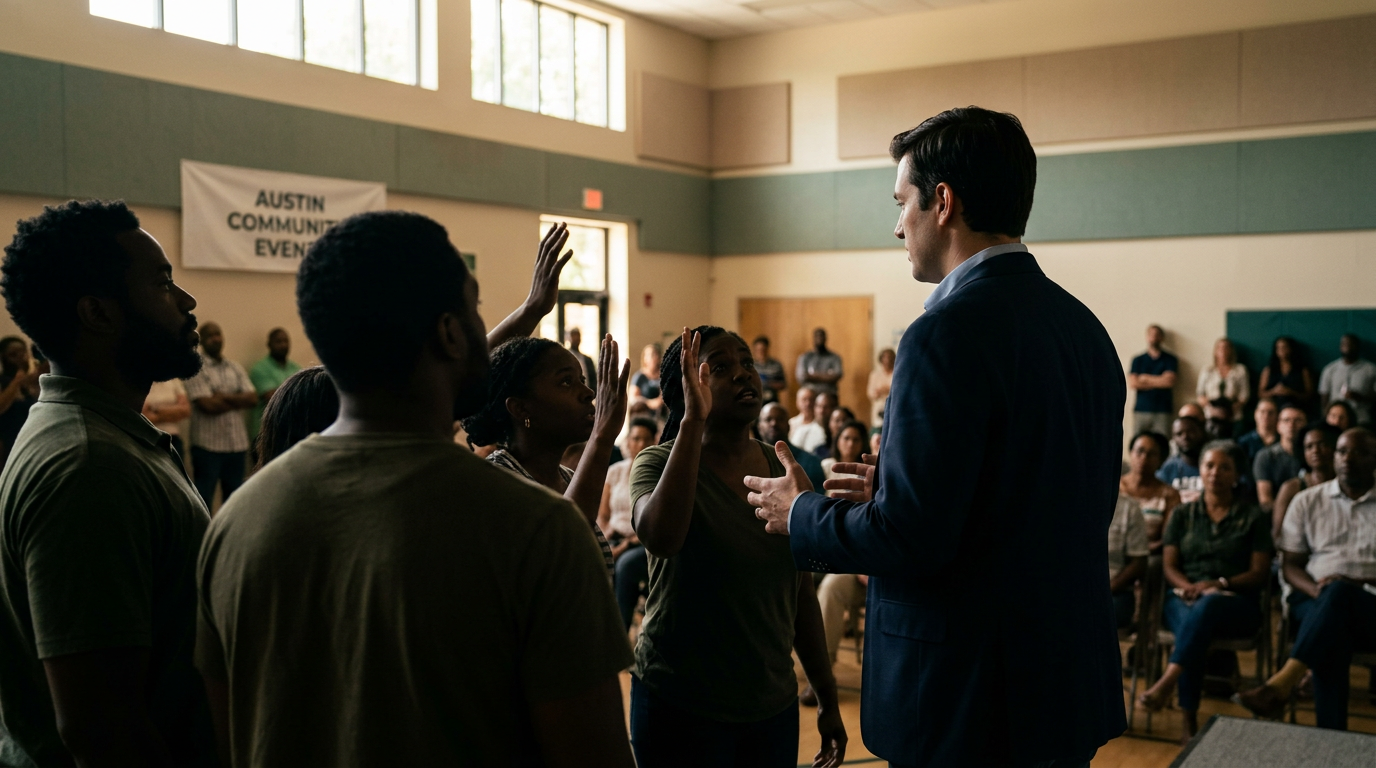
State Representative James Talarico, often viewed as a rising star within the Texas Democratic Party, faced an unexpectedly hostile reception during a recent constituent town hall meeting in late July 2026. What was intended as a routine legislative update quickly transitioned into a rigorous debate over representation, racial equity, and the perceived disconnect between elected officials and minority communities. The dialogue grew notably tense when community members directly challenged the Representative’s record and his ability to authentically represent the interests of Black Texans. This event serves as a milestone in the ongoing friction between the progressive wing of the Texas legislature and the base of voters who feel their specific cultural and economic needs are being sidelined for broader political theater. Historically, town halls in the Austin and Round Rock areas have been platforms for policy discussion regarding school finance and property tax relief, two areas where Talarico has built his reputation. However, the shift in tone reflects a broader national and statewide trend where voters are demanding more than just legislative competence; they are seeking deep-seated trust and accountability. Previously, Talarico gained prominence for his role in the 2021 quorum break where he and other Democrats fled to Washington D.C. to block voting legislation. While that move earned him national headlines, some local constituents now suggest that such high-profile stunts have not translated into tangible improvements for minority neighborhoods within his district.
Texas relevance
This incident is deeply relevant to Texas politics as it highlights the internal pressures facing the Texas Democratic caucus in urban and suburban hubs like Austin and Round Rock. Representative Talarico represents a district that bridges the gap between Travis and Williamson counties, areas that have seen massive demographic shifts over the last decade. As Texas continues to experience rapid population growth, the demands on representatives to address localized racial disparities become more acute. The skepticism displayed by constituents in this meeting suggests that the 'blue wave' coalition in Texas is not a monolith and that leaders must navigate complex intra-party dynamics to maintain support heading into the next legislative cycle.
The Origin of the Conflict
The tension at the town hall did not emerge in a vacuum. Over the past two years, activists in the Austin area have grown increasingly vocal about the impacts of gentrification and the perceived lack of legislative protection for historic minority neighborhoods. Many attendees at the meeting expressed frustration that while Talarico is often visible on national television discussing broad social issues, he has been less present in the specific trenches of local community disputes regarding housing and policing.
One of the primary grievances voiced during the session revolved around the concept of trust. A constituent stood to directly inform the Representative that there is a significant portion of the Black community that simply does not trust his motives or his legislative priorities. This sentiment reflects a larger debate in Texas politics regarding whether 'representative democracy' requires representatives who share the lived experiences and racial backgrounds of their primary voting blocs.
Legislative Record vs. Community Perception
James Talarico has spent much of his time in the Texas House focusing on education reform and the integration of faith into public service. He has been a vocal critic of Christian Nationalism, a stance that has won him praise from secular and progressive groups across the state. However, during the town hall, critics pointed out that these ideological battles often overshadow bread-and-butter issues like minority business grants and specific criminal justice reforms that impact the Black community directly.
The gap between a legislator's statewide brand and their local impact is a common theme in Texas politics. For Talarico, who represents a district that was heavily gerrymandered in the last redistricting cycle, the challenge is twofold. He must appeal to the liberal residents of North Austin while also retaining the trust of the suburban families in Round Rock. The town hall suggests that his current strategy may be leaving the most vulnerable members of his coalition feeling ignored.
The Role of Identity in Modern Texas Districts
As Texas cities expand, the traditional boundaries of political districts are shifting. Districts that were once reliably conservative are becoming 'purple,' and previously deep-blue urban centers are seeing internal shifts. In this environment, the identity of the politician becomes a focal point of voter scrutiny. The Austin town hall incident underscores the difficulty white politicians face when trying to lead movements that are centered on the experiences of people of color.
The constituents who challenged Talarico were not necessarily questioning his voting record, which aligns with most Democratic platform positions. Instead, they were questioning his proximity to the issues. They argued that a representative who does not live the daily reality of racial discrimination cannot fully comprehend or advocate for the solutions needed to dismantle systemic barriers in the Lone Star State.
Reactions from the Texas Democratic Party
Within the larger Texas Democratic Party, the Talarico incident is being viewed with caution. Party leaders are wary of any public displays of disunity, especially in a state where the Republican majority remains formidable. The concern is that if popular figures like Talarico cannot maintain the trust of their minority base, the party’s path to a statewide majority becomes even more narrow.
Some fellow legislators have come to Talarico’s defense, citing his work on school funding and his efforts to expand healthcare access. However, others privately acknowledge that the party has spent years taking the votes of Black and Hispanic Texans for granted. This town hall may serve as a wake-up call for the party infrastructure to invest more time in direct community engagement rather than relying on top-down messaging strategies.
Future Implications for Talarico’s Career
For Talarico, this event could be a defining moment. He has long been rumored to have ambitions for the U.S. Senate or the Texas Governor’s mansion. To succeed in a statewide race, a candidate must be able to mobilize a diverse coalition of voters. If he cannot resolve the trust issues within his own district, his ability to campaign effectively in places like Houston’s Third Ward or Dallas’s South Side will be severely diminished.
Moving forward, Talarico likely needs to pivot his communication style. The 'preacher-politician' model he has adopted may resonate with certain progressives, but it clearly faced resistance from those looking for concrete policy wins rather than moralizing speeches. His response to this criticism in the coming months will determine whether this town hall was a temporary setback or a sign of an irreparable fracture.
The Broader Landscape of Texas Town Halls
This is not the first time a Texas legislator has faced a 'hot' town hall. In recent years, both Republican and Democratic members have been confronted by angry constituents over issues ranging from property taxes to border security. However, the specific focus on racial trust distinguishes this event from the usual partisan bickering. It suggests that the voters are increasingly focused on the quality of their representation rather than just the party label.
The outcome of this confrontation will likely influence how other Texas legislators conduct their community outreach. There is a growing trend toward 'micro-town halls' or smaller, invite-only events to avoid the viral moments of conflict seen in Austin. Yet, for a democracy to function, these raw and uncomfortable public dialogues are often necessary to bring hidden grievances to the surface.
Analysis
The confrontation at the town hall suggests a growing 'authenticity gap' that many white progressive politicians face in increasingly diverse Texas districts. James Talarico has often used his background as a former teacher to frame himself as a champion for the underprivileged. However, the pushback from the Black community during this event indicates that rhetorical flourishes about 'equity' may no longer be sufficient for a voter base that feels underserved by the current legislative status quo. If Talarico intends to seek higher office—such as a statewide run—he will need to reconcile the divide between his public persona and the specific grievances of minority voters who feel their voices are being instrumentalized rather than genuinely heard.
Source attribution
This story was reported using a public release from the r/texas. Keep TX Red rewrote the coverage independently and links to the official statement for verification.
Frequently Asked Questions
- Which district does James Talarico represent?
- James Talarico represents Texas House District 50, which includes parts of Travis and Williamson counties, covering areas like North Austin and Round Rock.
- What specifically caused the tension at the town hall?
- Constituents expressed that they did not feel heard on local issues and explicitly stated that the Black community had a lack of trust in Talarico's leadership and motives.
- Has Talarico responded to the criticism?
- During the meeting, Talarico attempted to listen to the grievances, but the exchange remained heated. He has since emphasized his commitment to learning from the community and continuing his work on education and equity.
- Why is this significant for the Texas Democratic Party?
- It signals potential fractures in the party's most loyal voting base, suggesting that candidates must do more than just follow the party line to maintain minority support.
Official Sources
Take the next step
Browse the Newsroom →Read more about Keep Texas Red → Our full guide to what Keep Texas Red means and why Texans support it.
Get Texas updates delivered weekly.
Independent Texas reporting on politics, policy, and daily life. One email a week. Unsubscribe anytime.
Keep TX Red Newsroom
The Keep Texas Red Editorial Staff produces nonpartisan explainers, policy breakdowns, and educational resources to help Texans understand how their government works. All content is reviewed for accuracy and updated regularly.
About Keep TX Red →