Port of Brownsville: $3.2 Billion Autonomous Shipyard Expansion Unveiled
Governor Abbott announces Saronic Technologies will build 'Port Alpha' in Brownsville, creating 10,000 jobs and investing $3.2 billion in Texas.
Editorial disclaimer: Opinions and analysis on Keep TX Red are editorial content — not statements of fact. See our editorial standards.
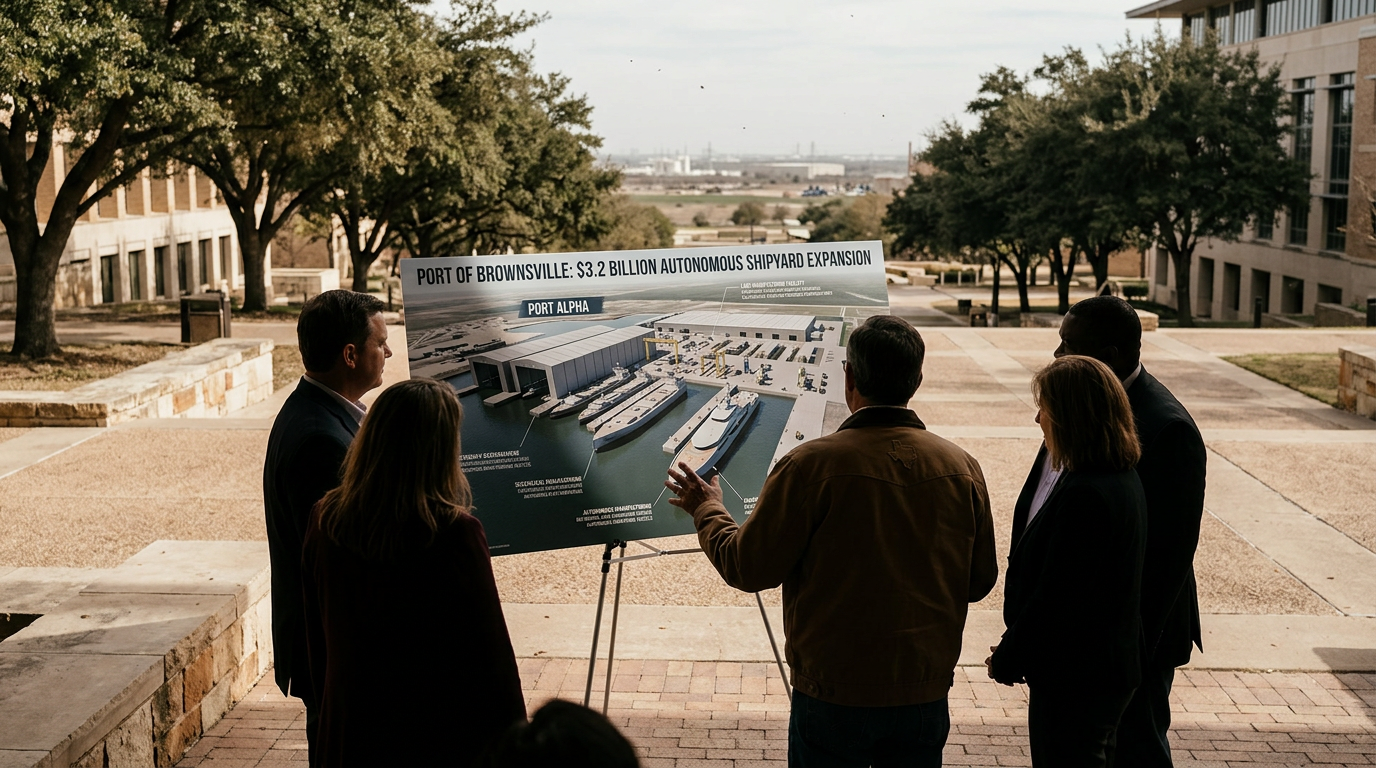
In a major announcement delivered from the company’s Austin headquarters, Governor Greg Abbott joined leaders from Saronic Technologies to unveil plans for an unprecedented maritime manufacturing facility at the Port of Brownsville. Named 'Port Alpha,' the project is designed to become the largest shipyard in the United States, specializing in the production of medium- and large-class autonomous and autonomy-capable vessels. This initiative represents a massive pivot toward high-tech maritime defense and commercial logistics within the Lone Star State. Texas has a long history of maritime excellence, from the busy terminals of Houston to the historic ports of Galveston, but this specific investment signals a shift toward a new era of automated seafaring technology. By leveraging the deep-water capabilities of the Rio Grande Valley, the state aims to secure a permanent leadership position in the global race for autonomous transportation systems. The project is backed by a substantial capital investment of approximately $3.248 billion, making it one of the largest single industrial commitments in the region's history. To facilitate this development, the State of Texas is utilizing the Texas Enterprise Fund (TEF), awarding an $80 million grant to ensure the facility is built on Texas soil. The TEF has historically been used to attract massive corporate relocations and expansions, serving as a 'deal-closer' for projects that provide significant statewide economic impact. This specific expansion is expected to generate upwards of 10,000 new jobs, providing a massive infusion of capital and employment opportunities for the South Texas workforce. The project timeline suggests a multi-phase build-out that will eventually transform the skyline of the Port of Brownsville into a hub for cutting-edge robotics and oceanic engineering.
Texas relevance
This announcement is a monumental win for the Rio Grande Valley and the broader Texas coastal economy. For decades, the Port of Brownsville has been a critical gateway for steel, liquid bulk, and wind energy components, but the Saronic Technologies project introduces a high-tech manufacturing layer that was previously absent. The injection of 10,000 jobs into Cameron County is expected to create a ripple effect, boosting local housing markets, service industries, and educational partnerships with institutions like the University of Texas Rio Grande Valley. Texas continues to lead the nation in corporate relocation and expansion, as the state’s regulatory environment and lack of personal income tax remain highly attractive to firms like Saronic that are outgrowing traditional coastal tech hubs in California or the Northeast.
The Rise of Autonomous Maritime Technology
Autonomous vessels represent the next frontier in both military and commercial shipping. Unlike traditional ships that require constant human intervention for navigation and engine management, the vessels produced at Port Alpha will utilize advanced artificial intelligence and sensor suites to operate with varying degrees of independence. These ships are designed to perform repetitive or hazardous tasks, such as long-range surveillance, cargo transport in contested waters, or environmental monitoring, without putting human crews at risk.
Saronic Technologies has positioned itself as a leader in this niche market by focusing on 'autonomy-capable' hulls. This means the ships can be fitted for remote operation or fully independent AI pathfinding depending on the mission requirements. The move to Brownsville allows the company to move from prototype stages into mass production, providing the scale necessary to meet the growing demands of the U.S. Navy and global logistics firms that are looking to modernize their fleets.
Economic Transformation of the Rio Grande Valley
The impact of 10,000 new jobs on the Rio Grande Valley cannot be overstated. Traditionally, this region has faced higher-than-average unemployment rates compared to the Texas 'Triangular' metros of Dallas, Houston, and Austin. The introduction of $750 million in annual paychecks will likely elevate the median household income in Brownsville and surrounding cities, creating a new middle class of skilled technicians, engineers, and fabricators.
Local officials expect that for every direct job created at the Port Alpha shipyard, several indirect jobs will be generated in the logistics, hospitality, and retail sectors. This 'multiplier effect' is why state leaders prioritized the TEF grant. The sheer volume of raw materials required—from specialized marine-grade steel to advanced semiconductors—will also likely attract tertiary suppliers to the region, creating a regional tech corridor along the coast.
Port Alpha: A Modern Engineering Marvel
Port Alpha is not merely a collection of docks; it is envisioned as a fully integrated advanced manufacturing ecosystem. The facility will incorporate robotic assembly lines and digital twin technologies to streamline the shipbuilding process. By utilizing modular construction techniques, Saronic intends to reduce the time it takes to bring a vessel from the design phase to the water, a critical factor in maintaining a competitive edge against international shipbuilders.
The shipyard's layout is specifically optimized for large-scale vessels that were previously difficult to build in traditional, older shipyards located in the Northeast. The deep-water access of the Port of Brownsville, combined with the lack of overhead obstructions, makes it one of the few locations in the United States capable of hosting a facility of this magnitude. This geographic advantage was a primary reason Saronic chose the Texas coast over other potential sites.
Strategic Role of the Texas Enterprise Fund
The $80 million grant from the Texas Enterprise Fund (TEF) served as the cornerstone of the deal. The TEF is often described as the state's 'closing fund,' used only when a project has a clear choice between a Texas location and an out-of-state competitor. In this instance, the grant ensures that the $3.2 billion investment stays within the state, providing a high-tech anchor for the South Texas economy for decades to come.
Governor Abbott's administration has used the TEF to target specific industries, including aerospace, biotechnology, and now, autonomous maritime systems. By providing these performance-based incentives, the state requires companies to meet strict hiring and investment benchmarks before funds are fully disbursed. This accountability ensures that the taxpayers' investment results in tangible economic growth and job creation for Texans.
Workforce Development and Education Ties
To fill 10,000 specialized roles, a robust educational pipeline must be established. Saronic is expected to collaborate with Texas Southmost College and the University of Texas Rio Grande Valley (UTRGV) to create vocational training programs centered on marine engineering and robotics. These programs will ensure that the local population has the skills necessary to take on high-paying roles within the Port Alpha facility.
This focus on workforce development is a hallmark of the Texas economic model. By aligning higher education with the needs of incoming industries, the state creates a self-sustaining cycle of innovation. Students in Brownsville will no longer feel the need to move to Austin or Houston to find high-tech careers; instead, the world's most advanced shipyard will be active in their own backyard, offering opportunities ranging from software development to heavy industrial fabrication.
Future Outlook for Texas Maritime Industry
The establishment of the largest shipyard in the country marks a turning point for the American maritime industry, which has struggled to compete with overseas facilities in recent decades. By focusing on autonomy and advanced manufacturing, Texas is skipping over traditional shipbuilding hurdles and leaping directly into the future of naval architecture. Port Alpha is likely to serve as a blueprint for other states looking to modernize their industrial infrastructure.
As global tensions rise and the need for secure supply chains becomes more apparent, Texas's role as an industrial powerhouse becomes even more critical. The Port of Brownsville is uniquely positioned to handle the logistical challenges of the 21st century, and the addition of Saronic Technologies ensures that the Lone Star State remains the top destination for pioneers in every field, from space exploration at nearby Boca Chica to the autonomous vessels of Port Alpha.
Analysis
The decision to award an $80 million TEF grant demonstrates the state's aggressive strategy to pivot from traditional manufacturing to high-tech defense and autonomy. Critics of state incentives often argue against corporate subsidies, yet the sheer scale of the $3.2 billion private investment and the projected $750 million in annual payroll suggests a massive return on investment for Texas taxpayers. By anchoring the 'largest shipyard in the country' in Brownsville, Governor Abbott is effectively diversifying the South Texas economy, reducing its reliance on international trade fluctuations and shifting it toward stable, long-term technological development. This project also enhances national security by ensuring that next-generation naval capabilities are designed and built domestically within a business-friendly jurisdiction.
Source attribution
This story was reported using a public release from the Office of the Governor. Keep TX Red rewrote the coverage independently and links to the official statement for verification.
Frequently Asked Questions
- What is Saronic Technologies?
- Saronic Technologies is an Austin-based company that specializes in the design and manufacture of autonomous maritime vessels. Their technology focuses on integrating artificial intelligence with marine hardware to create ships that can operate without human crews for various missions.
- Why was Brownsville chosen for this massive shipyard?
- The Port of Brownsville offers unique geographic advantages, including deep-water access and significant available land for large-scale industrial development. Its location in South Texas also provides access to a growing workforce and proximity to other high-tech aerospace and manufacturing hubs.
- What are the job requirements for the new Port Alpha facility?
- The 10,000 new jobs will span a wide range of skill sets, including maritime engineering, software development, robotics, specialized welding, and industrial management. The company is expected to work with local colleges to provide specific training for these roles.
Official Sources
Take the next step
Browse the Newsroom →Read more about Keep Texas Red → Our full guide to what Keep Texas Red means and why Texans support it.
Get Texas updates delivered weekly.
Independent Texas reporting on politics, policy, and daily life. One email a week. Unsubscribe anytime.
Keep TX Red Newsroom
The Keep Texas Red Editorial Staff produces nonpartisan explainers, policy breakdowns, and educational resources to help Texans understand how their government works. All content is reviewed for accuracy and updated regularly.
About Keep TX Red →