Austin Educational Gap: New Data Maps the Severe Divide Along I-35
Recent Census data highlights a persistent educational gap between East and West Austin, reflecting long-standing socioeconomic trends in the Texas capital
Editorial disclaimer: Opinions and analysis on Keep TX Red are editorial content — not statements of fact. See our editorial standards.
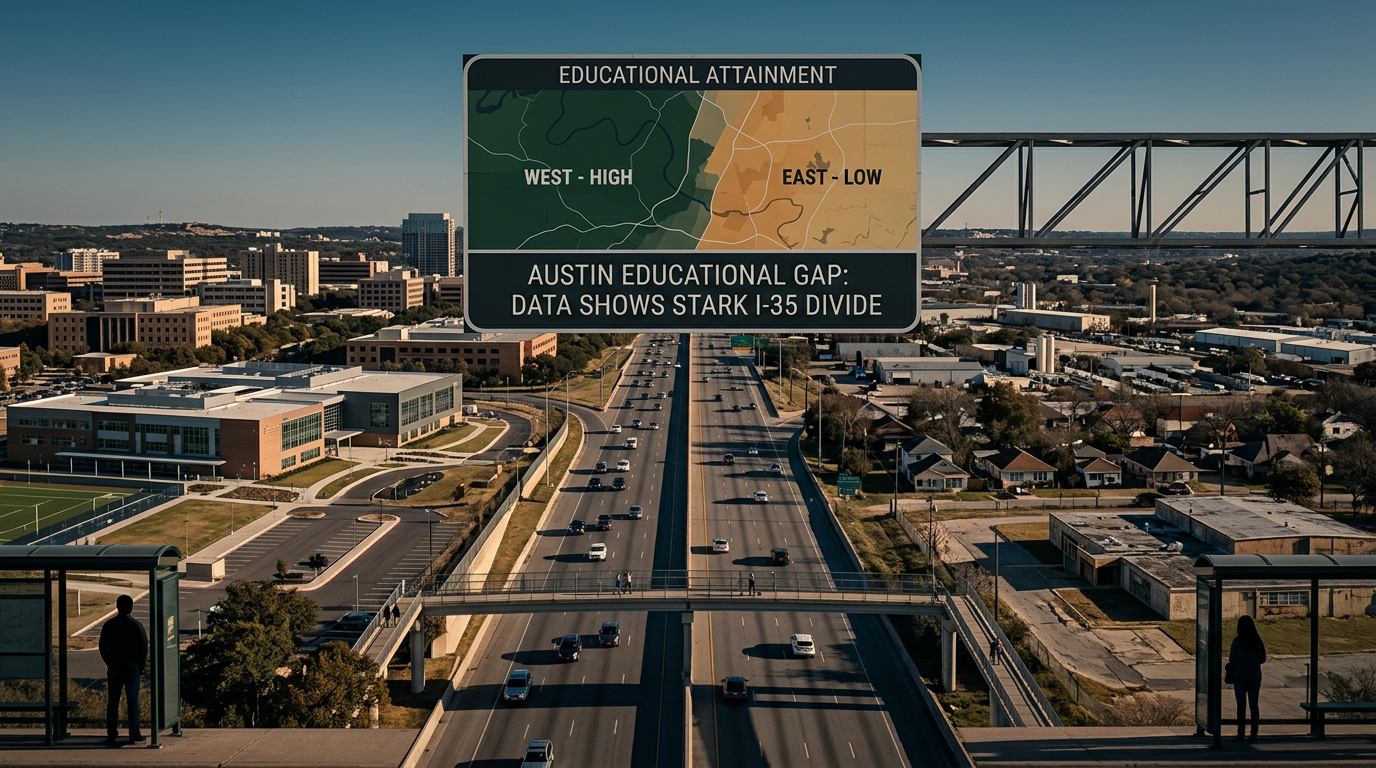
For decades, the Interstate 35 corridor has served as more than just a transportation artery for Austin; it has stood as a symbolic and literal barrier between disparate socioeconomic realities. According to the most recent 2024 Census data analysis, this divide remains particularly pronounced in educational attainment. While Austin boasts a population that is significantly more educated than the broader Texas and national averages, that intellectual capital is far from evenly distributed across the city’s footprint. Historical residential patterns in Central Texas were often shaped by mid-20th-century zoning laws and economic investments that favored the western hills over the eastern plains. This legacy continues to manifest in modern demographic maps. Residents living west of the interstate are statistically much more likely to hold advanced degrees, while eastern neighborhoods show higher concentrations of individuals who did not complete high school or opted out of the traditional four-year college path. The data highlights that proximity to the city's major academic institutions, such as the University of Texas at Austin, directly correlates with higher clusters of graduate and professional degree holders. As the city continues to grapple with rapid growth and skyrocketing housing costs, these educational disparities present unique challenges for the local labor market. The influx of technology firms and professional service providers has increased the demand for highly skilled labor, potentially widening the gap for those in areas where educational resources have historically been less accessible. Local policymakers are now faced with the task of reconciling Austin's reputation as a progressive tech hub with the reality of an entrenched educational partition.
Texas relevance
This issue is central to the future pulse of Central Texas, specifically impacting the Travis County workforce, tax base, and public school funding. The 'Austin Divide' has long been a focal point for Texas sociologists and urban planners who study how state infrastructure projects, like the planned expansion of I-35, might further impact or alleviate physical barriers between these distinct communities. Understanding these trends is critical for Texas business leaders who must navigate the state's bifurcated talent pool while addressing the equity of opportunity in the state's fastest-growing metropolitan area.
The Geographic Barrier of Interstate 35
The historical significance of I-35 in Austin cannot be overstated. Originally constructed along the line of East Avenue, the highway reinforced existing segregation patterns established by the city’s 1928 master plan. Today, that legacy persists through educational metrics. The 2024 data shows that the western side of the highway remains a stronghold for those with bachelor’s, master’s, and doctoral degrees.
Conversely, the eastern side continues to report higher percentages of residents who did not pursue higher education. This isn't merely a coincidence of geography but a reflection of how public and private investments have flowed through the city over the last century. Despite the recent influx of high-tech offices in East Austin, the residential educational profile changes at a much slower pace than the commercial landscape.
Austin vs. The National Average
When viewed as a whole, Austin is an outlier in the American South. The city’s percentage of residents with at least a four-year degree far exceeds the national average and stands well above the state average for Texas. This 'knowledge economy' has been a magnet for companies like Tesla, Oracle, and Google, which prioritize a highly educated workforce when choosing new headquarters.
However, this city-wide success story often masks the internal struggles of specific zip codes. While the aggregate numbers look impressive to outside investors, they fail to account for the pockets of the city where residents are significantly less likely to have finished high school. This disparity creates a 'tale of two cities' dynamic that complicates regional planning and workforce development initiatives.
Proximity to Higher Education Institutions
One of the clearest indicators of degree density in Austin is proximity to the University of Texas at Austin and other major campuses like St. Edward’s University. The western and central corridors surrounding these institutions are saturated with highly educated residents, many of whom are faculty, researchers, or alumni who chose to stay in the area after graduation.
This proximity creates a positive feedback loop for Western Austin, as higher educational attainment leads to higher household incomes, which in turn fuels better-funded local amenities and higher property values. Meanwhile, East Austin neighborhoods, despite being geographically close to these institutions, have historically lacked the same level of direct socio-economic integration with the university system.
The Role of Gentrification in Demographic Shifts
The divide is currently in a state of flux due to intense gentrification. As West Austin becomes increasingly unaffordable, many of those with advanced degrees are moving into East Austin, renovating older homes or moving into new mixed-use developments. This migration is technically 'improving' the educational statistics of East Austin, but it also risks displacing the original population that the data highlights as underserved.
This shift presents a challenge for researchers. When a neighborhood shows an increase in bachelor's degrees, is it because the local schools are succeeding, or is it because a different demographic has replaced the previous one? The 2024 Census data suggests that while the map is changing, the underlying disparity in access to education for native East Austinites remains a critical concern for the city council.
Economic Implications for the Texas Workforce
Texas has long prided itself on a 'business-friendly' environment, but that environment requires a workforce that can meet the needs of modern industry. The educational gap in Austin signifies a potential bottleneck for the local economy. If a large segment of the population is unable to participate in the high-skill job market, the city may become overly reliant on importing talent rather than cultivating it locally.
Furthermore, this divide affects the tax base. Areas with lower educational attainment often correlate with lower earning potential, which limits the growth of local tax revenue available for community improvements. For the state of Texas, ensuring that its flagship tech hub offers broad educational opportunities is not just a social issue, but a long-term economic necessity to maintain competitiveness against other emerging tech markets.
Analysis
While the data suggests a rigid divide, it is important to note the effects of gentrification currently reshaping East Austin. The demographic shift brought on by rising property taxes and new luxury developments may eventually blur these educational lines on a map, but not necessarily because the original residents are gaining more degrees. Rather, the 'educated' population is physically expanding eastward into historically underserved neighborhoods. From a policy perspective, this suggests that the educational divide isn't just about schools—it's about the affordability of living near the city's economic engines. If Austin wants to truly bridge this gap, the focus must shift from simply tracking where degree-holders live to ensuring that educational pathways are viable for those who have called East Austin home for generations.
Source attribution
This story was reported using a public release from the r/austin. Keep TX Red rewrote the coverage independently and links to the official statement for verification.
Frequently Asked Questions
- Why is Interstate 35 considered a divide in Austin?
- Historically, I-35 has served as a boundary created by mid-20th-century urban planning that segregated the city by race and class. Over time, this physical barrier solidified economic and educational differences, with more resources and development going to the west, while the east faced disinvestment.
- How does Austin's education level compare to the rest of Texas?
- Austin is one of the most educated cities in Texas and the United States. Its percentage of residents with at least a bachelor's degree is significantly higher than the Texas state average, largely driven by the presence of a flagship university and a booming technology sector.
- Is the educational divide in Austin getting better?
- The answer is complex. While more people with degrees are moving into East Austin, which changes the data on a map, the original residents of those areas still face significant hurdles in accessing the same educational and economic opportunities as their counterparts in the west.
Official Sources
Take the next step
Browse the Newsroom →Read more about Keep Texas Red → Our full guide to what Keep Texas Red means and why Texans support it.
Get Texas updates delivered weekly.
Independent Texas reporting on politics, policy, and daily life. One email a week. Unsubscribe anytime.
Keep TX Red Newsroom
The Keep Texas Red Editorial Staff produces nonpartisan explainers, policy breakdowns, and educational resources to help Texans understand how their government works. All content is reviewed for accuracy and updated regularly.
About Keep TX Red →