Immigration Enforcement Action Near Houston High School Leads to Student Custody Following Visa Violation
Federal authorities in Houston detained a high school student after the individual overstayed their visa, highlighting local immigration enforcement.
Editorial disclaimer: Opinions and analysis on Keep TX Red are editorial content — not statements of fact. See our editorial standards.
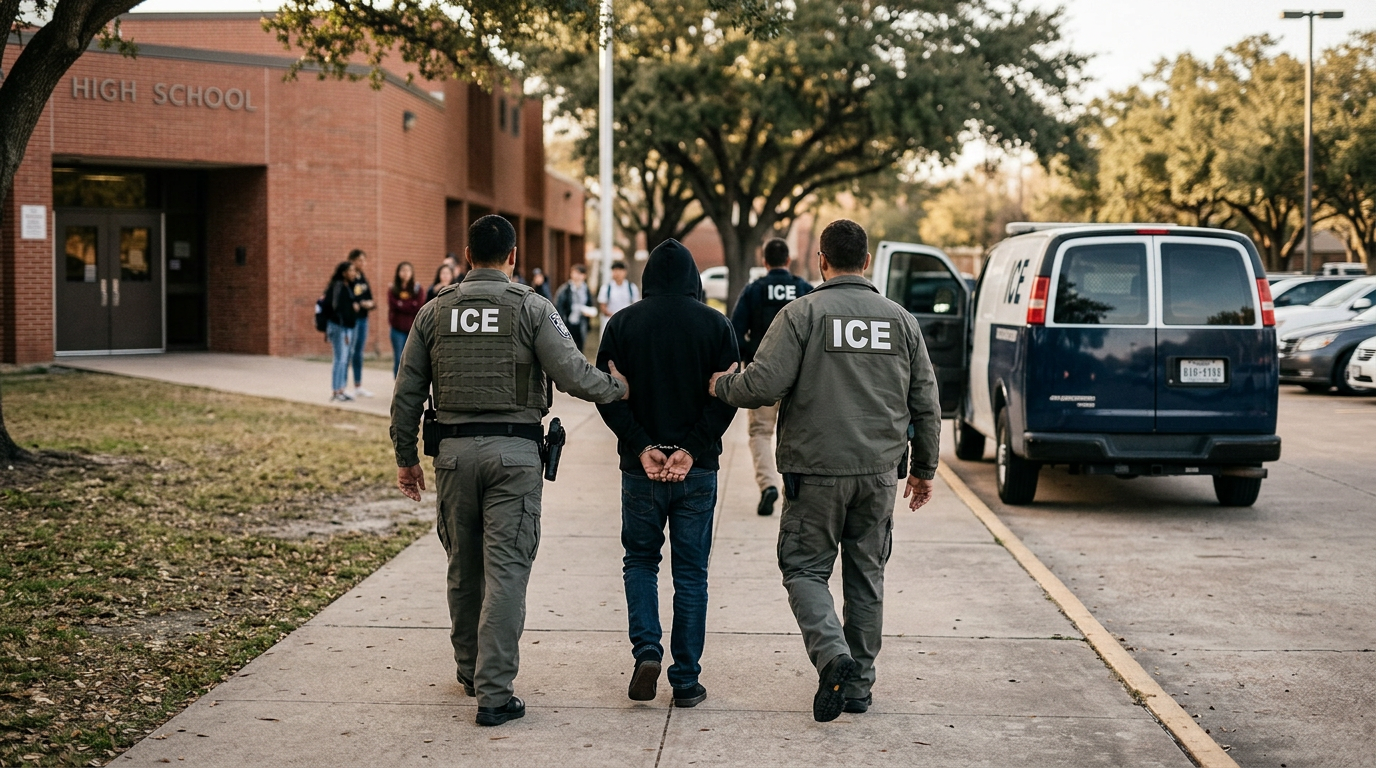
In a recent enforcement operation conducted in the Houston metropolitan area, U.S. Immigration and Customs Enforcement (ICE) officials took a high school student into custody following a determination that the individual had violated federal immigration laws by overstaying a visa. The incident occurred near an educational facility, drawing significant attention from the local community and law enforcement observers. Historically, Houston has served as a central hub for federal immigration activity due to its proximity to the Gulf Coast and major international transit corridors. This specific action follows a pattern of internal enforcement focused on non-citizens who enter the country through legal channels but fail to depart once their authorized stay expires. Unlike border interdictions, these internal enforcement actions rely heavily on database tracking and localized intelligence to identify subjects who have fallen out of legal status while living within the interior of the United States.
Texas relevance
As the largest city in Texas and the heart of Harris County, Houston remains at the center of the national debate over immigration policy and enforcement priorities. The state of Texas has increasingly prioritized the integrity of the visa system and the enforcement of federal statutes within its borders. This local arrest serves as a reminder that immigration enforcement is not limited to the Rio Grande Valley but is a frequent occurrence in urban centers across the Lone Star State. Texas residents are particularly attuned to these developments as the state legislature continues to explore ways to support federal agents while ensuring that local municipalities do not become sanctuary jurisdictions that obstruct the legal duties of federal immigration officers.
The Mechanism of Visa Overstay Tracking
The detention of a student in Houston highlights the sophisticated tracking tools utilized by the Department of Homeland Security's Student and Exchange Visitor Program (SEVP). When an individual enters the United States on a student or tourist visa, their records are digitized and monitored through centralized databases that alert officials when a departure date has passed without corresponding exit records. In the Houston area, these alerts are funneled to the local ICE field office for investigation and potential enforcement action.
In many cases, the transition from a legal visa holder to an 'overstay' status occurs automatically within the system. Once the grace period expires, federal authorities have the legal mandate to locate and detain the individual for removal proceedings. This specific Houston case demonstrates that even those currently enrolled in secondary education are not exempt from these statutory requirements, as federal law does indefinitely pause removal based on academic status if the underlying visa is no longer valid.
Local Impact on Houston Schools and Communities
The arrest of a student near or on the way to school creates a unique set of challenges for local administrators and community leaders. Houston-area school districts often emphasize that they do not collect information regarding the immigration status of their students, following established legal precedents. However, federal agents operating under federal jurisdiction are not bound by school district policies when conducting investigations or making arrests related to national immigration statues.
This event has sparked a dialogue among Houston parents and residents regarding the balance between security and the educational environment. While some residents view these actions as a necessary component of internal security, others express concern about the potential for disruption within the classroom. Regardless of the viewpoint, the presence of federal agents in residential and educational zones in Harris County indicates a commitment to total enforcement that spans beyond the physical border.
Texas State Policy and Federal Cooperation
The state of Texas has been vocal about its support for the enforcement of immigration laws, often passing legislation designed to compel local cooperation with federal authorities. Senate Bill 4 (SB 4) is a prime example of Texas's approach, which seeks to eliminate 'sanctuary' policies that might prevent local police from communicating with ICE. This environment creates a seamless path for federal agents to operate within cities like Houston, where state-level mandates align with federal enforcement goals.
Furthermore, the Texas Department of Public Safety often works in tandem with federal agencies during broad sweeps or task force operations. While this specific arrest appears to have been led by ICE, the cultural and political climate in Texas significantly favors an environment where federal agents can carry out their duties without the institutional resistance seen in states like California or New York. This ensures that visa violators in Texas are more likely to face enforcement actions than in other parts of the country.
Legal Proceedings Following Detention
Once a minor or young adult is detained for a visa overstay in Texas, they are typically transferred to a processing center where their case is reviewed by an immigration judge. Unlike the criminal court system, immigration proceedings are civil in nature, meaning the primary focus is determining the individual's right to remain in the country. The Houston student will likely face a hearing to determine if there are any legal grounds for a stay of removal or if deportation to the home country is the required outcome.
The legal process for visa overstays can be lengthy, involving multiple appeals and stays of execution depending on the specific circumstances of the individual's entry. In Texas, the dockets for immigration courts are notoriously backlogged, which may result in a prolonged period of supervised release or detention while the case navigates the federal bureaucracy. However, the initial arrest represents the first step in a legal chain that ends with the restoration of the individual’s legal status or their physical removal from the United States.
Broader Context of Immigration Enforcement in 2026
The year 2026 has seen a revitalized focus on internal removals as part of a broader national security strategy. Authorities have pointed out that overstays represent a vulnerability in the border management system, as individuals who enter legally bypass the initial physical barriers but still represent a failure of the system if they do not leave as promised. Houston, as a global city with a massive international population, is a primary site for these enforcement recalibrations.
National trends suggest that federal agencies are prioritizing the removal of individuals who have disregarded the terms of their visas to ensure that legal pathways remain respected. For every individual who overstays, there is a perception that they are 'skipping the line' or undermining those who apply for extensions through the proper channels. This creates a strong incentive for the government to act decisively when violations are identified in major Texas cities.
Safety and Security in Harris County
Local law enforcement in Harris County has stated that their primary goal is public safety, but they recognize that federal immigration enforcement plays a role in the overall security architecture of the region. By removing individuals who are in the country without valid authorization, federal agents argue that they are maintaining the integrity of the national security screening process that all visa applicants must undergo.
In the case of the Houston student, the arrest signifies that no specific demographic is entirely shielded from federal law if they are found to be in violation of the terms of their entry. This consistent application of the law is intended to serve as a deterrent to others who might consider disregarding their visa expiration dates while living in Texas.
Analysis
This enforcement action illustrates a shift toward stricter accountability for visa holders who remain in the country beyond their legal welcome. While much of the public discourse focuses on illegal border crossings, visa overstays represent a significant portion of the undocumented population in the United States. By executing arrests of individuals within the school-aged demographic, federal agencies are sending a clear signal that the expiration of a legal stay results in a change of status to 'removable,' regardless of the individual’s current activities or educational enrollment. Critics may argue about the optics of such arrests, but proponents of the rule of law point to the necessity of consistent enforcement to maintain the credibility of the legal immigration system. For Texas, this move underscores the reality that federal agencies are continuing to operate in metropolitan areas despite political friction between state and federal executive branches.
Source attribution
This story was reported using a public release from the r/houston. Keep TX Red rewrote the coverage independently and links to the official statement for verification.
Frequently Asked Questions
- What is a visa overstay?
- A visa overstay occurs when a foreign national enters the United States legally on a valid visa (such as a student or tourist visa) but remains in the country after the date their authorized stay has expired.
- Can students be arrested for immigration violations?
- Yes. While schools are often considered 'sensitive locations' where enforcement is limited, students are still subject to federal immigration laws. If a student's legal status expires, they can be detained and placed in removal proceedings regardless of their enrollment.
- How does ICE know someone has overstayed?
- ICE uses the Student and Exchange Visitor Information System (SEVIS) and other DHS databases to track the entry and exit of visa holders. If an exit is not recorded by the visa's expiration date, the individual is flagged in the system.
- What happens after an immigration arrest in Houston?
- Detainees are usually taken to a federal processing center. They then appear before an immigration judge in a civil court to determine whether they will be deported or if they have a legal basis to remain in the United States.
Official Sources
Take the next step
Browse the Newsroom →Read more about Keep Texas Red → Our full guide to what Keep Texas Red means and why Texans support it.
Get Texas updates delivered weekly.
Independent Texas reporting on politics, policy, and daily life. One email a week. Unsubscribe anytime.
Keep TX Red Newsroom
The Keep Texas Red Editorial Staff produces nonpartisan explainers, policy breakdowns, and educational resources to help Texans understand how their government works. All content is reviewed for accuracy and updated regularly.
About Keep TX Red →