Austin Rental Warning: Travelers Targeted by Misleading 'High-Crime' Ads
An international family's Austin vacation turned into a nightmare after a high-rated Airbnb on Burton Drive faced an attempted midnight break-in.
Editorial disclaimer: Opinions and analysis on Keep TX Red are editorial content — not statements of fact. See our editorial standards.
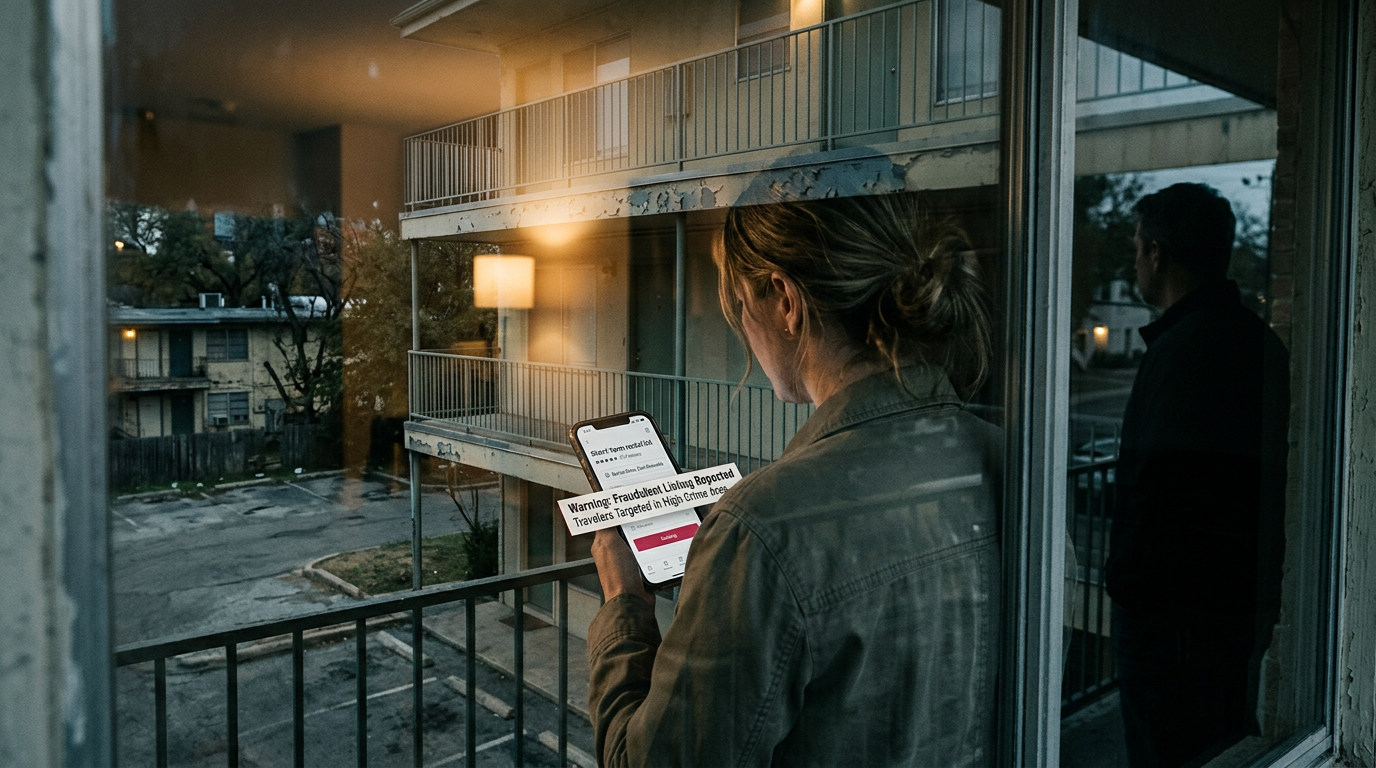
A family visiting from Germany for a six-day excursion to Central Texas experienced a harrowing security breach at a short-term rental property in Southeast Austin. Despite the property maintaining a 4.7-star rating on a major booking platform, the reality of the location near Burton Drive included a midnight attempted break-in and hazardous living conditions within the apartment complex. Historically, the area near East Riverside and Oltorf has undergone significant redevelopment, yet remnants of high-density, aging complexes continue to pose safety challenges for unsuspecting tourists who rely on digital reviews rather than local knowledge. The incident highlights a growing disconnect between online hospitality metrics and the physical reality of Austin's rapidly shifting urban landscape. The ordeal began on the third night of the family’s stay when an unidentified group of individuals attempted to manipulate the door handle and lock of the unit while the occupants were sleeping inside. This specific incident follows a pattern of local concerns regarding the 'Burton Drive' corridor, an area frequently cited in local police reports for property crimes and narcotics activity. While the interior of the rental was reportedly renovated to match the professional photography on the listing, the common areas of the complex were described as being littered with discarded mattresses and debris, signaling a lack of onsite security or property management oversight. This discrepancy often traps travelers who are unfamiliar with the specific block-by-block safety profiles of major Texas metropolitan centers.
Texas relevance
Austin, Texas, serves as a primary hub for international tourism and major events like South by Southwest and Formula 1. However, this incident underscores a critical issue for the Texas capital regarding the regulation and transparency of the short-term rental (STR) industry. As Austin continues to grapple with housing shortages and urban density, many older apartment complexes are being partially converted into high-turnover rentals. This creates a volatile environment for both permanent residents and visitors. For Texans, this story is a reminder of the 'digital vs. physical' divide in Austin's gentrifying neighborhoods, where high-end aesthetics inside a rental unit do not always equate to safety in the surrounding Travis County neighborhood. The incident also puts a spotlight on how local law enforcement resources are strained by the proliferation of STRs in areas where infrastructure has not kept pace with the transient population growth.
The Burton Drive Disconnect in Southeast Austin
Burton Drive has long been a focal point for Austin's urban planners and law enforcement alike. Located just south of Lady Bird Lake, the area sits in the shadow of the massive East Riverside redevelopment project. While new luxury high-rises are appearing just blocks away, the specific pocket containing older, sprawling apartment complexes continues to face systemic issues. These complexes are frequently utilized by short-term rental hosts due to their proximity to downtown, providing a cheaper entry point for investors than the high-rises on Congress Avenue.
The disconnect between the 'vibe' promoted in rental listings and the physical environment of Burton Drive is a recurring theme for Austin visitors. As seen in this recent incident, the presence of mattresses and trash in hallways is a hallmark of neglected property management. For a family flying in from Germany, the assumption that a high-rated listing ensures a safe neighborhood is a logical, yet dangerous, fallacy in the current Austin market. This highlights a desperate need for better regional mapping services that warn travelers about specific high-crime blocks.
Anatomy of a Midnight Security Breach
The reporting of the incident describes a terrifying scene where the family's son was awoken by the sound of the door handle being aggressively rattled. This indicates more than just a passing curiosity; it was a deliberate attempt to gain entry into a residential unit. In many Austin apartment complexes, locks are standardized or have not been updated to modern security protocols, making them prime targets for opportunistic criminals who know that 'out-of-towners' often carry cash, passports, and high-end electronics.
The family noted that they initially attempted to ignore the deteriorating condition of the building to avoid upsetting their host or their son who had booked the trip. This 'politeness trap' is common among international tourists and often leads to under-reporting of hazardous conditions. It was only when physical safety was threatened by the attempted intrusion that the severity of the situation became impossible to ignore. This highlights the importance of situational awareness when booking stays in unfamiliar urban centers.
The Role of Platform Ratings in Public Safety
The 4.7-star rating is the most controversial aspect of this story. On most major rental platforms, anything below a 4.5 is considered a failure, meaning the rating system is heavily inflated. Reviews often focus on the host's communication or the cleanliness of the linens rather than the security of the parking lot or the presence of loiterers in the corridors. This creates a false sense of security for users who assume a high score equates to a safe environment.
Texas lawmakers have debated various forms of STR regulation, but much of the focus has been on tax collection and noise complaints. This incident suggests that safety transparency should be at the forefront of the conversation. If a property is located in an area with high rates of reported break-ins, there is currently no requirement for a platform to disclose that information to a potential guest. The burden remains entirely on the consumer to research local crime maps, a task that is difficult for those not fluent in the nuances of local geography.
Impact on Austin’s International Reputation
As the 'Live Music Capital of the World,' Austin relies heavily on its image as a welcoming and safe destination. Incidents involving international tourists can have a long-lasting negative impact on the city's brand. When travelers from Europe or elsewhere return home with stories of attempted break-ins and derelict housing conditions, it undermines the millions of dollars spent on Texas tourism marketing. The German family’s experience is a cautionary tale that could discourage future high-spending visitors from choosing Austin over other Texas cities like San Antonio or Fort Worth.
Furthermore, this situation places a strain on the Austin Police Department (APD). APD has faced significant staffing challenges over the last several years, and responding to security issues at 'hidden' rental units located in high-crime apartment complexes adds a layer of complexity to their patrol duties. Without onsite security to manage these complexes, the police become the de facto security for the STR industry, a role that many argue should be funded by the platforms themselves.
Recommendations for Navigating the Texas Rental Market
For those planning to visit Austin, local experts suggest looking beyond the photos. Crime maps provided by the City of Austin are public record and should be consulted before booking any stay in the Southeast or North-Central corridors. Additionally, looking at Google Street View to see the surrounding blocks can reveal the 'trash and mattress' issues that host photos carefully crop out. If the surrounding area looks neglected, the security of the building is likely compromised as well.
Travelers should also consider the 'front desk' factor. While independent Airbnbs offer a local feel, they lack the 24-hour security presence of a traditional hotel. In areas like Burton Drive, having a controlled entrance with a security guard can be the difference between a safe vacation and a traumatic encounter. As Austin continues to grow, the 'buyer beware' mantra has never been more relevant for the short-term rental market.
Analysis
The failure here lies in the algorithmic validation of safety. A 4.7-star rating suggests a near-perfect experience, but platforms like Airbnb often prioritize the quality of the 'host' and the 'bedroom' over the verifiable safety of the zip code or the structural integrity of the complex. Critics of the current STR model in Texas argue that without stricter local ordinances requiring platforms to disclose local crime statistics or verify the security of building entrances, more visitors will find themselves in dangerous situations. This is particularly problematic for international travelers who lack the 'Texas intuition' required to navigate certain corridors of Southeast Austin. The fact that an attempted home invasion occurred illustrates that the current review-based system is insufficient for protecting the public.
Source attribution
This story was reported using a public release from the r/texas. Keep TX Red rewrote the coverage independently and links to the official statement for verification.
Frequently Asked Questions
- Where is Burton Drive in Austin, and why is it significant?
- Burton Drive is located in Southeast Austin, near the East Riverside Drive area. It is a region currently experiencing rapid gentrification, where high-end development sits adjacent to older, high-density apartment complexes that have historically faced higher crime rates.
- How can tourists verify the safety of an Austin neighborhood before booking?
- Visitors should use the Austin Police Department's crime viewer or third-party crime mapping sites. Additionally, checking recent street-level imagery and reading 'negative' reviews specifically for mentions of 'safety' or 'area' can provide a more accurate picture than the aggregate star rating.
- Do Airbnb ratings include the safety of the neighborhood?
- Generally, no. Ratings primarily reflect the guest's interaction with the host and the interior condition of the unit. Neighborhood safety is often subjective in reviews, and platforms do not currently integrate local law enforcement data into their scoring systems.
Official Sources
Take the next step
Browse the Newsroom →Read more about Keep Texas Red → Our full guide to what Keep Texas Red means and why Texans support it.
Get Texas updates delivered weekly.
Independent Texas reporting on politics, policy, and daily life. One email a week. Unsubscribe anytime.
Keep TX Red Newsroom
The Keep Texas Red Editorial Staff produces nonpartisan explainers, policy breakdowns, and educational resources to help Texans understand how their government works. All content is reviewed for accuracy and updated regularly.
About Keep TX Red →