Tarrant County Surveillance Map: See New License Plate Reader Locations
New reports track the rapid spread of Flock Safety cameras in North Richland Hills, Saginaw, and the HEB area, sparking debate over local privacy rights.
Editorial disclaimer: Opinions and analysis on Keep TX Red are editorial content — not statements of fact. See our editorial standards.
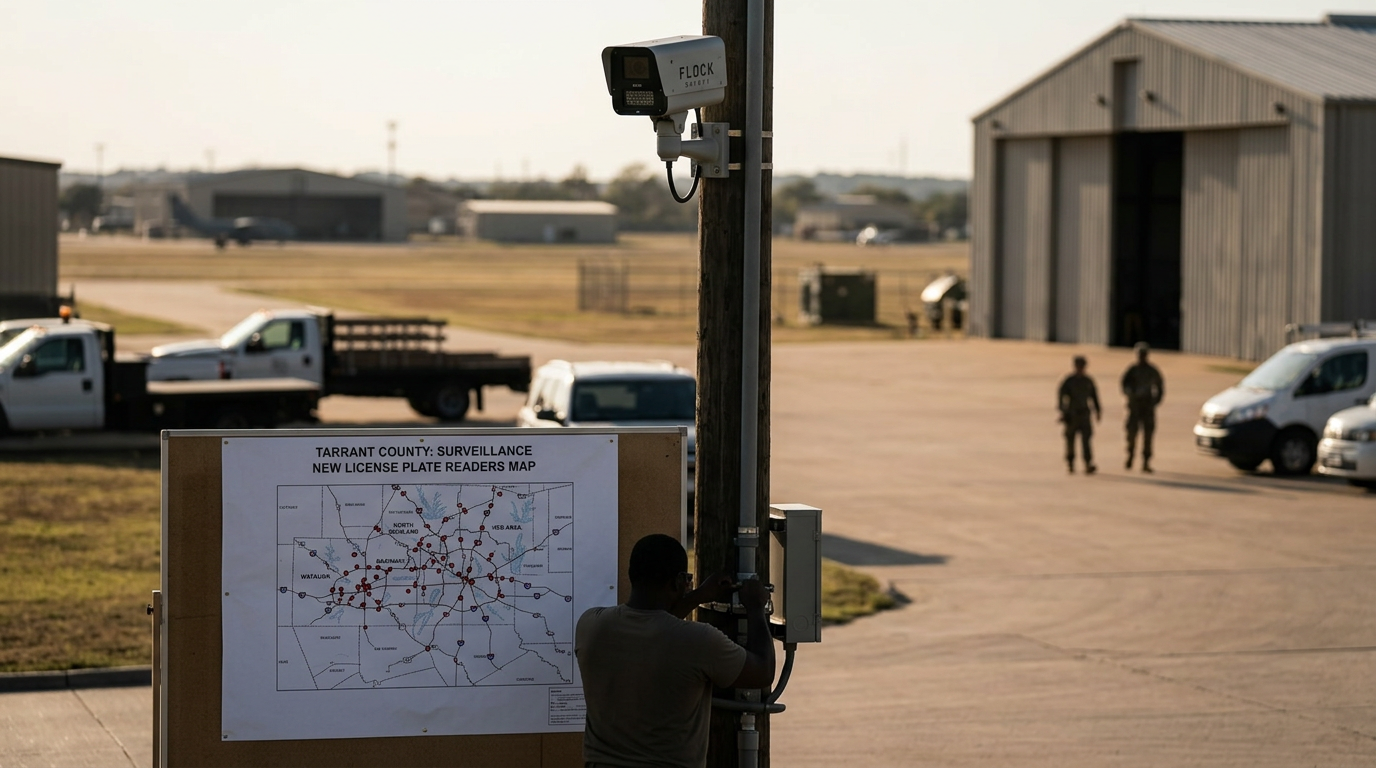
Recent community-led mapping efforts have highlighted a significant surge in the installation of Flock Safety license plate readers throughout Northeast Tarrant County. These automated systems, which capture high-resolution images of vehicle tags and distinct vehicle characteristics, are increasingly appearing in municipalities including North Richland Hills, Saginaw, Watauga, and the Hurst-Euless-Bedford (HEB) area. While local law enforcement agencies often tout these tools as essential for tracking stolen vehicles and finding missing persons, the physical density of the cameras has reached a point where residents are now taking it upon themselves to document the growing surveillance web. Historically, Texas cities have transitioned from traditional manual police patrols to technology-integrated policing, mirroring a national trend toward 'smart city' public safety models that rely heavily on private-sector hardware and cloud-based data storage. This documentation project by local citizens underscores a growing awareness and potential discomfort regarding how taxpayer funds are being allocated toward pervasive tracking systems without high-profile public referendums.
Texas relevance
The deployment of these cameras is a major hyperlocal issue centered in the Northeast Tarrant County corridor, specifically affecting the daily commutes of residents in the Fort Worth metropolitan area. In Texas, the debate over Automated License Plate Readers (ALPRs) touches on the state's tension between supporting robust law enforcement capabilities and protecting individual property and privacy rights. As more Tarrant County suburbs like Grapevine and Watauga adopt this technology, the region is becoming a primary test case for whether widespread surveillance can exist without infringing on the Texas constitutional spirit of liberty. The concentration of these devices in highly trafficked commercial and residential zones means that virtually every vehicle movement in these North Texas neighborhoods is now being logged into a digital database accessible by multiple agencies.
The Rapid Rise of Flock Technology in North Texas
The growth of Flock Safety in the Fort Worth outskirts is not an isolated event but part of a coordinated push by municipal police departments to create a 'virtual perimeter' around their jurisdictions. Unlike older traffic cameras, these systems use machine learning to identify not just license plates, but vehicle make, color, and specific alterations like roof racks or bumper stickers. This allows police to receive real-time alerts when a vehicle associated with a crime enters city limits.
The recent mapping data provided by residents indicates that the deployment is becoming more dense in areas like Saginaw and North Richland Hills. In these communities, cameras are often placed at major intersections and neighborhood entrances, effectively ensuring that no vehicle can enter or exit certain districts without being photographed. This level of coverage was once reserved for high-security areas but is now becoming the standard for suburban Texas residential life.
Taxpayer Funding and Private Contracts
One of the primary frustrations voiced by Tarrant County residents involves the use of public funds to pay for recurring service contracts with private surveillance companies. Most of these cameras are not owned by the city but are leased on an annual basis, creating a permanent line item in municipal budgets. In the HEB area, residents have noted that while the initial costs might seem manageable, the long-term cumulative expense across dozens of camera nodes adds up to hundreds of thousands of dollars.
Critics argue that these funds could be better utilized for increasing the number of sworn officers on the street or improving traditional infrastructure. The current model relies on 'policing by algorithm,' where the private company manages the data and the alerting system, raising questions about the accountability of public safety spending. When a private entity holds the data generated by public surveillance, the line between government oversight and corporate interests becomes increasingly blurred.
Privacy Implications and Data Sharing Networks
The core of the controversy in Northeast Tarrant County lies in the 'hot list' and data-sharing features of the Flock system. Data captured in Watauga can be instantly shared with agencies in Grapevine or even out-of-state departments, provided they are part of the same network. While this is efficient for catching fleeing felons, it also means that the movement patterns of law-abiding Texans are being stored in cloud databases for weeks or months at a time.
Privacy advocates warn that without strict state-level oversight, this data could be misused for purposes beyond its original intent. For instance, if a local ordinance changes, these cameras could theoretically be used to track violations that residents never anticipated when the systems were first installed. The current lack of a unified Texas state policy on ALPR data retention means that each small city in Tarrant County is essentially making its own rules regarding the privacy of its citizens.
The Impact on Local Communities and Commuters
For the average commuter in the HEB or Saginaw area, the pervasive presence of these cameras changes the psychological landscape of the neighborhood. Residents have reported seeing these devices mounted on standard utility poles or standalone solar-powered masts, often without signage. This 'invisible' surveillance can create a sense of being constantly watched, which some community members argue is contrary to the open, friendly atmosphere typically associated with North Texas suburbs.
On the other hand, supporters in these same towns point to successful instances where the cameras helped recover stolen property or locate elderly residents who had wandered away from home. These anecdotes are the primary drivers of political support for the cameras. However, as the mapping project shows, the sheer volume of cameras in Tarrant County is starting to outweigh the occasional success story in the minds of some concerned locals who value their anonymity.
Future Legislative Challenges in the Texas Statehouse
As cities like North Richland Hills and Grapevine continue to expand their surveillance footprints, the issue is likely to move from local city council chambers to the Texas Legislature. There has been growing interest among state representatives in defining exactly how long license plate data can be kept and who has the right to access it. Texas has always prided itself on being a 'low-control' environment for citizens, and the rise of automated tracking is a direct challenge to that reputation.
If more Tarrant County residents follow the lead of those currently mapping the cameras, it could create the political momentum necessary for a state-wide 'opt-out' or a requirement for public voting before new surveillance networks are funded. Until such a shift occurs, the expansion in Northeast Tarrant County is expected to continue, with more camera nodes appearing on the outskirts of Fort Worth each year.
Analysis
The silent proliferation of Flock cameras across Tarrant County represents a shift in local governance where security is increasingly outsourced to automated, third-party platforms. While the promise of reduced crime is a compelling political sell, the lack of transparency regarding data retention periods and inter-agency sharing through the Flock 'Clear Creek' network should give taxpayers pause. In the Texas political landscape, there is a burgeoning cross-partisan concern regarding the 'surveillance state,' where the convenience of technology may eventually come at the cost of personal anonymity. The fact that citizens are now crowdsourcing maps to track these devices suggests a trust gap between the municipal governments of Northeast Tarrant and the people they serve. If public officials do not provide clearer metrics on the efficacy and privacy safeguards of these systems, they may face future legislative pushback at the state level in Austin, where privacy advocates are already eyeing tighter regulations on ALPR data.
Source attribution
This story was reported using a public release from the r/fortworth. Keep TX Red rewrote the coverage independently and links to the official statement for verification.
Frequently Asked Questions
- What exactly do Flock Safety cameras record?
- These cameras capture high-resolution images of the rear of vehicles, identifying the license plate number, state of origin, and specific vehicle features like color, make, and model. They are designed to operate in all weather conditions and both day and night.
- Are these cameras used for traffic tickets?
- No, Flock Safety cameras are primarily used for law enforcement investigations and real-time alerts for stolen vehicles or wanted individuals. They are generally not equipped with the hardware or software used for speed enforcement or red-light camera violations.
- Who has access to the data collected in Tarrant County?
- Access is typically restricted to law enforcement personnel. However, the system allows for data sharing between different police departments across the state and country who use the same platform, provided there is an established agreement between the agencies.
Official Sources
Take the next step
Browse the Newsroom →Read more about Keep Texas Red → Our full guide to what Keep Texas Red means and why Texans support it.
Get Texas updates delivered weekly.
Independent Texas reporting on politics, policy, and daily life. One email a week. Unsubscribe anytime.
Keep TX Red Newsroom
The Keep Texas Red Editorial Staff produces nonpartisan explainers, policy breakdowns, and educational resources to help Texans understand how their government works. All content is reviewed for accuracy and updated regularly.
About Keep TX Red →