Texas Democrats Demand Inquiry Into Paxton’s Voter Residency Claims
Texas Democrats seek investigation into AG Ken Paxton over allegations of voting at a previous residence during the May primary runoff elections.
Editorial disclaimer: Opinions and analysis on Keep TX Red are editorial content — not statements of fact. See our editorial standards.
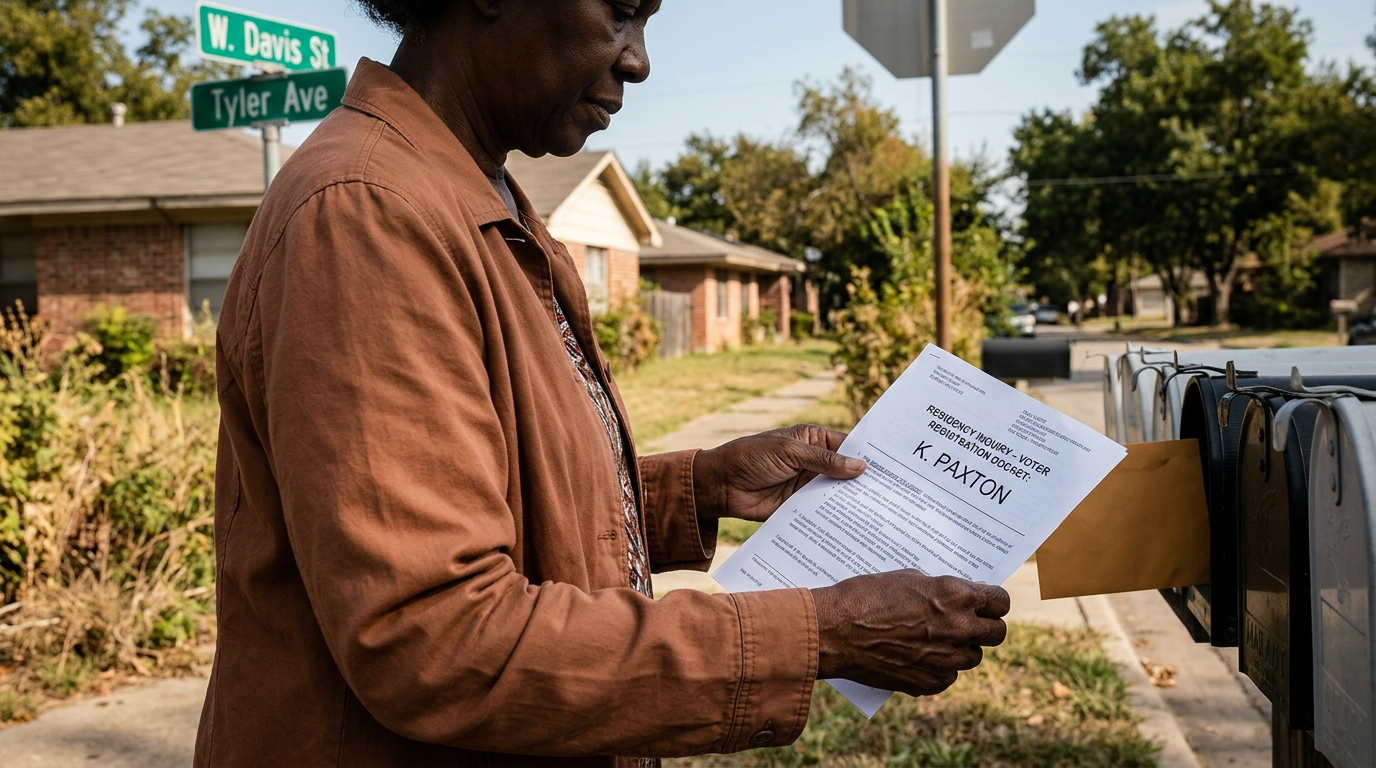
Legislative Democrats in Texas have formally requested a deep-dive investigation into Attorney General Ken Paxton regarding his recent voting history. The controversy centers on the May primary runoff election cycle, where reports suggest Paxton may have cast a ballot while utilizing a residential address that he no longer occupies. Under Texas Election Code, voters are required to update their registration to reflect their current domicile, and failing to do so while purposely voting in a different precinct can carry significant legal penalties. This request for an inquiry follows a pattern of high-profile legal scrutiny for the Attorney General, who has frequently championed strict adherence to voting laws and spearheaded numerous election integrity lawsuits across the state. Contextually, Texas has some of the most rigorous voter registration laws in the United States. Following the passage of Senate Bill 1 in 2021, the state heightened the consequences for various forms of illegal voting. Historically, the Attorney General’s office itself has been the primary agency responsible for prosecuting such infractions, creating a unique situation where the state's top legal officer is now the subject of the very allegations his office typically investigates. Previous cases involving residency disputes in Texas politics have led to varying outcomes, ranging from simple administrative corrections to full-blown criminal indictments, depending on the intent and the specific actions of the individual involved.
Texas relevance
This development is directly relevant to all Texas voters as it touches upon the core integrity of the state's electoral system. The situation primarily impacts Collin County and Travis County, where Paxton maintains professional and personal ties. Citizens rely on the consistency of the Texas Secretary of State and local election administrators to ensure that every participant, regardless of political stature, follows the standard procedures for residency verification. If a sitting Attorney General is found to have circumvented these rules, it could lead to legislative shifts regarding how voter rolls are maintained and how residency is defined for high-ranking public officials moving between the state capital and their home districts.
The Specific Allegations and May Primary Timeline
The current accusations stem from the May 2026 primary runoff, a period of intense political maneuvering within the Republican party. Reports surfaced detailing that Paxton allegedly listed a residence on his voter registration that he had reportedly vacated months prior. If the Attorney General voted in a precinct associated with his old address rather than his current one, he could theoretically be in violation of the requirement that a voter must reside in the territory for which they are casting a ballot.
Investigators and critics are looking at the specific date of his move versus the date the ballot was cast. In Texas, a voter who moves within the same county can often update their address at the polling place, but moving across county lines or failing to maintain a continuous residence in a specific precinct can complicate a voter's eligibility. The focus is currently on whether Paxton maintained a legal claim to the property used for his registration during the runoff period.
Democratic Strategy and Formal Requests for Action
Democratic lawmakers have not been silent on the issue, drafting letters to the Texas Secretary of State and local district attorneys. They argue that if any other citizen had engaged in similar behavior, they would face immediate legal repercussions. By demanding an investigation, they are attempting to force a public accounting of Paxton's residency status, potentially involving subpoenas for utility bills, property records, and tax filings to establish his true domicile.
The strategic move by the opposition is designed to highlight what they describe as a double standard in the enforcement of Texas election laws. While Paxton has frequently sought to prosecute local election officials for procedural errors, he now finds himself on the defensive. This push for an investigation is part of a broader Democratic effort to challenge the GOP's narrative on election integrity ahead of the general election cycle.
Texas Residency Laws for Public Officials
Residency for public officials in Texas is often a complex legal gray area. State law generally defines a residence as 'one's home and fixed place of habitation to which one intends to return after any temporary absence.' For individuals like the Attorney General, who must balance time between the state capital in Austin and their hometowns, the law allows for a degree of flexibility. However, that flexibility does not extend to voting in a district where one no longer maintains a physical presence or an intent to reside.
The courts have previously ruled that a person's 'intent' is a primary factor in determining residency. This means that if Paxton can demonstrate that he intended to return to his previous address, or that the move was not yet permanent, he may have a strong legal defense. Conversely, if he had already established a new permanent residence and updated his driver's license or other official documents, the case for a violation becomes much stronger under current Texas statutes.
Potential Penalties and Legal Procedural Paths
Under the Texas Election Code, illegal voting is classified as a felony, though the severity can vary based on the circumstances. If an investigation is launched and evidence suggests a knowing violation, the case would typically be handled by a local District Attorney. However, given the political sensitivities, there may be calls for a special prosecutor to be appointed to avoid any appearance of partisanship in the proceedings.
Beyond criminal penalties, there are administrative consequences. The Texas Ethics Commission and the State Auditor’s Office could also become involved if state resources were used in the process of his relocation or if his residency status affects his eligibility to hold office. A formal investigation would likely start with a review of the voter rolls and the signature rosters from the May primary to confirm exactly which address was utilized.
The Role of the Texas Secretary of State
The Texas Secretary of State’s office serves as the chief election officer for the state and is often the first stop for complaints regarding voter eligibility. While the Secretary of State does not have direct prosecutorial power, they are responsible for referring potential crimes to the Attorney General’s office—the very office Paxton leads. This inherent conflict of interest is why Democrats are calling for an independent third-party investigation.
The Secretary of State is also responsible for maintaining the statewide voter registration database. If the database shows that Paxton failed to update his information despite purchasing new property or selling his old residence, it could be used as evidence in a formal inquiry. The office is under constant pressure to ensure that the rolls are clean and accurate, making this a high-stakes situation for the administration's credibility.
Wider Implications for Texas Election Integrity
This incident has sparked a larger conversation about the fairness of election law enforcement in the Lone Star State. Supporters of the Attorney General argue that this is a politically motivated 'witch hunt' designed to distract from his work on border security and deregulation. They contend that residency issues are common and rarely lead to criminal charges unless there is clear evidence of large-scale fraud.
On the other hand, voting rights advocates warn that if a high-ranking official is allowed to flout residency requirements, it undermines the trust that the public has in the system. They point to cases of regular citizens who have faced years of prison time for honest mistakes on voter forms. The outcome of this inquiry will likely set a precedent for how 'intent' and 'residency' are interpreted for all Texans moving forward, potentially leading to more precise definitions in future legislative sessions.
Analysis
The scrutiny of Ken Paxton’s personal voting habits serves as a sharp political contrast to his public-facing role as a crusader for election security. For years, Paxton has utilized his platform to argue that even minor deviations from the Texas Election Code threaten the sanctity of the democratic process. By allegedly failing to update his own registration after a move, he has provided his political detractors with ammunition to label him as hypocritical. However, it remains a high legal bar to prove 'willful' or 'intentional' fraud in residency cases. Often, these disputes are resolved as clerical errors. The political fallout, regardless of the legal outcome, will likely energize the Democratic base heading into the next legislative session, while Paxton’s supporters will likely view this as continued lawfare against a conservative icon.
Source attribution
This story was reported using a public release from the r/texas. Keep TX Red rewrote the coverage independently and links to the official statement for verification.
Frequently Asked Questions
- What constitutes a 'residence' for voting purposes in Texas?
- In Texas, a residence is defined as the place where a person lives and intends to remain. It is not just about where someone owns property, but where they physically inhabit. If a person moves, they are generally required to update their voter registration within 30 days to remain eligible to vote in their new precinct.
- Can a person be prosecuted for voting at an old address?
- Yes, under the Texas Election Code, voting in a precinct where you do not reside can be considered illegal voting. While simple mistakes are often handled through administrative corrections, a 'knowing' or 'intentional' act of voting at a false address is a felony in the state of Texas.
- Who has the authority to investigate the Texas Attorney General?
- An investigation could be initiated by a local District Attorney (such as in Collin or Travis County), the Texas Secretary of State, or a special prosecutor appointed by the court. Because the Attorney General's office is the state's chief legal agency, external oversight is often required to ensure an impartial process.
Official Sources
Take the next step
Browse the Newsroom →Read more about Keep Texas Red → Our full guide to what Keep Texas Red means and why Texans support it.
Get Texas updates delivered weekly.
Independent Texas reporting on politics, policy, and daily life. One email a week. Unsubscribe anytime.
Keep TX Red Newsroom
The Keep Texas Red Editorial Staff produces nonpartisan explainers, policy breakdowns, and educational resources to help Texans understand how their government works. All content is reviewed for accuracy and updated regularly.
About Keep TX Red →