Texas AG Ken Paxton Scrutinized Over Reported Campaign Attendance
Ken Paxton faces questions regarding crowd size claims at a recent campaign event as observers note discrepancies with venue occupancy limits.
Editorial disclaimer: Opinions and analysis on Keep TX Red are editorial content — not statements of fact. See our editorial standards.
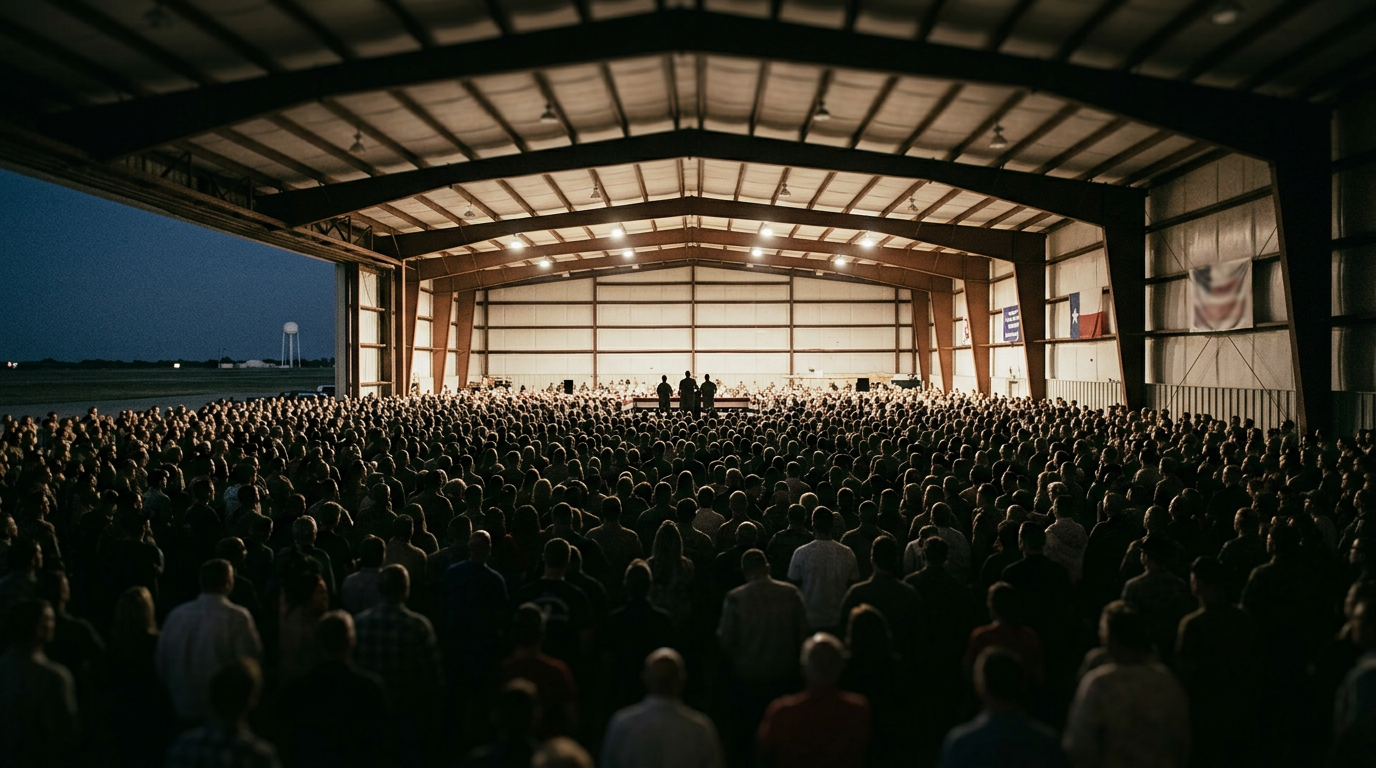
Texas Attorney General Ken Paxton has recently become the center of a social media controversy following claims regarding the attendance figures at one of his political rallies. The debate emerged after the Attorney General reported attendance numbers that reportedly exceeded the legal fire code capacity of the venue. Historically, crowd size has served as a primary metric for political momentum in Texas, with candidates often utilizing large turnouts to demonstrate grassroots support and fundraising potential. This incident follows a long tradition of Texas politicians using high-energy events to solidify their base, though technological advancements in digital recording and public records access have made these claims subject to higher levels of public verification than in previous decades. Critics and observers have pointed to the physical limitations of the building used for the event as evidence that the estimates provided by the campaign may have been inflated for political effect. In recent years, the verification of political crowd sizes has become a flashpoint for partisan disagreement, with both major parties frequently disputing the others' metrics. Understanding the specific capacity of Texas event spaces is not just a matter of political pride; it involves public safety regulations enforced by local fire marshals. When a public figure cites numbers that significantly deviate from the maximum occupancy allowed by law, it often invites scrutiny from both local regulatory bodies and political opponents seeking to challenge the candidate's credibility. For the Paxton campaign, these numbers were intended to show a surge in support as the election cycle intensifies, but the resulting fallout has shifted the conversation from policy to the accuracy of campaign messaging.
Texas relevance
The controversy surrounding Ken Paxton's rally is deeply rooted in the current political climate of the Lone Star State, where high-profile figures often use massive public gatherings to signal strength to national donors and internal party rivals. As a statewide elected official, Paxton's ability to draw crowds in different regions of Texas—from the Panhandle to the Rio Grande Valley—is seen as a bellwether for his political longevity. This specific instance reflects a broader trend in Texas where the digital landscape allows voters to cross-reference official claims with public safety records, such as those held by municipal building inspectors and fire departments. Furthermore, this situation highlights the evolving nature of Texas political theater, where the visual impact of a packed room is often prioritized over the logistical reality of the square footage, creating a friction point between campaign optics and verifiable data.
The Logistics of Venue Capacity in Texas
In the state of Texas, the maximum occupancy of any indoor venue is determined by the local fire code, which considers factors such as the number of exits, the presence of sprinkler systems, and the total square footage available for standing or seated occupants. These regulations are strictly enforced to ensure that in the event of an emergency, a swift evacuation is possible without causing injury or loss of life. When a political event occurs, organizers are expected to adhere to these limits, though the excitement of a high-stakes campaign can sometimes lead to overcrowding.
The venue in question had a documented capacity that was significantly lower than the figures shared by the Attorney General's team. This gap suggests that either the campaign was utilizing an unofficial estimation method or that the event indeed exceeded the legal safety limits. In either scenario, the discrepancy provides an opening for critics to question the logistical management of the campaign and the accuracy of its public disclosures. Public safety experts note that exceeding capacity by hundreds of people would typically result in visible congestion that was not entirely reflected in the available photographs from the event.
Political Messaging and the 'Sold Out' Narrative
Campaigns often use the 'sold out' or 'beyond capacity' narrative to create a sense of urgency and popularity. For Ken Paxton, maintaining a high-energy public profile is essential for mobilizing his base across the vast geography of Texas. By reporting numbers that suggest massive interest, a campaign can sway undecided voters who might want to align themselves with a winning or popular movement. This psychological framing is a staple of modern American politics, particularly in large states where physical attendance is one of the few ways to gauge local enthusiasm.
However, when the reported numbers are mathematically impossible based on the architecture of the building, the narrative can backfire. Instead of projecting strength, it can lead to accusations of dishonesty that detract from the candidate's core platform. In this case, the focus shifted from the Attorney General’s legislative goals or legal victories to a debate over his honesty regarding a single afternoon's event. This underscores the risk inherent in using hyperbolic language when verifiable data is readily available to the public.
The Role of Social Media in Fact-Checking Candidates
The emergence of this controversy was fueled by social media users who compared the Attorney General's posts with public records and photos of the venue. In the past, a politician could make a claim about a crowd size, and unless a local reporter bothered to check with the fire marshal, the claim would largely stand unchallenged. Today, amateur sleuths and political activists can use tools like Google Earth, floor plans, and digital crowd-counting software to produce their own estimates within minutes of a post going live.
This democratization of fact-checking has changed how Texas campaigns operate. There is now a persistent 'digital shadow' following every public appearance, where every empty chair or crowded hallway is documented and shared. For Paxton, this means that every claim is subject to immediate peer review by the public. The speed at which the discrepancy was identified and shared online suggests that Texas voters are more engaged than ever in monitoring the communications of their elected officials, holding them to a higher standard of literal accuracy.
Historical Context of Rally Attendance in Texas
Long before the digital era, Texas political legends like Lyndon B. Johnson and W. Lee 'Pappy' O'Daniel used massive rallies to build their legends. These events were often characterized by musical performances, food, and high rhetoric, designed to draw thousands of people from surrounding rural areas. During those times, 'official' counts were often whatever the candidate's staff told the local newspapers, and there was little infrastructure to verify those claims. The rally remains a cornerstone of the Texas political identity, symbolizing a grassroots connection to the land and the people.
The current dispute involving Ken Paxton is a modern iteration of this long-standing tradition. While the tools for verification have improved, the motivation remains the same: to show that the candidate is the voice of a massive, unstoppable movement. As Texas continues to grow and its urban centers become more crowded, the logistics of these rallies will only become more complex. The conflict between the traditional 'big Texas' style of campaigning and the precision of modern data analysis is likely to continue in future election cycles.
Impact on the Attorney General’s Election Strategy
Ken Paxton has survived numerous political and legal challenges throughout his career by leaning into his support among the conservative grassroots in Texas. His strategy often relies on framing himself as a targeted outsider fighting against established interests. Because of this, his supporters are often willing to overlook minor errors or exaggerations, viewing them as distractions created by a hostile media. This incident might not alienate his core followers, but it could impact his ability to win over skeptical moderate voters who value precise and honest communication.
Strategic analysts suggest that in a tight race, credibility on small matters can influence public perception on larger issues. If a campaign is seen as unreliable regarding something as simple as a headcount, it opens the door for opponents to challenge their data on more critical topics like crime rates, economic statistics, or legal outcomes. The Paxton campaign may need to adjust its reporting procedures for future events to ensure that their claims are grounded in verifiable facts, thereby closing off a primary avenue of criticism from his political rivals.
Public Safety Implications of Overcrowding
Beyond the political optics, there is a genuine concern regarding public safety when attendance figures are manipulated. If a campaign truly did fit hundreds of people beyond a venue’s capacity, it would constitute a significant safety hazard. Fire marshals in Texas are tasked with ensuring that aisles remain clear and that exits are not blocked by overflow crowds. A campaign that brags about exceeding these limits is, in effect, admitting to a violation of local ordinances designed to protect those very supporters.
On the other hand, if the numbers were simply inflated and the room was not actually overcrowded, the campaign faces a different kind of risk—the loss of trust. Either the campaign was negligent regarding safety, or it was untruthful about its success. Neither outcome is ideal for a candidate seeking to project an image of law and order. This situation serves as a reminder to all political organizations in Texas that the sanctuary of the rally stage does not exempt them from the physical and legal constraints of the real world.
Analysis
OPINION: The fixation on crowd size in Texas politics often obscures more substantive policy discussions, yet it remains a vital tool for campaigns to project an image of inevitability. While the opposition is quick to seize on discrepancies between reported numbers and fire marshal limits, it is important to note that these metrics are frequently estimated by campaign staff rather than official counters. The backlash against Paxton indicates a growing demand for transparency among the Texas electorate, where even minor exaggerations can be magnified by the speed of social media. Moving forward, Texas candidates may need to provide more consistent methodologies for how they calculate attendance if they wish to avoid the reputational risks associated with visual and mathematical inconsistencies.
Source attribution
This story was reported using a public release from the r/texas. Keep TX Red rewrote the coverage independently and links to the official statement for verification.
Frequently Asked Questions
- How is the capacity of a Texas event venue determined?
- Venue capacity in Texas is determined by local fire marshals based on the International Fire Code (IFC) and local amendments. Calculations are based on square footage, the number of designated exits, and whether the event is seated or standing room only. These limits are strictly enforced to ensure a safe evacuation can occur during an emergency.
- Why do political campaigns often focus on crowd sizes?
- Crowd size is used as a visual shorthand for a candidate's popularity and grassroots momentum. Large turnouts suggest that a candidate has a motivated base, which can help in fundraising and attracting media attention. In a large state like Texas, these events are critical for building a statewide presence.
- Can a candidate be fined for exceeding venue capacity?
- Yes, if an event is found to be in violation of local fire codes, the venue owner or the event organizers can be cited or fined by local authorities. In extreme cases, the fire marshal has the power to shut down an event or prevent people from entering once the legal limit has been reached.
Official Sources
Take the next step
Browse the Newsroom →Read more about Keep Texas Red → Our full guide to what Keep Texas Red means and why Texans support it.
Get Texas updates delivered weekly.
Independent Texas reporting on politics, policy, and daily life. One email a week. Unsubscribe anytime.
Keep TX Red Newsroom
The Keep Texas Red Editorial Staff produces nonpartisan explainers, policy breakdowns, and educational resources to help Texans understand how their government works. All content is reviewed for accuracy and updated regularly.
About Keep TX Red →