Rio Grande Flooding: Border Buoys Dislodged Near Eagle Pass After Heavy Rains
Recent heavy rains and flooding in Eagle Pass have shifted hundreds of floating border barriers, raising questions about maintenance and river safety.
Editorial disclaimer: Opinions and analysis on Keep TX Red are editorial content — not statements of fact. See our editorial standards.
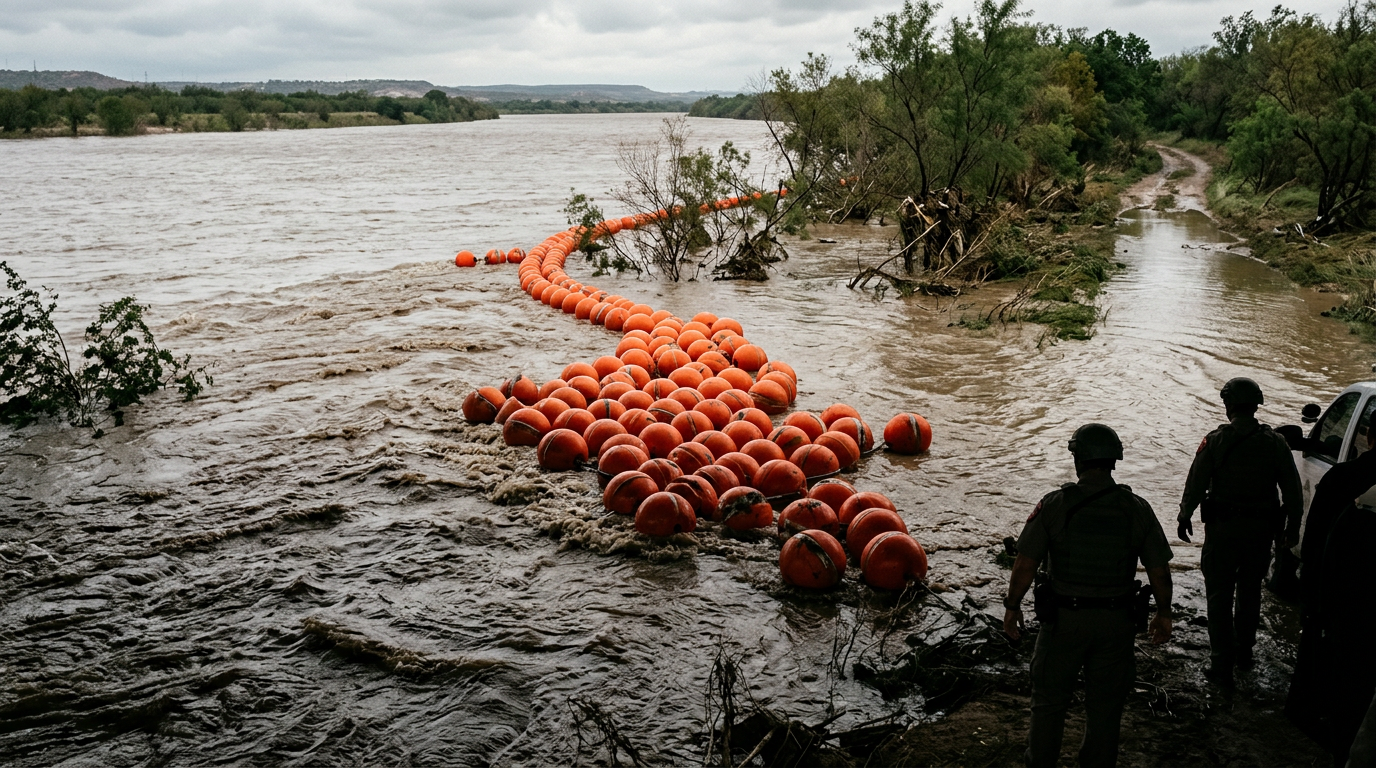
Recent environmental developments along the Rio Grande have impacted Texas's physical border infrastructure. Following a period of significant rainfall and subsequent flooding in the Eagle Pass region, hundreds of the state-installed orange buoy barriers have reportedly shifted from their original positions. These floating barriers, which were deployed as part of a multi-billion dollar border security initiative, were observed moving downstream due to the sheer force of the rising water levels. This event follows a series of seasonal weather patterns that frequently challenge the stability of man-made structures along the international boundary. Historically, the Rio Grande is known for its unpredictable surges, with Eagle Pass often serving as a focal point for both migration concerns and hydrological changes. The installation of these buoys in 2023 was a landmark moment for Texas state policy, marking the first time a state government attempted to build a water-based physical barrier to deter illegal crossings. Previous attempts to secure this region relied heavily on land-based fencing and increased personnel. The move by the elements suggests that even permanent-style maritime installations face unique vulnerabilities during the Texas monsoon and heavy rain seasons.
Texas relevance
This incident directly affects the jurisdictional waters of Texas and the municipal safety of Eagle Pass and Maverick County. As the state continues to invest taxpayer funds into Operation Lone Star, the durability and maintenance of these barriers are of significant interest to Texas residents. The movement of these buoys could potentially impact local river navigation and requires the attention of the Texas Department of Public Safety (DPS) and the Texas Military Department to ensure they are anchored correctly and do not pose a hazard to local bridge infrastructure or downstream communities like Laredo.
Hydrological Pressures and Infrastructure Stability
The Rio Grande is not a static border but a dynamic waterway subject to extreme fluctuations. When heavy rains occur in the watersheds upstream or in the surrounding hills of Eagle Pass, the river can rise several feet in a matter of hours. The pressure exerted by high-velocity water, combined with debris like logs and brush, places immense strain on the cabling and anchoring systems designed to hold the buoys in place.
Engineering experts have long noted that the sedimentation and changing riverbed topography in Maverick County make permanent anchoring difficult. As the water level rises, the buoyancy of the spheres increases the upward pull on the weighted anchors. If the riverbed shifts or the weight is inadequate for the current, the entire chain of barriers can begin to migrate, as seen in this most recent weather event.
Local Impact on Eagle Pass and Maverick County
Citizens in Eagle Pass have become accustomed to the heavy presence of state and federal law enforcement, but the physical movement of large-scale infrastructure presents new challenges. Floating debris the size of these buoys can potentially damage dock structures or become lodged against bridge pylons, necessitating expensive emergency removal operations.
Local officials are tasked with monitoring the river status to ensure that public safety is not compromised. While the primary goal of the barriers is border security, the secondary effects on river access and local environmental conditions remain a priority for the community. The displacement forces a coordinated response between local law enforcement and state agencies to prevent the shifted barriers from interfering with legitimate river monitoring activities.
Ongoing Legal and Regulatory Scrutiny
The buoy barriers have been at the center of a protracted legal battle between the State of Texas and the federal government. The U.S. Department of Justice has previously argued that the barriers violate the Rivers and Harbors Act, which prohibits the unauthorized construction of obstacles in navigable waters. This recent displacement could provide further evidence for those arguing that the barriers are not permanent or controlled structures.
Texas officials, however, maintain that the state has the constitutional authority to protect its borders under invasion clauses. The legal status of these buoys is currently tied up in the appellate courts, and their physical movement due to weather may become a factor in arguments regarding their impact on the navigability and safety of the international waterway.
Maintenance Costs and Taxpayer Responsibility
Operation Lone Star has spent billions of dollars on various deterrents, ranging from concertina wire to shipping containers and the floating buoys. Every time a significant weather event damages or moves these installations, the cost of repair and repositioning falls on the Texas taxpayer. The logistical feat of hauling hundreds of interconnected maritime buoys back upstream requires specialized equipment and significant man-hours.
As the state prepares for future budget cycles, the 'maintenance tail' of these border projects will be scrutinized. Legislators will need to determine if the high cost of maintaining water-based barriers in a flood-prone river is the most efficient use of resources compared to land-based technological surveillance and additional personnel on the riverbanks.
The Evolution of Border Security Tactics
The introduction of floating barriers represented a shift in Texas's strategy, moving from passive land observation to active water intervention. This move was intended to close gaps where traditional fencing could not be easily erected due to the proximity of the river. The buoys were designed to be difficult to climb or swim under, creating a physical psychological deterrent for those attempting to cross the river in deep-water sections.
However, the reality of managing a border on a river means that tactical plans must adapt to the climate. If the buoys continue to shift during the rainy season, the state may look into reinforced anchoring technologies or hybrid solutions that combine floating elements with more permanent pier-like structures, though these would likely face even steeper regulatory hurdles from the International Boundary and Water Commission.
Environmental Considerations and River Health
Environmental groups have raised concerns regarding how the shifting buoy lines might affect the local ecosystem. When the barriers move downstream, they can trap silt and organic material, potentially altering the flow of the river and impacting fish habitats. The movement of the anchors along the riverbed also disturbs the local flora and fauna that inhabit the Rio Grande's unique riparian corridor.
Furthermore, the loose buoys themselves could become a form of pollution if they were to break apart or lose their integrity. State officials have assured the public that the materials used are durable and non-toxic, but the long-term presence of synthetic materials in a major waterway remains a point of observation for environmental monitors and local conservationists.
Analysis
OPINION: The recent displacement of the border buoys underscores a recurring tension between state-led security initiatives and the raw power of Texas nature. While the barriers serve as a visible signal of the state's commitment to border integrity, the high costs associated with their retrieval and re-anchoring after every major flood will likely become a point of debate in upcoming legislative sessions. Proponents will argue this is a minor maintenance hurdle in a larger fight for sovereignty, while critics may point to the incident as evidence that water-based barriers are an impractical long-term solution for a river as volatile as the Rio Grande. Ultimately, the effectiveness of the deterrent is only as strong as its ability to withstand the environment it was built to police.
Source attribution
This story was reported using a public release from the r/TexasPolitics. Keep TX Red rewrote the coverage independently and links to the official statement for verification.
Frequently Asked Questions
- Why were the buoys placed in the Rio Grande?
- The buoys were installed by the State of Texas as part of Operation Lone Star to act as a physical deterrent to prevent individuals from attempting to cross the river illegally in high-traffic or dangerous areas near Eagle Pass.
- Are the shifted buoys a danger to the public?
- While the buoys themselves are buoyant, their movement into navigation channels or near bridge supports can pose hazards to boats and infrastructure. State authorities monitor these movements to mitigate risks.
- Who pays for the repair and repositioning of the barriers?
- The maintenance, retrieval, and re-anchoring of the border buoys are funded by Texas taxpayers through the state budget allocated to border security initiatives.
Official Sources
Take the next step
Browse the Newsroom →Read more about Keep Texas Red → Our full guide to what Keep Texas Red means and why Texans support it.
Get Texas updates delivered weekly.
Independent Texas reporting on politics, policy, and daily life. One email a week. Unsubscribe anytime.
Keep TX Red Newsroom
The Keep Texas Red Editorial Staff produces nonpartisan explainers, policy breakdowns, and educational resources to help Texans understand how their government works. All content is reviewed for accuracy and updated regularly.
About Keep TX Red →