Texas Hemp Law: Delta-8 and Delta-9 Restrictions Start July 31
New hemp regulations take effect July 31, banning specific cannabinoids in Texas after a prolonged legal battle between the state and hemp distributors.
Editorial disclaimer: Opinions and analysis on Keep TX Red are editorial content — not statements of fact. See our editorial standards.
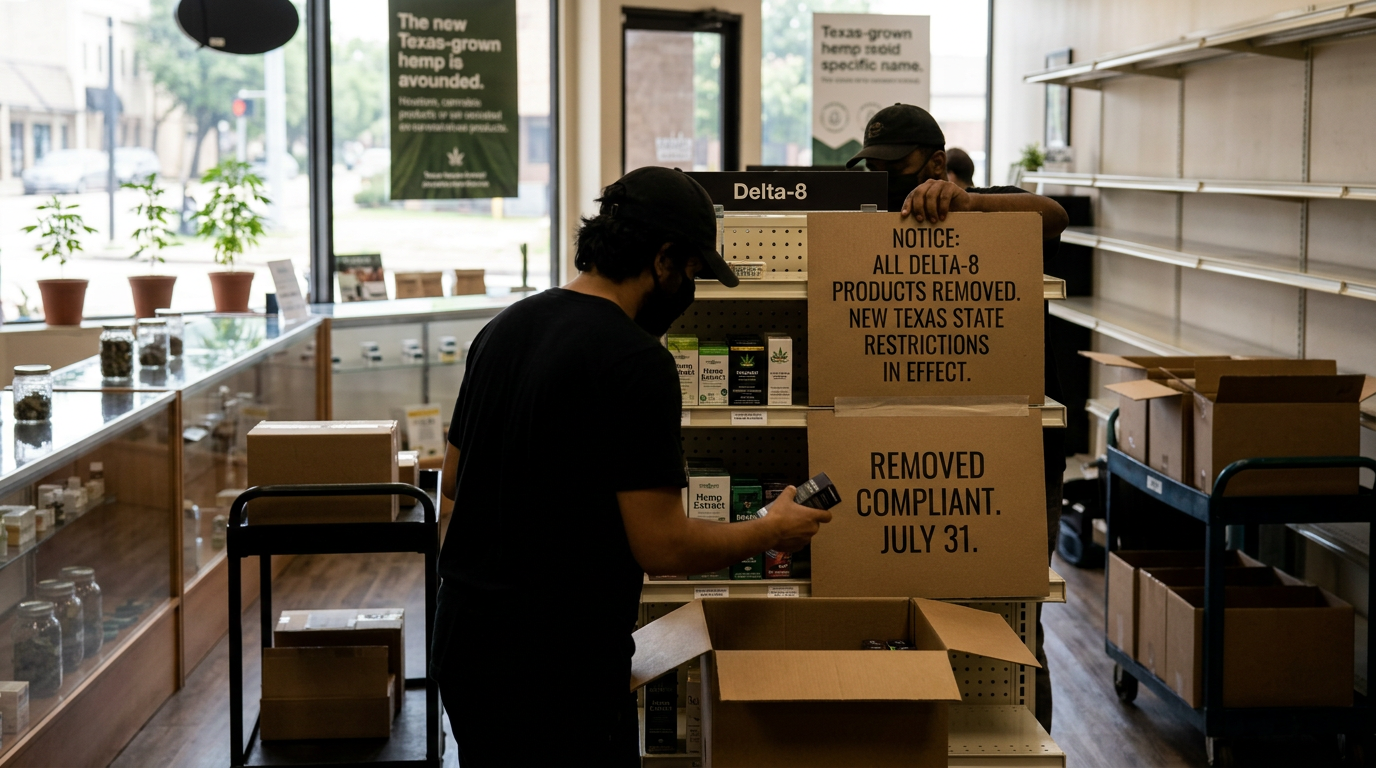
Beginning July 31, 2026, the retail landscape for hemp-derived products in Texas will undergo a significant transformation as new state-mandated restrictions take effect. Following a protracted legal struggle between state health officials and the hemp industry, certain cannabinoids that were previously available in smoke shops and convenience stores will be removed from shelves. This shift marks the culmination of the state’s effort to narrow the definitions established by the 2019 Farm Bill and the subsequent Texas House Bill 1325, which originally legalized hemp production but left room for the emergence of psychoactive hemp derivatives like Delta-8 THC. Throughout the state, business owners and consumers are preparing for a new enforcement era where specific synthetic and semi-synthetic compounds face a total ban under the Department of State Health Services (DSHS) guidelines. The regulatory landscape in Texas has been volatile since the federal government decoupled hemp from the Controlled Substances Act. While Texas initially followed suit to support a local hemp agricultural industry, the rapid rise of concentrated hemp-derived THC products led to immediate friction between the executive branch and stakeholders. State officials have consistently argued that these products pose a public safety risk due to a lack of traditional oversight and the manufacturing processes used to convert CBD into intoxicating isomers. Conversely, the hemp industry has maintained that these products provide therapeutic benefits and significant tax revenue for the state. As the July 31 deadline approaches, the ambiguity that characterized the Texas hemp market for the last several years is being replaced by a codified set of prohibitions aimed at curbing the availability of alternative cannabinoids.
Texas relevance
This regulatory change directly impacts thousands of Texas-based businesses, from small rural hemp farms to urban retail outlets in cities like Dallas, Houston, and San Antonio. Texas has one of the largest hemp markets in the United States, and these bans could result in significant economic shifts as retailers are forced to liquidate inventory or pivot to compliant products. Historically, Texas has been a battleground for hemp rights, notably seen in the 2021 attempts by DSHS to list Delta-8 as a Schedule I substance, which was temporarily blocked by the courts. This latest development represents a more permanent shift in how the state governs its local cannabis-adjacent economy.
The Legal Journey to the July Deadline
The path to the July 31 restrictions is paved with several years of intense litigation and administrative maneuvering. When the Texas Legislature passed House Bill 1325 in 2019, the primary goal was to allow Texas farmers to participate in the growing hemp market. However, the legislation defined hemp by its Delta-9 THC content—limiting it to 0.3% on a dry weight basis. This definition unintentionally allowed for the manufacturing of other isomers like Delta-8, Delta-10, and HHC, which could be synthesized from hemp-derived CBD and still fall under the legal limit of Delta-9.
The Texas Department of State Health Services initially tried to implement a ban on these products in 2021 by updating their scheduled substances list without a legislative vote. This sparked an immediate lawsuit from companies like Hometown Hero, based in Austin, which argued that the agency exceeded its authority. Lower courts initially sided with the distributors, allowing the products to stay on market under temporary injunctions while the case moved through the appellate system. The finality of the July 31 deadline suggests that the state has successfully navigated these legal hurdles, establishing a clear timeframe for the removal of the targeted substances.
Identifying the Banned Substances
Under the new rules, the state is specifically targeting cannabinoids that are produced through chemical synthesis rather than direct extraction from the plant matter in its natural state. While naturally occurring CBD and low-potency Delta-9 remain legal under the previous thresholds, the synthesized isomers that provide 'high' experiences are the primary targets. This includes Delta-8 THC, which has become the most popular alternative to traditional marijuana in the state, as well as more potent derivatives like THC-O and various THC-P variants.
Retailers are being instructed to conduct thorough audits of their stock. Any product that contains an amount of these specific cannabinoids will be considered an adulterated or misbranded product under Texas law post-July 31. This classification allows state health inspectors to seize products and levy fines against businesses that fail to comply. The state has indicated that the focus is on the molecular integrity of the products, particularly those that have been modified to increase potency beyond what is found in the raw hemp flower.
Economic Consequences for Texas Retailers
The economic footprint of the hemp industry in Texas is substantial, with estimates suggesting it contributes hundreds of millions of dollars to the state's economy annually. Many boutique smoke shops and health-focused CBD stores have relied on Delta-8 sales to sustain their operations. Owners report that these products often make up more than 50% of their total revenue. The sudden removal of these items could lead to store closures and job losses across the state, particularly for small independent operators who lack the diverse inventory of larger chains.
Furthermore, Texas farmers who invested in high-CBD hemp oil production may find fewer domestic buyers. If the demand for CBD—the primary ingredient for synthesized THC—drops due to the retail ban, the wholesale price of hemp biomass could plummet. This creates a ripple effect throughout the agricultural sector, where Texas farmers are already struggling with volatile weather and high input costs. Industry advocates are currently looking for alternative markets for their products, including export opportunities to states with more permissive hemp laws.
Consumer Impact and Safety Concerns
For the consumer, the July 31 change means reduced access to products they may have used for sleep, anxiety, or pain management. Critics of the ban argue that by removing regulated (though loosely) retail products, the state may inadvertently drive consumers back to the illicit black market. In the underground market, there is no requirement for third-party lab testing, which could lead to an increase in health risks related to heavy metals, pesticides, or inaccurate dosing.
The state’s counter-argument emphasizes that the current loosely regulated market is itself a safety risk. Officials point to reports of accidental ingestions by minors and the lack of standardization in how these synthetic compounds are created. By enforcing a ban, the state hopes to eliminate what it views as a 'gray market' that bypasses the intent of Texas’s strict drug laws. Consumers will need to transition to federally compliant Delta-9 products that meet the dry-weight requirements or stick to non-intoxicating versions of CBD and other minor cannabinoids like CBG.
Enforcement and Compliance Expectations
Enforcement of the new hemp rules will fall largely under the jurisdiction of the DSHS and local law enforcement agencies. Retailers can expect increased inspections following the July 31 deadline. These inspections will likely involve reviewing certificates of analysis (COAs) for all hemp products on store shelves. A COA is a document from an accredited laboratory that details the cannabinoid profile of a product. If a COA shows the presence of a banned substance, the retailer could face immediate administrative action.
Local police departments may also play a role, although their involvement usually occurs if products are suspected of exceeding the 0.3% Delta-9 limit, which remains a criminal threshold in Texas. The distinction between administrative violations handled by DSHS and criminal violations handled by police remains a critical area for business owners to understand. To ensure compliance, many Texas hemp businesses are currently consulting with legal counsel to revise their inventory lists and update their product labeling.
Future of the Texas Hemp Industry
Despite the new restrictions, the hemp industry in Texas is not disappearing; rather, it is evolving. Forward-looking companies are already pivoting toward 'legal limit' Delta-9 edibles. Because the law limits Delta-9 by weight, a heavy gummy or brownie can still contain a noticeable amount of THC while remaining below the 0.3% threshold. This 'compliant' market is expected to expand as the dedicated Delta-8 market shrinks. Additionally, interest in minor cannabinoids that are not chemically modified, such as CBN (cannabinol) for sleep, is expected to grow.
The legislative session in 2027 will likely see renewed efforts to clarify these laws. Industry lobbyists are expected to push for a more robust regulatory framework that includes licensing fees and higher safety standards in exchange for keeping certain products legal. Meanwhile, state leadership appears committed to maintaining a traditional stance on THC. The July 31 deadline is just the latest chapter in a long-term debate over how Texas will balance agricultural opportunity with its historical opposition to cannabis culture.
Analysis
The upcoming enforcement represents a strategic victory for Texas state agencies that have sought to close the 'hemp loophole' for years. By targeting specific molecular structures rather than hemp as a plant, the state is attempting to draw a hard line between industrial hemp and psychoactive retail products. While this move is framed as a health and safety measure, the political undertones suggest a continued resistance to any form of cannabis legalization by the current state leadership. For the Texas GOP and conservative voters, this tightening of rules aligns with a 'law and order' approach to substance control, even as neighboring states move toward broader decriminalization. The long-term impact may be a consolidation of the Texas hemp industry, where only the most well-capitalized firms can navigate the shifting compliance requirements.
Source attribution
This story was reported using a public release from the r/texas. Keep TX Red rewrote the coverage independently and links to the official statement for verification.
Frequently Asked Questions
- Will Delta-8 be completely illegal in Texas after July 31?
- Yes, under the updated Department of State Health Services rules, Delta-8 THC is categorized as a controlled substance, making its sale and possession within the state a violation of the new regulatory framework.
- Can I still buy CBD oil in Texas?
- Yes, CBD oil that contains less than 0.3% Delta-9 THC and does not contain the newly banned synthetic cannabinoids remains legal for purchase and use in Texas.
- What should retailers do with their existing stock?
- Retailers must remove all banned products from their shelves before the July 31 deadline. Many businesses are holding clearance sales to liquidate inventory before the state's enforcement begins.
- Does this law affect medical marijuana in Texas?
- No, this change only affects the hemp market. The Texas Compassionate Use Program, which allows for low-THC medical cannabis for specific qualifying conditions, remains a separate program and is unaffected by these hemp retail restrictions.
Official Sources
Take the next step
Browse the Newsroom →Read more about Keep Texas Red → Our full guide to what Keep Texas Red means and why Texans support it.
Get Texas updates delivered weekly.
Independent Texas reporting on politics, policy, and daily life. One email a week. Unsubscribe anytime.
Keep TX Red Newsroom
The Keep Texas Red Editorial Staff produces nonpartisan explainers, policy breakdowns, and educational resources to help Texans understand how their government works. All content is reviewed for accuracy and updated regularly.
About Keep TX Red →