Houston Protest Movements Intensify Following Fatal Federal Law Enforcement Shooting
Public outcry grows in Houston following the fatal shooting of Lorenzo Salgado Araujo by ICE agents, sparking debates on federal oversight.
Editorial disclaimer: Opinions and analysis on Keep TX Red are editorial content — not statements of fact. See our editorial standards.
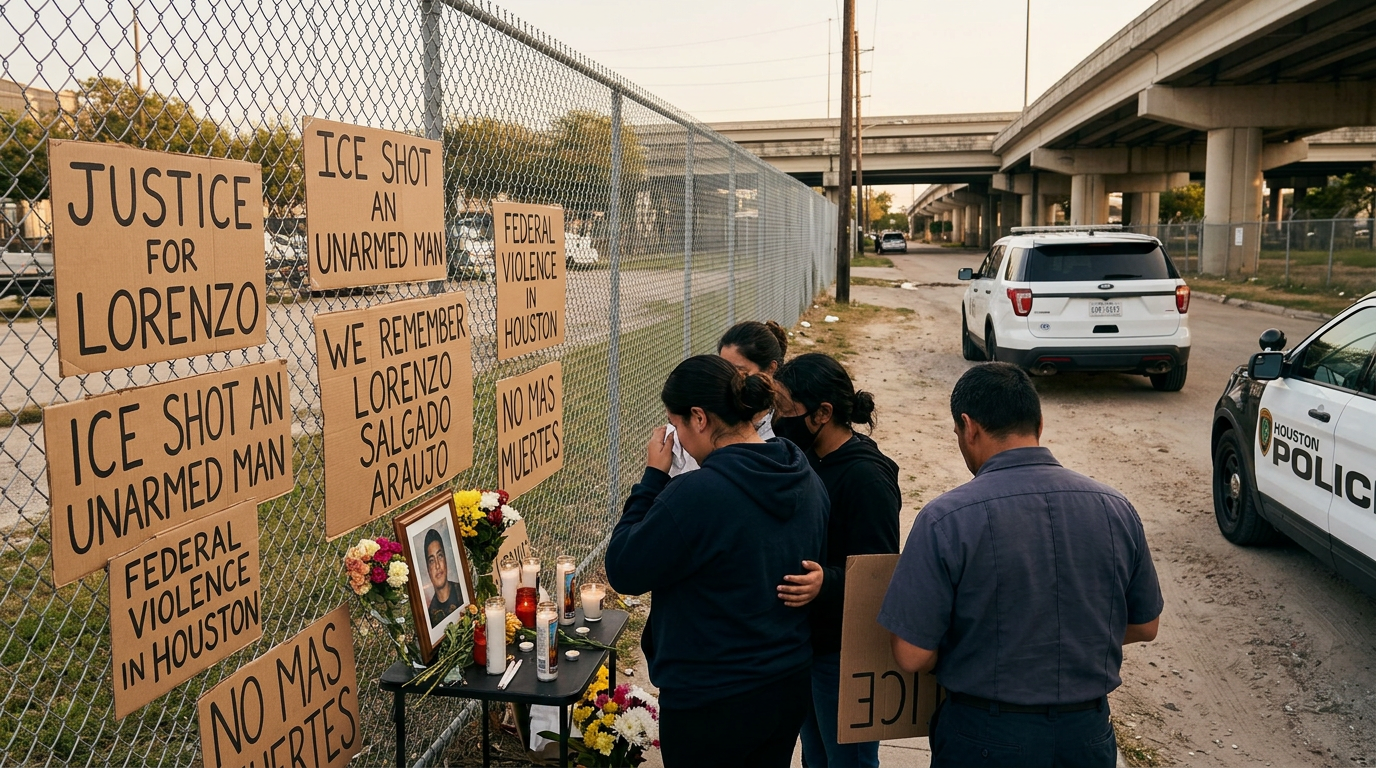
The city of Houston has entered a period of significant social friction following the fatal shooting of Lorenzo Salgado Araujo by Immigration and Customs Enforcement (ICE) agents. In the wake of the incident, local residents have mobilized, transforming the site of the shooting into a focal point for public grieving and political demonstration. This movement has cascaded from the streets into the formal halls of governance, specifically the Houston City Council, where community members are demanding a clear accounting of the events that led to the use of lethal force. Historically, Texas has seen similar friction points in major metropolitan hubs like Dallas and Austin, where local populations often react swiftly to perceived federal overreach or lack of transparency in law enforcement operations involving immigrants. The current situation in Houston reflects a broader tension between federal mandate execution and municipal peace, exacerbated by the visibility of the legal and physical aftermath in a heavily populated residential area.
Texas relevance
This situation is a uniquely Texas issue because Houston serves as one of the primary hubs for federal immigration enforcement activities in the Southern United States. The city's diverse demographics and its proximity to the border make it a central stage for the ongoing debate over how federal agencies interact with local communities. Texas law, particularly statutes concerning the cooperation or lack thereof between municipal police and federal immigration authorities, provides the backdrop for why these confrontations often lead to such significant public outcry. The outcome of the investigations into this specific shooting could influence future local policies regarding how the Houston Police Department coordinates with federal task forces, a topic that has remained a lightning rod in the Texas Legislature for several sessions.
An Afternoon of Escalation in Harris County
The incident began as a standard enforcement operation but quickly spiraled into a lethal encounter on the streets of Houston. According to preliminary reports, the interaction in which Lorenzo Salgado Araujo was killed happened rapidly, leaving witnesses and family members with a sense of shock. Unlike local law enforcement shootings, which are typically subject to immediate body-camera release policies under certain municipal guidelines, federal agencies operate under different protocols, leading to an information lag that has frustrated the community.
As the news of the shooting spread, the immediate area was cordoned off, but the perimeter soon became a site of protest. This underscores the logistical challenges faced by Houston’s municipal services when federal actions occur within city limits. The local police department often finds itself in the difficult position of managing crowds and securing scenes for an investigation that is not entirely under their control, highlighting a jurisdictional complexity inherent to Texas's largest city.
In the days following the event, the physical space of the shooting has been transformed into a memorial. This transition from a crime scene to a public altar is a recurring phenomenon in Texas's urban centers, serving as both a place of mourning and a platform for political speech. This development has kept the incident at the forefront of the local news cycle, preventing the story from fading as new headlines emerge.
Testimony and Tension at Houston City Council
The energy from the streets eventually migrated to the Houston City Council chambers. During public comment sessions, dozens of residents and activists filled the room to voice their grievances directly to the Mayor and Council members. The testimony has been characterized by emotional appeals and demands for the city to take a firmer stand against federal agency tactics that residents perceive as high-risk or unnecessary in residential neighborhoods.
Council members have responded with a mix of caution and concern, noting that their oversight over federal agencies like ICE is legally limited. However, the political pressure is mounting for the city to re-evaluate its memorandum of understanding with federal law enforcement. These documents often dictate how much information is shared and how much logistical support local officers provide during federal stings or arrests.
The public's demand for answers focuses on the specific justification for the use of deadly force. Without a clear narrative from federal investigators, the city council is left to manage a constituents' crisis with very few administrative tools. This has led to a stagnant political environment where officials can offer little more than promises to monitor the situation, a response that has so far failed to satisfy the gathered crowds.
Federal Law Enforcement Protocols and Public Transparency
One of the primary points of contention in the Houston incident is the perceived lack of transparency inherent in federal investigations. Unlike the Houston Police Department, which has faced significant reforms regarding transparency and the release of video evidence, ICE and other federal entities often keep such materials internal for the duration of a multi-month or multi-year investigation. This cultural clash between local expectations and federal policy is at the heart of the current unrest.
Legal experts in Texas point out that when a federal agent is involved in a shooting on municipal soil, the legal shield provided by federal immunity can make it exceptionally difficult for local prosecutors or families to seek traditional forms of accountability. This creates a perception of a 'dual system' of justice in Houston, where federal agents are seen as operating outside the norms established for local and state police officers.
The push for federal law enforcement reform is not new to Texas, but the death of Salgado Araujo has localized a national debate. Moving forward, the conversation in Houston will likely center on whether the city can or should implement 'transparency triggers' that would require federal partners to adhere to local standards of disclosure if they wish to utilize city infrastructure or person-power in their operations.
Impact on Community Trust and Police Relations
Beyond the immediate political fallout, the shooting has serious implications for the long-term trust between Houston's immigrant communities and law enforcement in general. Community leaders argue that when federal agents use lethal force in these neighborhoods, it discourages residents from reporting local crimes or cooperating with municipal police for fear that any law enforcement presence could lead to a similar outcome. This 'chilling effect' is a major concern for public safety advocates.
The Houston Police Department has spent years building outreach programs to ensure that all residents, regardless of their legal status, feel safe engaging with officers to report victimization. Events like the Salgado Araujo shooting are seen by many as a setback to these efforts. When the line between local protection and federal enforcement is blurred by a single violent incident, the social fabric of the neighborhood begins to fray under the weight of suspicion.
To combat this, some local officials are calling for a definitive 'separation of duties' announcement, clarifying that municipal resources were not involved in the actual execution of the shooting. Still, for many residents, the distinction between a badge from the city and a badge from the federal government is less important than the presence of a firearm in their community.
The Long-Term Legal and Civil Path Forward
The legal aftermath of the shooting is expected to be protracted. Civil rights attorneys representing the family have begun the process of independent fact-finding, which often includes seeking private surveillance footage from nearby businesses to piece together the moments leading up to the gunfire. These independent investigations are often the only way for the public to receive information in the short term, as official reports are processed through federal channels.
This case may also trigger a review by the Department of Justice, though such interventions are rare and usually reserved for systemic issues rather than individual incidents. Regardless, the civil litigation that typically follows such events will serve as a discovery process that could eventually bring more facts to light. In Texas, the outcome of these lawsuits often hinges on the ability to prove that federal protocols were violated or that the force used was objectively unreasonable.
The city of Houston stands at a crossroads. As it balances its role as a major international gateway with its responsibility to protect its citizens, the resolution of the Salgado Araujo case will serve as a precedent. Whether it leads to policy reform or a hardening of existing divisions remains to be seen, but the 'Houston inflection point' is now a documented chapter in the state's ongoing struggle with the complexities of federalism.
Analysis
OPINION: The escalating rhetoric at Houston City Hall suggests that the local government is being pressured to act as a buffer between its residents and federal agencies. While ICE operates under federal jurisdiction, the clinical silence often maintained by federal departments during active investigations frequently clashes with the immediate demands for transparency from a grieving public. This gap in communication creates a vacuum where distrust grows. If federal authorities do not provide a comprehensive timeline and justification for the shooting soon, Houston may see a legislative push to further restrict local resources from assisting in federal immigration initiatives, a move that would undoubtedly trigger a legal showdown with state-level leadership in Austin.
Source attribution
This story was reported using a public release from the Texas Monthly. Keep TX Red rewrote the coverage independently and links to the official statement for verification.
Frequently Asked Questions
- What happened to Lorenzo Salgado Araujo?
- Lorenzo Salgado Araujo was fatally shot by federal agents from Immigration and Customs Enforcement (ICE) during an enforcement operation in Houston. The specific details surrounding the immediate cause for the use of lethal force are currently under investigation and have not yet been fully disclosed by the federal agency.
- Does the Houston City Council have oversight over ICE?
- No, the Houston City Council does not have direct oversight or authority over federal agencies like ICE. However, the Council can influence how the Houston Police Department interacts or collaborates with these agencies through city ordinances and budgetary control.
- How does Texas law handle cooperation with federal immigration agents?
- Texas law, specifically through legislation like Senate Bill 4 (SB4), generally requires local law enforcement agencies to cooperate with federal immigration detainer requests. However, the specifics of how local police assist in active federal field operations are often managed through local department policies and inter-agency agreements.
- What are the protesters demanding from the city?
- Protesters and community members are primarily demanding a full and transparent investigation into the shooting, the release of any available video footage, and a formal reassessment of how federal agencies are permitted to operate within Houston's residential neighborhoods.
Official Sources
Take the next step
Browse the Newsroom →Read more about Keep Texas Red → Our full guide to what Keep Texas Red means and why Texans support it.
Get Texas updates delivered weekly.
Independent Texas reporting on politics, policy, and daily life. One email a week. Unsubscribe anytime.
Keep TX Red Newsroom
The Keep Texas Red Editorial Staff produces nonpartisan explainers, policy breakdowns, and educational resources to help Texans understand how their government works. All content is reviewed for accuracy and updated regularly.
About Keep TX Red →