Governor Abbott Appoints Robert Howden as New Texas Secretary of State Following Nelson Resignation
Robert Howden, a veteran legislative strategist, steps in as the new Texas Secretary of State to manage state elections and international relations.
Editorial disclaimer: Opinions and analysis on Keep TX Red are editorial content — not statements of fact. See our editorial standards.
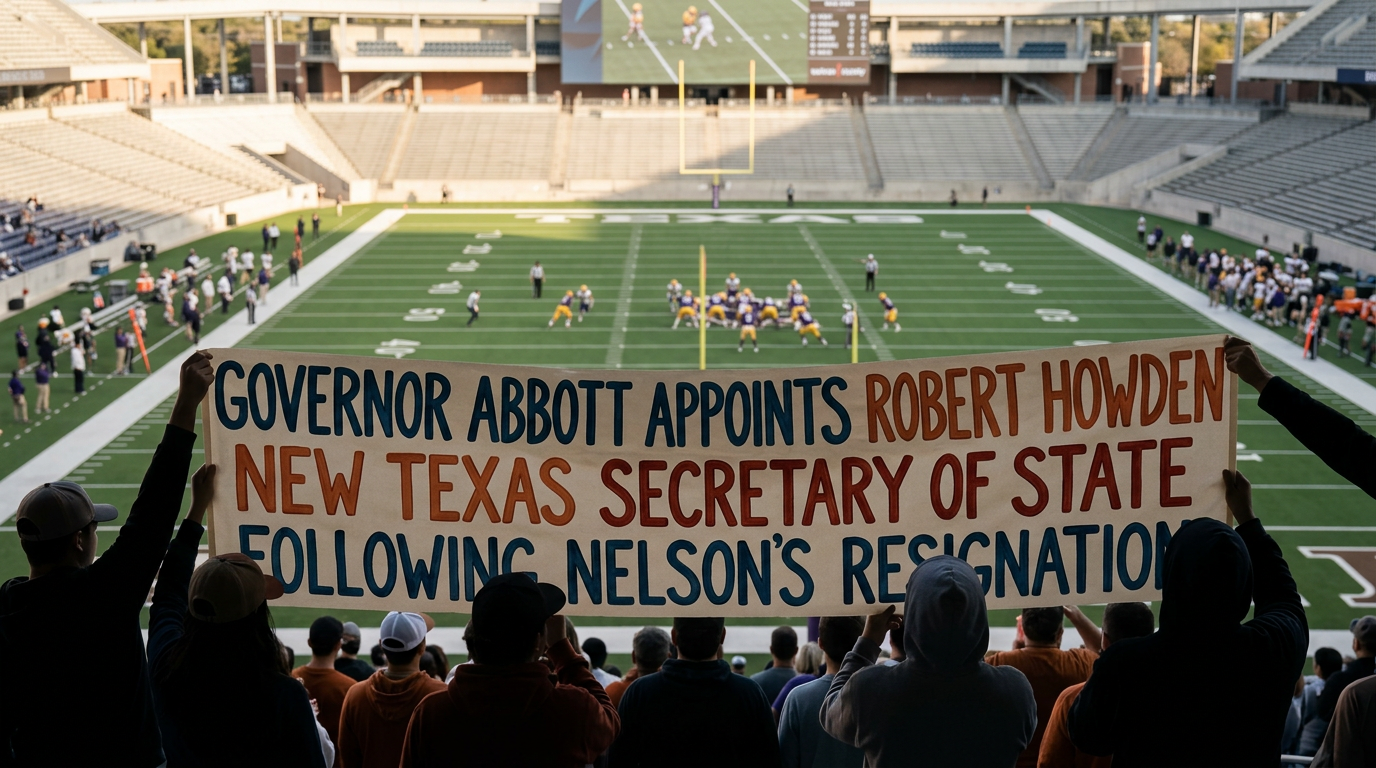
Governor Greg Abbott has officially designated Robert Howden as the next Texas Secretary of State, filling a critical vacancy in the state's executive branch. Howden moves into this prominent role following the departure of Jane Nelson, whose resignation concluded on a Friday morning. This appointment places a seasoned political operative at the helm of the agency responsible for overseeing Texas elections, maintaining business filings, and serving as the primary liaison for international affairs. Historically, this position has seen frequent turnover under various administrations, with the Secretary acting as the Governor's eyes and ears on the ground during high-stakes election cycles. Howden's background as a legislative insider suggests a continuation of the administration's current regulatory and electoral strategies. The Secretary of State is a constitutionally mandated office, though unlike other high-ranking officials in the state, it is an appointed rather than an elected position. This specific transition comes at a time when the state is refining its voting protocols and seeking to strengthen trade ties with neighbors like Mexico. Howden's previous tenure within the Governor's office provided him with the necessary groundwork to navigate the complex relationship between the executive branch and the state legislature. As he assumes control of the agency, the office is expected to maintain its focus on election integrity and economic development initiatives that characterize the current leadership's platform in Austin.
Texas relevance
The Secretary of State holds immense power over the 254 counties in Texas, serving as the chief election officer. For Texans, this transition means a new hand at the wheel for the 2026 election cycle and beyond. Any changes in leadership at this level can influence how voting laws are interpreted, how business registrations are processed in one of the world’s largest economies, and how Texas presents itself to foreign dignitaries and investors. In recent years, the office has overseen significant audits of election results and navigated the implementation of sweeping changes to the state's election code. Every citizen who casts a ballot or registers a corporation in Texas is directly impacted by the efficiency and policy directives of the Secretary of State's office.
The Strategic Role of the Texas Secretary of State
While many Texans are familiar with the Governor and Lieutenant Governor, the Secretary of State operates in a multi-faceted capacity that touches almost every aspect of state governance. As the chief election officer, the Secretary is responsible for ensuring that election laws are applied uniformly across vastly different jurisdictions, from the sprawling suburbs of North Texas to the rural reaches of the Panhandle. This involves providing guidance to county clerks and managing the state's voter registration database.
Beyond the ballot box, the office is the gateway for the Texas economy. It manages the filing of business documents, liens, and various other public records that allow the wheels of commerce to turn. For a state that prides itself on being a premier destination for business relocation, the administrative efficiency of this office is a key selling point for the administration's economic narrative. Howden will now oversee the staff tasked with maintaining these essential public records.
International relations also fall under the Secretary's purview. The Secretary serves as the Governor's lead ambassador for international affairs, representing Texas interests in meetings with foreign consuls and trade delegations. Given the importance of the United States-Mexico-Canada Agreement (USMCA) to the Texas economy, the Secretary's role in facilitating cross-border dialogue is more than symbolic; it is a vital component of the state's global economic strategy.
Howden’s Background and Legislative Experience
Robert Howden is not a newcomer to the intricacies of the Texas Capitol. Before this appointment, his role as legislative director for Governor Abbott placed him at the center of the most contentious debates in recent legislative sessions. This experience gave him a front-row seat to the drafting and passage of laws that he will now be tasked with implementing from an administrative standpoint. His understanding of the legislative process is expected to streamline coordination between the Secretary’s office and the state house.
Howden’s career in Austin has been marked by a focus on policy implementation and stakeholder management. Colleagues often describe him as a detail-oriented strategist who understands the political landscape of Texas as well as anyone currently serving in government. This background is particularly useful for a Secretary of State, who must often defend state policies in courtrooms or before hostile legislative committees. His transition from the Governor's inner circle to a departmental head preserves the continuity of Abbott's executive vision.
His appointment also signals a move toward stability. After the departure of Jane Nelson, who brought decades of legislative experience to the role, the administration needed someone who could hit the ground running without a significant learning curve. Howden’s familiarity with the existing staff and the ongoing initiatives within the Secretary of State’s office suggests that there will be very little disruption in the agency's daily operations during this transition period.
The Legacy of Jane Nelson’s Tenure
Jane Nelson, the outgoing Secretary, left a significant mark on the office during her relatively brief tenure. A former state senator known for her leadership on the Senate Finance Committee, Nelson brought a high level of gravitas and bipartisan respect to the position. Her resignation marks the end of a chapter where the office focused on stabilizing election procedures following the turbulent 2020 and 2022 cycles. Nelson was often praised for her professional demeanor and her deep knowledge of the state budget.
During her time in office, Nelson traveled extensively across the state to meet with local election officials, attempting to bridge the gap between Austin and the various county governments. Her departure was anticipated, yet it still creates a void in the state's leadership that Howden is now expected to fill. Her legacy will likely be viewed as one of competence and transition, moving the office past the immediate controversies of previous election audits and toward a more standardized administrative footing.
Nelson’s retirement from the role signifies a broader shift in the administration's personnel strategies as it looks toward the next legislative session and the upcoming election years. By handing the reins to Howden, the administration is moving from a profile of legislative seniority to one of executive-branch strategy. This shift may reflect the Governor's desire for a more direct line of communication and control over the agency's future direction.
Challenges Facing the New Secretary
One of the primary challenges Howden will face is the ongoing debate over election security and voter access. Texas has been a focal point for national discussions regarding how elections are conducted, and the Secretary of State is often the first line of defense for the state's policies. Howden will be responsible for overseeing the implementation of new technology and security measures while ensuring that the voting process remains accessible to all eligible Texans as the state's population continues to boom.
The technological infrastructure of the Secretary of State's office is also a perennial concern. As cyber threats evolve, protecting the integrity of the state's voter rolls and business filing systems is a high-priority task. Howden will need to work closely with the Department of Information Resources to ensure that the agency's digital assets are secure against both foreign and domestic interference. This technical side of the job is often overlooked but is essential for maintaining public trust in state institutions.
Additionally, the Secretary must manage the various legal challenges that frequently target the office. From lawsuits regarding ballot language to disputes over candidate eligibility, the Secretary of State is a common defendant in high-profile litigation. Howden’s background in legislative law will be put to the test as he coordinates with the Attorney General's office to defend state statutes and administrative rules in both state and federal courts.
Economic Implications and Trade Relations
As the state’s chief protocol officer, Howden will spend a significant amount of time engaging with international partners. Texas is the nation’s top exporter, and much of that success depends on smooth relations with foreign governments. The Secretary of State plays a key role in hosting foreign dignitaries and organizing trade missions that promote Texas industries like energy, technology, and agriculture. Howden’s ability to sell the 'Texas Miracle' to international audiences will be a key metric of his success.
Maintaining the state's business-friendly environment is another core mission. The Secretary’s office manages the Business and Public Filings Division, which processes thousands of registrations every month. Any delays or inefficiencies in this department can have real-world consequences for entrepreneurs and corporations looking to do business in Texas. Howden is expected to continue the push for modernization within this division to ensure that Texas remains competitive with other business-heavy states like Florida and Nevada.
The role also involves a degree of advocacy for the state's economic interests at the federal level. While foreign policy is primarily a federal concern, the Secretary of State often provides input on how federal trade agreements or border policies impact the Texas economy. Howden will likely find himself in frequent communication with federal agencies to ensure that Texas’s unique needs are understood and addressed in Washington D.C.
The Appointment Process and Senate Confirmation
In the state of Texas, the Secretary of State is appointed by the Governor with the advice and consent of the Senate. This process ensures that the appointee has the backing of the upper chamber of the legislature. While the Governor’s appointment takes effect immediately, the formal confirmation process often involves hearings where senators can question the appointee on their vision for the office and their commitment to upholding state law.
Because Howden served as the Governor's legislative director, he already has deep relationships with many of the senators who will be voting on his confirmation. This familiarity is likely to make the confirmation process smoother than it might be for an outsider. However, the process still provides an opportunity for lawmakers to voice their concerns or priorities regarding how the Secretary’s office should be managed over the next few years.
The timing of such appointments is often strategic, occurring during periods that allow the new official to settle in before the next regular legislative session begins. By taking the role now, Howden has several months to review agency operations and prepare his legislative priorities for the upcoming session. His successful confirmation will solidify his standing as one of the most powerful unelected officials in the state government.
Analysis
The selection of Robert Howden reflects a preference for internal loyalty and deep legislative expertise within the Abbott administration. By choosing his former legislative director, Abbott ensures that the Secretary of State's office remains tightly aligned with the Governor's specific policy goals. This move avoids the potential friction that can occur when a more independent political figure takes the role. Howden is known for his ability to translate executive priorities into actionable policy, a skill that will be vital as Texas continues to face national scrutiny over its voting procedures and border-related trade policies. This appointment suggests that the executive office intends to maintain a very close watch on the administrative functions of the state through a trusted ally.
Source attribution
This story was reported using a public release from the Texas Standard. Keep TX Red rewrote the coverage independently and links to the official statement for verification.
Frequently Asked Questions
- What are the primary duties of the Texas Secretary of State?
- The Texas Secretary of State is the chief election officer, responsible for the uniform application of election laws across the state. The office also handles business and public filings, oversees the state's notary public system, and serves as an ambassador for international affairs and trade relations on behalf of the Governor.
- Why is the Secretary of State an appointed position in Texas?
- Unlike most other high-ranking state officials in Texas who are elected by the public, the Secretary of State is appointed by the Governor and must be confirmed by the Texas Senate. This structure was established by the Texas Constitution to allow the Governor to select a close advisor to manage these specific administrative and ceremonial functions.
- Who did Robert Howden replace?
- Robert Howden replaced Jane Nelson, who resigned from the position on a Friday morning. Nelson was a well-known figure in Texas politics, having served as a long-time member of the Texas Senate before her appointment to the Secretary of State role.
- How does this appointment affect Texas business owners?
- The Secretary of State’s office manages the filing of all corporate documents and business registrations in Texas. A new Secretary can influence the efficiency of these services and the implementation of any new regulations passed by the legislature that affect how businesses are registered or maintained in the state.
Official Sources
Take the next step
Browse the Newsroom →Read more about Keep Texas Red → Our full guide to what Keep Texas Red means and why Texans support it.
Get Texas updates delivered weekly.
Independent Texas reporting on politics, policy, and daily life. One email a week. Unsubscribe anytime.
Keep TX Red Newsroom
The Keep Texas Red Editorial Staff produces nonpartisan explainers, policy breakdowns, and educational resources to help Texans understand how their government works. All content is reviewed for accuracy and updated regularly.
About Keep TX Red →