Houston Migrant Van Shooting: Federal Probe Targets Possible Drug Smuggling Links
FBI finds potential meth in a van involved in a fatal Houston shooting, while defense attorneys claim the substance was merely common table salt.
Editorial disclaimer: Opinions and analysis on Keep TX Red are editorial content — not statements of fact. See our editorial standards.
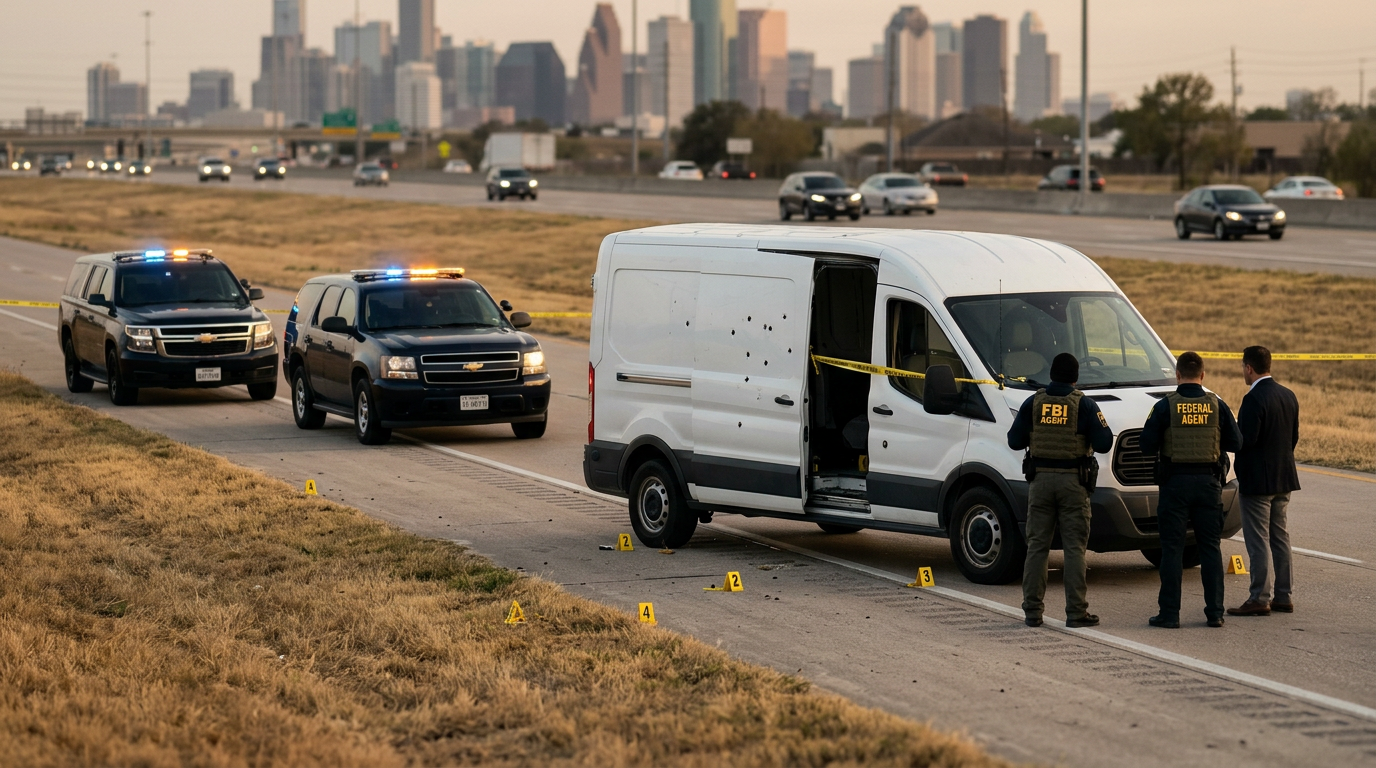
A fatal shooting in Houston involving a van transporting migrants has entered a complex legal phase as federal investigators and defense attorneys clash over the nature of evidence found at the scene. The incident, which resulted in a loss of life and multiple injuries, initially drew attention due to the circumstances of the transport. However, recent filings from the Federal Bureau of Investigation suggest that the vehicle may have been involved in more than just human smuggling. Federal agents reported the discovery of a white crystalline substance within the vehicle, which they have characterized as methamphetamine based on preliminary assessments. This discovery significantly alters the potential charges and the scope of the federal investigation into the criminal networks operating within the Houston metro area. Historically, Houston has served as a major logistical hub for both labor trafficking and narcotics distribution due to its proximity to the Gulf Coast and major interstate arteries like I-10 and I-45. In previous years, the Department of Justice has noted that these criminal enterprises frequently overlap, with vehicles used for human transport also being utilized to move illicit substances to maximize profit per transit. This latest incident follows a pattern of increased federal scrutiny on 'stash houses' and transport vans in Harris County, which remains one of the most active jurisdictions for federal human smuggling prosecutions in the United States. The tension between local law enforcement and federal agencies often surfaces in these cases, but the current dispute centers entirely on the forensic validity of the evidence collected from the van. In a sharp rebuttal to the federal claims, legal counsel representing the driver and associated parties has challenged the FBI’s narrative. The defense team asserts that the substance identified as a dangerous narcotic is, in fact, common table salt. This dispute over chemical identification has become a focal point of the pretrial proceedings, as it dictates whether the prosecution can pursue enhanced sentencing based on drug trafficking statutes. The defense argues that the rush to characterize the substance as meth is a 'prejudicial error' that unfairly taints the public perception of the migrants and the driver involved in the fatal encounter. As the case moves forward, the disparity between an alleged major drug haul and a common household seasoning presents a stark divide in the factual record.
Texas relevance
The city of Houston is at the center of this legal battle, highlighting the persistent challenges Texas face as a primary corridor for international transit and organized crime. Texas residents frequently deal with the fallout of high-speed chases and violent encounters involving smuggling operations that spill into residential neighborhoods. This case is particularly relevant to the Houston community because it underscores the strain on local medical and emergency resources when these interstate operations turn violent on city streets. Furthermore, the accuracy of forensic testing in Texas federal courts is a matter of significant public interest, as it impacts the integrity of the judicial system within the state.
The Circumstances of the Fatal Encounter
The investigation began following a violent incident on a Houston-area roadway where a van carrying several individuals was targeted by gunfire. The shooting resulted in immediate chaos, leading to a fatal outcome for at least one passenger and causing the vehicle to come to a halt under intense police scrutiny. Surveillance footage and witness accounts suggest the van was being tracked by unidentified assailants prior to the discharge of weapons, a hallmark of inter-gang rivalry or 'rip-off' crews common in the smuggling trade.
Local Houston police were the first on the scene, but the case was quickly elevated to federal jurisdiction once the status of the passengers as undocumented migrants was confirmed. The transition from a local homicide investigation to a federal smuggling and narcotics inquiry changed the stakes for all involved. The FBI's involvement brought greater resources but also higher pressure to identify a motive for the shooting, leading agents to search the vehicle for contraband that could explain why it became a target of a daylight assassination attempt.
While the identity of the shooter remains a separate branch of the ongoing probe, the focus has shifted heavily toward what was inside the van. Prosecutors are looking for links between the transport of people and the transport of high-value illicit goods. In many Texas-based smuggling cases, the presence of drugs is often what triggers violence, as competing organizations vie for control of the lucrative routes that pass through the state's largest city.
The Forensic Dispute: Methamphetamine vs. Salt
At the heart of the current legal filing is the FBI's claim that a significant quantity of methamphetamine was recovered from the vehicle. This assertion is based on initial field tests and the visual appearance of the substance. Such claims are standard in federal affidavits to secure warrants and justify pre-trial detention without bail. However, the exact weight and purity of the substance have yet to be publicly verified by a secondary, independent laboratory analysis, leaving a window of opportunity for the defense to challenge the narrative.
The defense attorney's counter-claim that the substance is salt is not as unusual as it might seem to the public. In various high-profile cases across the country, field test kits used by law enforcement have been known to produce 'false positives' for substances like powdered sugar, drywall dust, or salt. By identifying the substance as salt, the defense is targeting the credibility of the FBI's probable cause. If the 'meth' disappears from the evidentiary record, the narrative shifts from a dangerous drug-running operation back to a human smuggling case, which carries different legal weight and public sentiment.
This disagreement creates a waiting period for definitive lab results. In the interim, the reputation of the individuals involved hangs in the balance. The defense has been vocal in the media, suggesting that the government is 'over-charging' and 'over-sensationalizing' the case to fit a political narrative regarding border insecurity and crime in Texas cities. This rhetorical battle highlights the adversarial nature of the Houston federal court system.
Impact on the Migrant Community in Houston
The passengers in the van, many of whom are now witnesses in a federal criminal case, find themselves in an incredibly vulnerable position. The trauma of the fatal shooting is compounded by the possibility of being tied to a narcotics investigation. In Houston, where the migrant population is a vital part of the local economy, incidents like these often drive a wedge between immigrant communities and law enforcement. The fear of being wrongly accused of drug trafficking may prevent other witnesses from coming forward in similar cases.
Advocates in the Harris County area have noted that migrants are often the victims of these criminal enterprises, not the masterminds. If the van was indeed carrying both people and drugs, the migrants may have been used as 'human shields' for the contraband without their knowledge. This tactic is a recurring theme in North Texas and Houston-area smuggling rings, where the safety of the human cargo is secondary to the security of the product. The outcome of the 'salt vs. meth' debate will significantly impact how these individuals are treated by the immigration court system.
Furthermore, the shooting has reignited calls for increased security on Texas highways. Residents living near the major transit loops in Houston have expressed concern over the frequency of high-stakes criminal activity. The perception that vans carrying migrants are also moving heavy narcotics adds a layer of fear to the community, regardless of whether the specific substance in this case turns out to be illicit or mundane.
The Role of the FBI in Texas Smuggling Cases
The FBI’s role in Texas has expanded significantly over the last decade, particularly through Task Forces that combine federal, state, and local assets. These units are designed to dismantle the infrastructure of cartels that operate within the state. Because Houston is a primary 'command and control' center for multiple cartels, the FBI prioritizes any case that involves a combination of violence, human smuggling, and narcotics. This 'triple threat' makes the Houston field office one of the busiest in the nation.
Critics of federal overreach argue that the FBI's desire to secure high-level convictions can lead to a 'rush to judgment.' By labeling the substance as methamphetamine early in the process, the agency sets a tone for the prosecution that is difficult to walk back. In this case, the agency’s reputation is on the line; a confirmation of salt would be a public relations setback and a legal hurdle for the U.S. Attorney’s Office for the Southern District of Texas.
However, supporters of the agency point out that the volume of drugs flowing through Houston is at record highs. The presence of crystalline substances in a smuggling van is statistically much more likely to be narcotics than household spices. The FBI maintains that their investigative techniques are rigorous and that the truth will be substantiated by the final laboratory reports. For now, the agency stands by its initial assessment, pending further forensic validation.
Legal Precedents and Field Test Reliability
The reliability of field tests—often referred to as 'NIK' tests—has been a point of contention in Texas courts for years. Multiple studies and previous court cases in Harris County have shown that these kits are susceptible to temperature fluctuations and user error. Because they rely on a colorimetric reaction, the interpretation of the result can sometimes be subjective. If this case goes to trial, the methodology of the initial search and the training of the officers who performed the test will be under intense cross-examination.
Texas law has seen similar instances where initial drug busts were later debunked. For example, in past incidents in the Houston area, substances thought to be liquid meth turned out to be cleaning supplies. These errors have led to wrongful incarcerations and significant settlements. The defense in this current migrant van case is likely drawing on these local precedents to sow doubt in the minds of potential jurors and the presiding judge.
The resolution of this evidentiary dispute will likely take weeks as the substance is processed through a DEA-certified laboratory. During this time, the defendants remain in custody, and the families of the victims await answers. The legal maneuverings in Houston's federal courthouse will determine whether this case is a landmark narcotics bust or a tragic example of investigative overreach.
Analysis
The conflicting reports regarding the substance found in the Houston van point to a broader issue within the federal justice system: the reliability of field testing versus laboratory confirmation. If the defense's claim that the substance is simply salt holds true, it would suggest a significant failure in the initial investigative phase, potentially undermining other aspects of the government's case. Conversely, if laboratory results confirm the presence of methamphetamine, it reinforces the argument that human smuggling in Texas is intrinsically linked to the broader operations of transnational cartels. This case serves as a microcosm of the intense pressure federal agents face to produce results in the 'War on Drugs,' sometimes at the risk of procedural accuracy. For Texas voters and residents, the outcome of this forensic dispute will serve as a bellwether for how smuggling and trafficking are prosecuted in the post-2024 enforcement landscape.
Source attribution
This story was reported using a public release from the r/TexasPolitics. Keep TX Red rewrote the coverage independently and links to the official statement for verification.
Frequently Asked Questions
- Why is the FBI involved in a Houston shooting case?
- The FBI typically takes the lead on cases involving human smuggling across state or international lines, especially when there is a fatal incident or suspected link to organized crime and narcotics trafficking. Because the van was transporting migrants, it triggered federal jurisdiction under human smuggling statutes.
- How common are errors in field drug tests?
- Field drug tests are known to have a margin of error and can produce false positives. While they are useful for establishing probable cause at the scene, they are not considered definitive evidence in court until they are verified by a controlled laboratory setting using more precise methods like gas chromatography.
- What happens if the substance is actually salt?
- If laboratory results confirm the substance is salt, the federal government will likely have to drop any narcotics-related charges. However, the individuals could still face serious charges related to human smuggling, kidnapping, or other crimes associated with the fatal shooting and the transport of undocumented migrants.
- How does this impact the migrants who were in the van?
- The survivors are currently considered witnesses and may be eligible for specific visas (such as U-visas) if they cooperate with the investigation. However, the presence of drugs in the vehicle complicates their legal standing until it is proven whether they had any knowledge of or involvement with the alleged contraband.
Official Sources
Take the next step
Browse the Newsroom →Read more about Keep Texas Red → Our full guide to what Keep Texas Red means and why Texans support it.
Get Texas updates delivered weekly.
Independent Texas reporting on politics, policy, and daily life. One email a week. Unsubscribe anytime.
Keep TX Red Newsroom
The Keep Texas Red Editorial Staff produces nonpartisan explainers, policy breakdowns, and educational resources to help Texans understand how their government works. All content is reviewed for accuracy and updated regularly.
About Keep TX Red →