Texas Grid Stability: Governor Abbott Questions High-Consumption Data Centers
Governor Abbott warns data centers could strain the Texas grid, despite major investments from tech sectors and political stakeholders across the state.
Editorial disclaimer: Opinions and analysis on Keep TX Red are editorial content — not statements of fact. See our editorial standards.
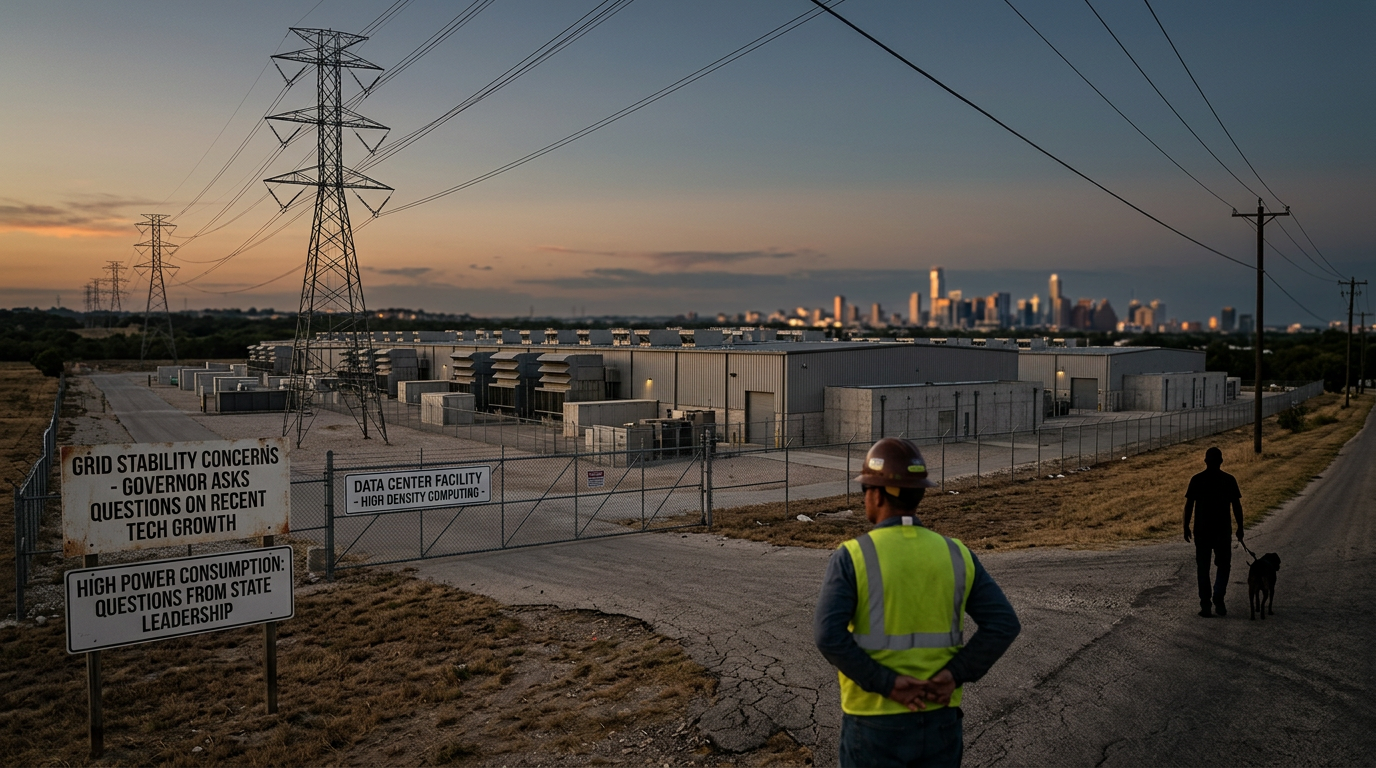
Recent discussions regarding the development of high-density data centers in Texas have sparked a debate between executive leadership and the growing industrial tech sector. Governor Greg Abbott has recently signaled a shift in tone regarding these facilities, which are essential for hosting artificial intelligence (AI) and cloud computing infrastructure. Historically, Texas has been a premier destination for these centers due to a deregulated energy market and business-friendly tax structures. However, during various public forums and legislative briefings throughout 2026, the Governor has emphasized that the massive electrical load required by these centers must be balanced against the reliability of the state's residential and commercial power grid. This shift marks a significant departure from previous years when the state actively recruited large-scale server farms and cryptocurrency mining operations to bolster the local economy. The core of the current tension lies in how much energy these facilities consume compared to the value they provide in terms of job creation and tax revenue, with some critics suggesting the strain on the Electric Reliability Council of Texas (ERCOT) may outweigh the benefits. This scrutiny comes at a time when the state is still reeling from the memory of Winter Storm Uri and ongoing concerns about summer peak demands, forcing a collision between the desire for an 'innovation-first' economy and the absolute necessity of a stable energy supply for over 30 million residents.
Texas relevance
Texas is currently the epicenter of the global data center boom, with significant clusters forming in the Dallas-Fort Worth metroplex, San Antonio, and the Austin-Round Rock corridor. The state's relevance in this conversation is absolute, as ERCOT operates an almost entirely isolated power grid that does not cross state lines, meaning any instability caused by data centers cannot be easily mitigated by importing power from neighbors. For decades, Texas led the nation in energy production and diversification, but the sheer scale of the 24/7 energy demand from modern AI data centers is testing the limits of current transmission infrastructure. Local school districts and municipalities across Texas also have a stake in this, as they often offer Chapter 403 (formerly Chapter 313) tax incentives to attract these multibillion-dollar projects. If the Governor and the Legislature move to restrict these sites or impose new 'grid-readiness' fees, it could reorganize the economic landscape of rural Texas counties where these facilities are increasingly being built to take advantage of vast land and proximity to wind and solar farms.
The Evolution of Digital Growth in the Lone Star State
Texas has spent the last decade positioning itself as a haven for silicon-based industries. From the relocation of major hardware manufacturers to the expansion of social media server farms, the state has leveraged its lack of a state income tax and vast land availability. This strategy was largely successful, turning areas like North Texas into a data center hub that rivals Northern Virginia. However, the nature of these facilities has changed significantly. In the past, data centers were relatively passive storage sites, but the advent of high-performance computing and generative AI has turned them into massive energy sinks.
Governor Abbott’s recent skepticism reflects a concern that these centers are 'energy gluttons' that do not provide the same level of employment as manufacturing or retail. A facility that costs $1 billion to build might only employ 30 to 50 permanent staff members once operational. This discrepancy has led to a revaluation of just how much the state should subsidize or encourage their growth, particularly when the power grid is under stress during extreme Texas heatwaves or winter freezes.
The state's leadership is also responding to local outcry. In some Texas communities, residents have complained about the noise generated by cooled server racks and the visible sprawl of transmission lines required to power them. As local opposition grows, it creates a political environment where the Governor must align himself with the 'average Texan' over the interests of multinational corporations and their local subsidiaries.
ERCOT and the Challenge of Incremental Loading
The Electric Reliability Council of Texas (ERCOT) faces a unique challenge compared to other regional power authorities. Because the Texas grid is largely standalone, every megawatt of new demand must be met with a megawatt of new production or conservation. Recent estimates suggest that the pipeline for new data centers in Texas could demand upwards of 20 to 30 gigawatts of power over the next decade. To put that in perspective, a single gigawatt is enough to power roughly 750,000 homes during normal conditions.
Governor Abbott’s pushback is inherently tied to the structural integrity of this grid. If a single industry can threaten the stability of the entire system, the political fallout for the executive branch would be catastrophic. By publicly questioning the expansion of these sites, the Governor is setting the stage for ERCOT to implement stricter interconnection requirements. These requirements could include mandates that data centers bring their own power generation online or agree to be the first to power down during a grid emergency.
Furthermore, the Governor’s office is looking at the 'duck curve' of renewable energy. Many of these data centers claim to be green by sourcing power from West Texas wind farms. However, wind power is intermittent, and many data centers require constant base-load power. This means that during the night or when the wind isn't blowing, these centers are drawing heavily from thermal gas and coal plants, narrowing the safety margin for the rest of the state.
Political Contributions and the Construction Boom
One of the most complex aspects of this issue is the intersection of policy and political finance. Many of the developers, real estate investment trusts, and energy firms involved in the construction of Texas data centers are significant contributors to state-level campaigns. This creates a perceived conflict of interest that critics are quick to point out. While the Governor may speak about the need to protect the grid, the permits for these facilities continue to be approved at a rapid pace through various state and local agencies.
The construction of a data center involves a massive supply chain, including concrete, steel, and electrical components, many of which are provided by Texas-based companies. These industries have a vested interest in the continuation of the construction boom. Consequently, the Governor’s 'pushback' may be less about stopping development and more about refining the rules of engagement. By framing the issue as a grid reliability problem, the administration can demand more concessions from tech giants without actually ending the lucrative construction cycle.
Financial records indicate that millions of dollars have flowed from tech-adjacent industries into the coffers of Texas leadership over the last several election cycles. This is a standard part of the political landscape in a state as large as Texas, but it does add a layer of scrutiny to any public declaration made by the Governor. Voters and activists are watching to see if the rhetoric regarding grid safety translates into actual legislative limits during the next session.
Impact on Local Taxes and Community Infrastructure
For small Texas towns, a new data center represents a massive increase in the local property tax base. In rural counties with limited industry, a single server farm can become the largest taxpayer overnight, funding new schools, roads, and emergency services. This local benefit often clashes with state-level concerns. While a small town might see a data center as a lifeline, the state sees it as a liability for the regional power grid. This creates a 'not in my backyard' dynamic at the state level that is directly opposed by the 'please in my backyard' attitude of local officials.
Governor Abbott has the power to influence how these local incentives are structured. By suggesting that data centers are putting too much pressure on the state, he may be paving the way for the Texas Legislature to limit the types of tax breaks these companies can receive. If the state removes the financial incentive for these centers to relocate to Texas, many projects currently in the planning stages may move to states like Arizona or Georgia instead.
This economic tug-of-war is fundamental to the Texas identity. The state prides itself on being a destination for business, but that reputation is built on the promise of affordable and reliable utilities. If the influx of new tech causes electricity prices to spike for the average Texan, the political cost of being 'business-friendly' will become too high for any elected official to ignore.
The AI Revolution and Exponential Energy Needs
The shift from traditional data storage to Artificial Intelligence (AI) processing has changed the energy calculus entirely. AI chips, such as those produced by NVIDIA, consume significantly more power than standard CPUs. As the global race for AI dominance accelerates, the demand for high-tier data centers has skyrocketed. This is no longer just about hosting websites or storing photos; it is about the computational power required to train large language models and run complex simulations.
Governor Abbott’s administration is acutely aware that Texas cannot afford to fall behind in the AI race, but it also cannot afford for the AI race to break the state. The Governor has mentioned that the state needs to find a way to make these centers 'responsible citizens' of the grid. This could involve the use of large-scale on-site battery storage or small modular nuclear reactors (SMRs) which are currently being explored as a long-term solution to the energy crisis.
Ultimately, the Governor is signaling a move toward a 'dual-priority' energy strategy. He wants Texas to lead the world in technological infrastructure, but he is demanding that the technology adapts to the state's energy reality, rather than the state adapting to the technology's limitless appetite for electricity. This sets a precedent that other energy-intensive industries, including crypto and hydrogen production, will likely have to follow.
Analysis
The Governor's current stance represents a complex political balancing act involving energy security, economic growth, and campaign optics. On one hand, maintaining a 100% reliable grid is a primary political imperative for any Texas leader, especially with the 2026 and 2027 legislative cycles on the horizon. On the other hand, the very stakeholders who fund major state campaigns are often the venture capitalists and developers building out this technology. By 'pushing back' publicly, the Governor is likely signaling to the tech industry that the 'free ride' of low-cost, high-consumption energy may be ending in favor of a pay-to-play model where centers must fund their own back-up generation or grid upgrades. This isn't necessarily a pivot away from tech, but rather a pivot toward a more protective energy policy that prioritizes household stability over industrial scaling.
Source attribution
This story was reported using a public release from the r/TexasPolitics. Keep TX Red rewrote the coverage independently and links to the official statement for verification.
Frequently Asked Questions
- Why are data centers specifically being targeted by Governor Abbott?
- Data centers consume enormous amounts of electricity 24/7, unlike other industries that can scale back during off-peak hours. As Texas faces growing concerns over grid reliability during extreme weather, these facilities represent a significant and constant load that could squeeze the safety margin of the ERCOT system.
- Do these data centers create a lot of jobs in Texas?
- Compared to manufacturing or retail, data centers are relatively low-employment industries relative to their physical and financial size. While they provide construction jobs and a massive tax base, the long-term operational staff is usually very small, which leads some officials to question their total economic value.
- What is the Governor's proposed solution to the energy demand?
- While specific legislation is still in development, the Governor has hinted at requiring data centers to have their own 'behind-the-meter' power generation or battery storage systems to ensure they do not draw from the public grid during times of high demand.
- How does this affect my personal electric bill in Texas?
- When industrial demand increases significantly, it can drive up the wholesale price of electricity, which eventually trickles down to consumer rates. The Governor's pushback aims to prevent this scenarios by ensuring that large industrial users pay their fair share of infrastructure costs.
Official Sources
Take the next step
Browse the Newsroom →Read more about Keep Texas Red → Our full guide to what Keep Texas Red means and why Texans support it.
Get Texas updates delivered weekly.
Independent Texas reporting on politics, policy, and daily life. One email a week. Unsubscribe anytime.
Keep TX Red Newsroom
The Keep Texas Red Editorial Staff produces nonpartisan explainers, policy breakdowns, and educational resources to help Texans understand how their government works. All content is reviewed for accuracy and updated regularly.
About Keep TX Red →