Governor Greg Abbott Issues Disaster Update Amid Severe Texas Flooding and Infrastructure Challenges
Governor Abbott coordinates state response as heavy rainfall and flooding impact several Texas counties, prompting emergency declarations and rescues.
Editorial disclaimer: Opinions and analysis on Keep TX Red are editorial content — not statements of fact. See our editorial standards.
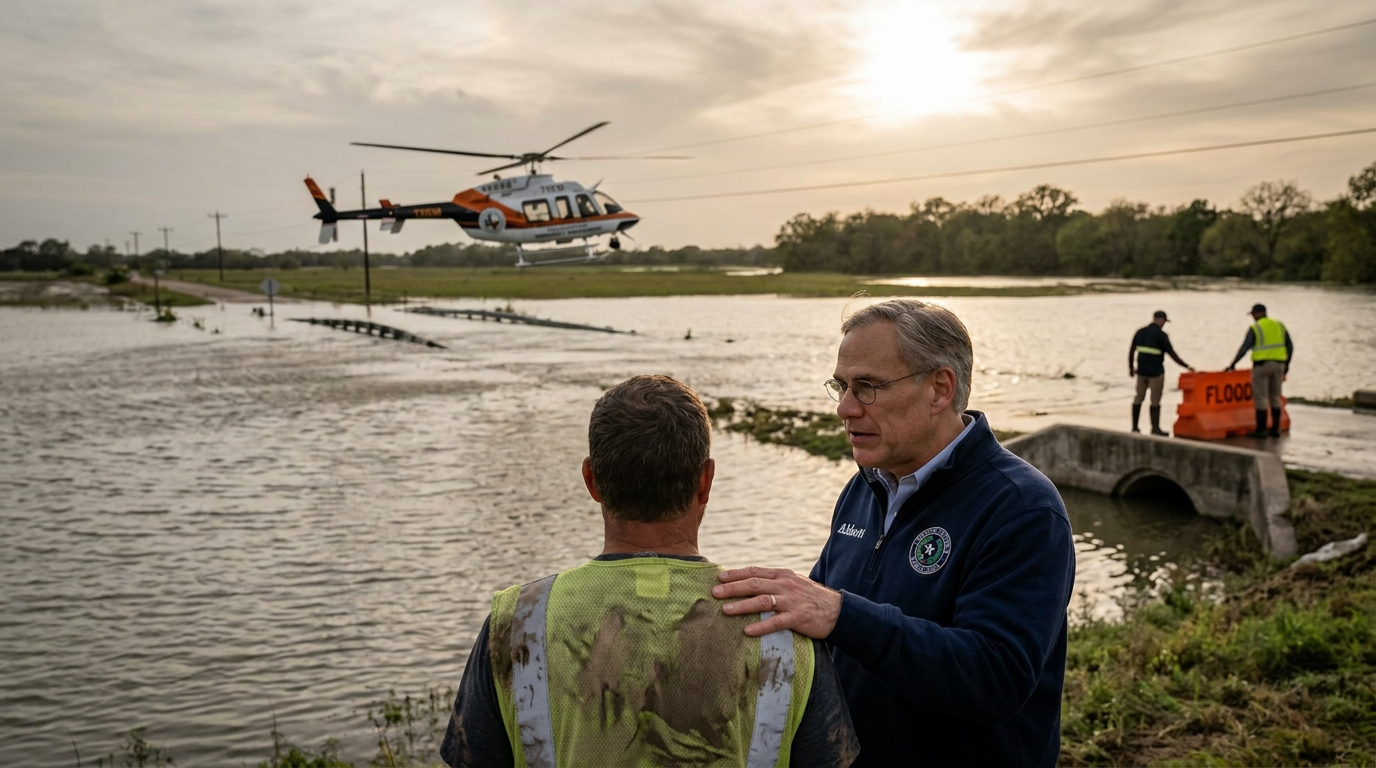
Governor Greg Abbott held a comprehensive press briefing to address the escalating flooding crisis affecting multiple regions across the Lone Star State. Following a series of intense weather systems that dumped historic amounts of rain, the Governor outlined the immediate steps being taken by the Texas Division of Emergency Management (TDEM) and other state agencies. The briefing served as a status report on active water rescues, the deployment of high-water vehicles, and the ongoing coordination between local municipalities and state leadership. Historically, Texas has faced significant challenges with its major river basins during the spring and summer months, often requiring rapid state intervention to prevent loss of life and property. This current event follows a pattern of erratic weather seen over the last decade, where prolonged droughts are punctuated by flash flood events that overwhelm traditional drainage systems. The Governor emphasized the severity of the saturated ground conditions, which have led to rapid runoff and rising river levels in areas that were previously stable. By activating the State Emergency Operations Center to a higher readiness level, Abbott ensured that assets such as the Texas A&M Task Force 1 and the Texas Department of Public Safety (DPS) were positioned for rapid response. The state’s focus remains on the preservation of life, with a specific emphasis on residents living within the floodplains of the Trinity, Brazos, and San Jacinto rivers. State officials are monitoring these waterways closely as upstream runoff continues to move toward the Gulf of Mexico, potentially causing delayed flooding in downstream communities even after the rain has stopped.
Texas relevance
This situation is of critical importance to Texas residents as the flooding impacts major transit corridors and residential hubs within the Houston and East Texas regions. Recent meteorological data indicates that these specific areas of Texas are increasingly vulnerable to backwater flooding and infrastructure failure when the soil reaches full saturation. For Texans, the state’s response is a test of the updated flood mitigation protocols passed in recent legislative sessions. The economic impact on Texas agriculture and local business in the affected counties also remains a primary concern for the Governor's office.
State Resource Deployment and Personnel
Governor Abbott confirmed that the Texas Division of Emergency Management has dispatched numerous boats and aircraft to the hardest-hit regions. These assets are not merely for rescue but are also being utilized for damage assessment and the delivery of essential supplies to isolated communities. The Texas Military Department has also been placed on standby to assist with heavy-lift operations should bridges or main roads become impassable for standard emergency vehicles.
The workforce behind these efforts includes hundreds of state employees and volunteers who are working around the clock. The Governor highlighted the role of the Texas Department of Transportation (TxDOT) in monitoring road closures and clearing debris that can act as makeshift dams, further exacerbating the flooding. This multi-agency approach is intended to create a seamless safety net for residents who find themselves trapped by rising waters.
River Basin Monitoring and Reservoir Peaks
A major portion of the briefing focused on the hydrologic projections for Texas's major river systems. Experts from the Texas Water Development Board are working alongside the Governor’s team to predict crest times for various sections of the Trinity River. Unlike flash flooding, which occurs and recedes quickly, river flooding can last for weeks as water moves through the system. This creates a prolonged threat to foundation stability and long-term infrastructure integrity.
Reservoir management is also under heavy scrutiny. Authorities are carefully balancing the need to release water to maintain dam safety without inundating the homes located downstream. The Governor noted that several reservoirs are currently at or near capacity, requiring precise engineering decisions to mitigate the overall impact. This delicate balance is often the most difficult aspect of flood management in the expansive Texas landscape.
Impact on Transportation and Public Safety
The flooding has significantly disrupted travel across the state, with dozens of state highways and country roads currently underwater. TxDOT has launched a real-time tracking tool to help Texans navigate around flooded sectors, but the Governor warned that conditions change rapidly. He reiterated the 'Turn Around, Don't Drown' mantra, noting that a significant percentage of flood-related fatalities in Texas occur in vehicles.
Public safety officials are also concerned about the hidden dangers within floodwaters, including downed power lines, displaced wildlife, and hazardous chemicals. The Governor’s briefing included a plea for citizens to respect barricades and avoid 'sightseeing' in flooded areas, which can impede the work of first responders and put additional lives at risk. The state is prepared to enforce closures through local law enforcement if necessary.
Agricultural and Economic Consequences
In many of the rural counties affected, the flooding is more than a temporary inconvenience; it is a threat to the local cattle and crop industries. Governor Abbott addressed the concerns of Texas ranchers who are struggling to move livestock to higher ground. The loss of grazing land and the potential for crop destruction in the fertile bottomlands could have a secondary economic impact that lasts well beyond the current weather cycle.
State agencies are already preparing to assist with agricultural recovery grants and low-interest loans. By declaring a state of disaster early, Abbott has paved the way for federal assistance and triggered state-level price-gouging protections for residents buying emergency supplies. This economic safeguarding is a standard part of the Texas disaster response playbook, ensuring that the recovery process can begin as soon as the waters recede.
The Role of Local Leadership in Disaster Prep
While the state provides the resources, Governor Abbott made it clear that local county judges and mayors are the frontline commanders in this crisis. Texas law grants these officials significant power to issue curfews and evacuation orders. The coordination between the Governor’s office and these local entities is crucial for ensuring that warnings reach every household, especially in areas with limited internet or cell service.
Ongoing training exercises conducted in the off-season are now being put to the test. These 'tabletop' scenarios help ensure that different jurisdictions can communicate on the same radio frequencies and share critical data in real-time. The Governor expressed confidence in the local leadership’s ability to manage their specific populations while leaning on the state for 'heavy lift' support when local capacities are exceeded.
Long-Term Flood Mitigation Strategies
Looking beyond the current crisis, the Governor touched upon the importance of long-term investments in Texas's water infrastructure. Since the historic floods of previous years, the state has diverted billions toward drainage projects and better topographic mapping. These investments are designed to give residents more lead time during weather events and to guide smarter development in flood-prone regions.
The Governor noted that the state is constantly learning from these events to refine its response. Data gathered during this current flooding will be used to update flood zone maps and improve the predictive models used by the National Weather Service and TDEM. This iterative process is essential for a state growing as fast as Texas, where new construction can often change the way water flows during heavy storms.
Analysis
The Governor’s proactive stance in this briefing reflects a shift toward early intervention in disaster management, likely aiming to avoid the logistical bottlenecks seen in past major storms. By leveraging LiveNOW and other broad communication platforms, the administration is attempting to bypass local communication delays and speak directly to citizens about the dangers of low-water crossings. The emphasis on state-local cooperation suggests that while the state is providing the muscle—equipment and personnel—it is relying heavily on local county judges to trigger the necessary evacuation orders. This decentralized approach remains a hallmark of Texas disaster policy, placing the onus on local leaders to understand their specific geography while the state provides the overarching resource umbrella.
Source attribution
This story was reported using a public release from the Governor Abbott — Video Moments (Google News). Keep TX Red rewrote the coverage independently and links to the official statement for verification.
Frequently Asked Questions
- What should residents do if they are in a flooded area?
- Residents should prioritize safety by avoiding travel through water, monitoring local news for evacuation orders, and staying off of roads marked as closed by TxDOT. If trapped, they should move to the highest point possible and call 911.
- How does a state disaster declaration help?
- A disaster declaration by the Governor allows for the mobilization of state resources, unlocks emergency funding, and enables local authorities to implement stricter safety measures. it also triggers laws that prevent price gouging for essential goods.
- Where can I find real-time road closure information in Texas?
- Texas residents can use the DriveTexas.org website, which is maintained by TxDOT, to see active road closures, construction, and weather-related delays across the entire state highway system.
Official Sources
Take the next step
Browse the Newsroom →Read more about Keep Texas Red → Our full guide to what Keep Texas Red means and why Texans support it.
Get Texas updates delivered weekly.
Independent Texas reporting on politics, policy, and daily life. One email a week. Unsubscribe anytime.
Keep TX Red Newsroom
The Keep Texas Red Editorial Staff produces nonpartisan explainers, policy breakdowns, and educational resources to help Texans understand how their government works. All content is reviewed for accuracy and updated regularly.
About Keep TX Red →