Federal Response Team Evaluates Hill Country Infrastructure Following Severe July Flooding in Kerrville
Texas representatives visit Kerrville to address infrastructure gaps and federal funding needs following catastrophic July flooding along the Guadalupe.
Editorial disclaimer: Opinions and analysis on Keep TX Red are editorial content — not statements of fact. See our editorial standards.
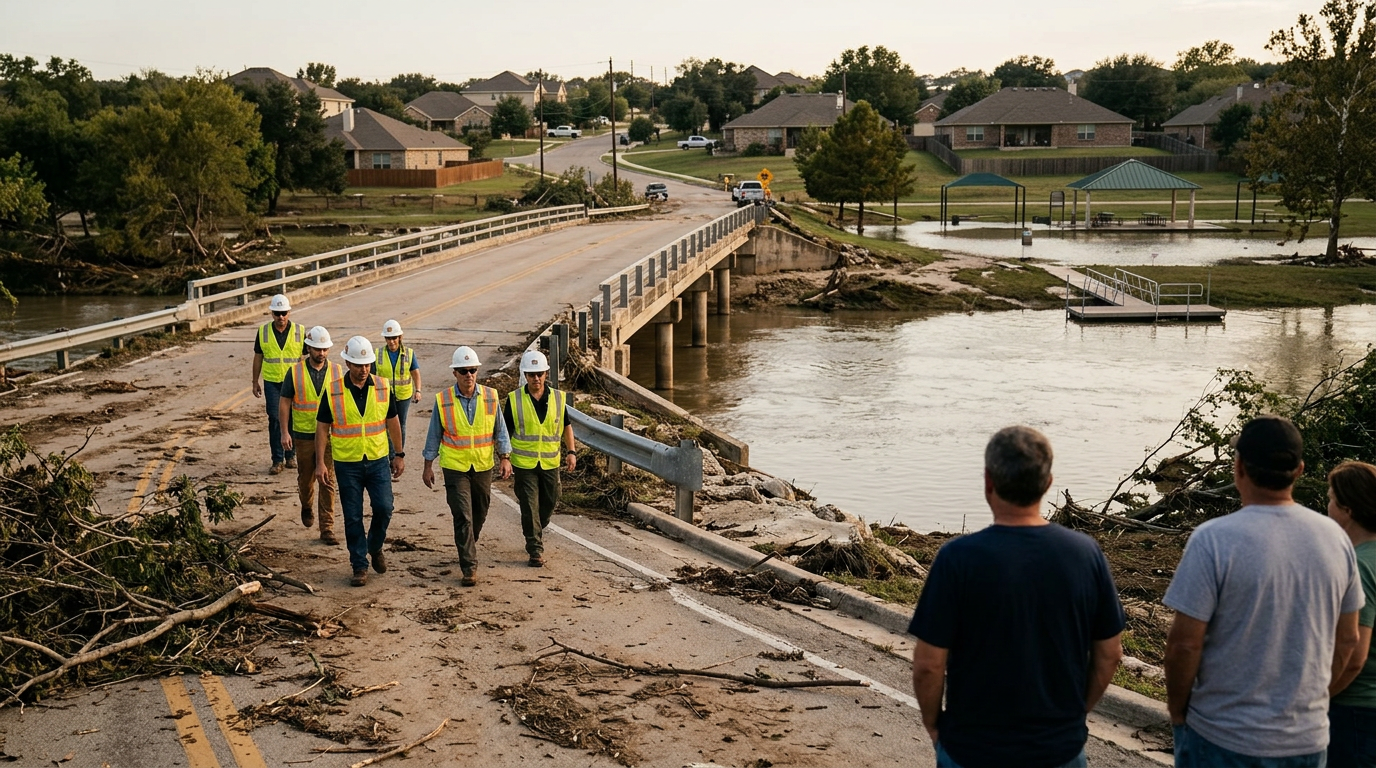
Following a series of intense weather systems that stalled over the Texas Hill Country in mid-July 2026, the city of Kerrville and surrounding Kerr County are facing a significant recovery effort. Heavy precipitation led to rapid rises in the Guadalupe River, bypassing historical safety margins and inundating local residential areas and public parks. Representative Chip Roy, who represents the region in the 21st Congressional District, conducted an on-site inspection this week to survey the damage and discuss long-term recovery strategies with local officials. The focus of the visit was to identify specific points of failure in the current drainage systems and to determine how federal resources can best supplement the state and local response. Historically, the Hill Country has been known as 'Flash Flood Alley' due to its unique topography and thin soil layers that provide little absorption for high-volume rainfall. This recent event serves as a reminder of the region’s vulnerability, prompting a renewed push for updated hydrological mapping and modernized flood control structures. The Representative emphasized that while short-term safety is the immediate priority, the long-term goal for the delegation is securing the necessary appropriations to prevent such devastating economic losses in the future.
Texas relevance
This situation is critically relevant to Texas as it highlights the ongoing battle between rapid population growth and aging infrastructure in the Hill Country. Kerrville acts as a hub for the Upper Guadalupe region, and any impact on its infrastructure ripples through the local economy, affecting ranching, tourism, and small businesses. Texas leadership at both the state and federal levels must coordinate to manage the Guadalupe River basin, which serves as a vital water source and a primary flood risk for thousands of residents. As more Texans move into these scenic but high-risk areas, the state’s ability to secure federal disaster mitigation grants becomes a cornerstone of public safety policy.
Hydrological Impact on the Guadalupe River
The Guadalupe River is the lifeblood of Kerrville, but during the July 2026 storms, it transformed into a significant threat. Record-breaking rainfall upstream in the Hunt and Ingram areas funneled into the narrow river valley, causing water levels to rise at a rate that challenged current early-warning systems. The suddenness of the surge resulted in the closure of multiple low-water crossings and the evacuation of several riverside RV parks and neighborhoods.
Local officials noted that the crest reached levels not seen in over a decade, testing the integrity of the Louise Hays Park developments and the various dams managed by the Upper Guadalupe River Authority. While the structural damage to major bridges was limited, the accumulation of debris—including massive cypress trees and displaced docks—has created new hazards that require specialized equipment to clear. The environmental impact on the river’s water quality and the displacement of local wildlife also remain ongoing concerns for the county’s environmental teams.
Federal Funding and Bureaucratic Hurdles
One of the primary reasons for the congressional visit was to navigate the complex web of federal disaster funding. Representative Chip Roy discussed the role of the Federal Emergency Management Agency (FEMA) and the potential for a disaster declaration that would unlock low-interest loans and direct grants for affected homeowners. However, the process of documenting the threshold of damage required for such a declaration is often arduous for smaller communities.
The discussion also touched on the need for 'pre-disaster mitigation' funds. These are federal dollars allocated to improve infrastructure before a flood occurs, rather than just repairing what was broken. Kerrville leadership is advocating for a more streamlined application process, noting that the current system often favors large metropolitan areas like Houston or Dallas, leaving rural and semi-rural Texas counties to compete for a smaller pool of resources despite facing similar catastrophic risks.
Local Emergency Management Response
The Kerrville Fire Department and the Kerr County Sheriff’s Office were praised for their rapid response during the height of the flooding. High-water rescue teams were deployed to assist residents trapped in vehicles, and emergency shelters were established within hours of the first reports of rising water. The coordination between local law enforcement and the Texas Department of Transportation (TxDOT) was instrumental in preventing casualties by closing state highways that intersect with the river’s path.
Despite the successful rescue operations, local leaders are now focusing on the 'after-action' reports to identify communication gaps. During the storm, some residents reported issues with cellular service, which cut off access to digital alerts. As a result, there is a renewed interest in expanding the network of physical sirens and enhancing the reach of the local emergency broadcast system to ensure that every resident, regardless of their location or technology access, receives timely warnings.
Long-Term Infrastructure Sustainability
The long-term health of Kerrville depends on infrastructure that can withstand the increasingly volatile weather patterns of Central Texas. This includes upgrading the city's stormwater drainage systems, which were designed for much lower volume capacities decades ago. Urbanization in the city center has increased the amount of impervious cover—surfaces like concrete and asphalt that prevent water from soaking into the ground—leading to higher runoff rates during storms.
Public works officials are considering the implementation of green infrastructure, such as detention ponds and permeable pavements, to slow down the flow of water into the Guadalupe. These projects, however, carry high price tags that are difficult for the local tax base to absorb alone. The partnership between the Texas delegation and the local government is aimed at securing federal infrastructure grants that specifically target these types of modernization efforts to ensure Kerrville’s safety for the next generation.
Community Impact and Economic Recovery
Beyond the physical damage, the flooding has dealt a blow to Kerrville’s summer tourism season. The Guadalupe River is a major draw for visitors who contribute significantly to the local retail and hospitality sectors. With several parks closed for debris removal and water safety assessments, local business owners are bracing for a dip in revenue. The congressional delegation has committed to working with the Small Business Administration (SBA) to provide relief to these local enterprises.
The resilience of the Kerrville community has been on full display as volunteers and local non-profits mobilize to help neighbors clean out flooded homes. However, the psychological impact of recurring flood events cannot be overlooked. For many residents, the sight of a darkening sky now brings a sense of anxiety. Addressing this requires not just physical repairs, but a transparent plan from the government that demonstrates a commitment to long-term flood mitigation and community safety.
Analysis
Opinion: The situation in Kerrville illustrates a recurring theme in Texas politics: the tension between local control and the necessity of federal intervention during natural disasters. While Texas pride often leans toward self-reliance, the sheer scale of modern flooding events outstrips the municipal budgets of smaller Hill Country towns. Representative Roy’s presence suggests a shift toward proactive infrastructure planning rather than reactive disaster relief. However, the success of these initiatives will depend on whether the federal government can streamline the bureaucratic hurdles within FEMA and the Army Corps of Engineers, which often delay projects for years after the initial floodwaters have receded. For Kerrville residents, the hope is that this visit translates into tangible concrete and steel improvements rather than just policy discussions in Washington.
Source attribution
This story was reported using a public release from the Texas Congressional Delegation (Google News). Keep TX Red rewrote the coverage independently and links to the official statement for verification.
Frequently Asked Questions
- What caused the recent flooding in Kerrville?
- The flooding was caused by a series of high-intensity rainstorms that stalled over the Texas Hill Country in mid-July. The rapid runoff into the Guadalupe River basin led to a significant surge that exceeded the capacity of local drainage systems and low-water crossings.
- Is there federal assistance available for affected Kerrville residents?
- Currently, local and state officials are documenting the extent of the damage to determine if the region meets the threshold for a federal disaster declaration. If approved, residents may have access to FEMA grants and SBA low-interest loans for home and business repairs.
- What is being done to prevent future floods in the area?
- Texas representatives are advocating for federal funding to modernize infrastructure, including improved stormwater management and reinforced riverbank protections. Additionally, the Upper Guadalupe River Authority continues to monitor and improve early warning systems and dam operations.
Official Sources
Take the next step
Browse the Newsroom →Read more about Keep Texas Red → Our full guide to what Keep Texas Red means and why Texans support it.
Get Texas updates delivered weekly.
Independent Texas reporting on politics, policy, and daily life. One email a week. Unsubscribe anytime.
Keep TX Red Newsroom
The Keep Texas Red Editorial Staff produces nonpartisan explainers, policy breakdowns, and educational resources to help Texans understand how their government works. All content is reviewed for accuracy and updated regularly.
About Keep TX Red →