Texas Senate Race religion debate: Paxton and Talarico Clash Over Faith
Attorney General Ken Paxton and Representative James Talarico clash over the role of faith in governance as the 2026 Senate race intensifies.
Editorial disclaimer: Opinions and analysis on Keep TX Red are editorial content — not statements of fact. See our editorial standards.
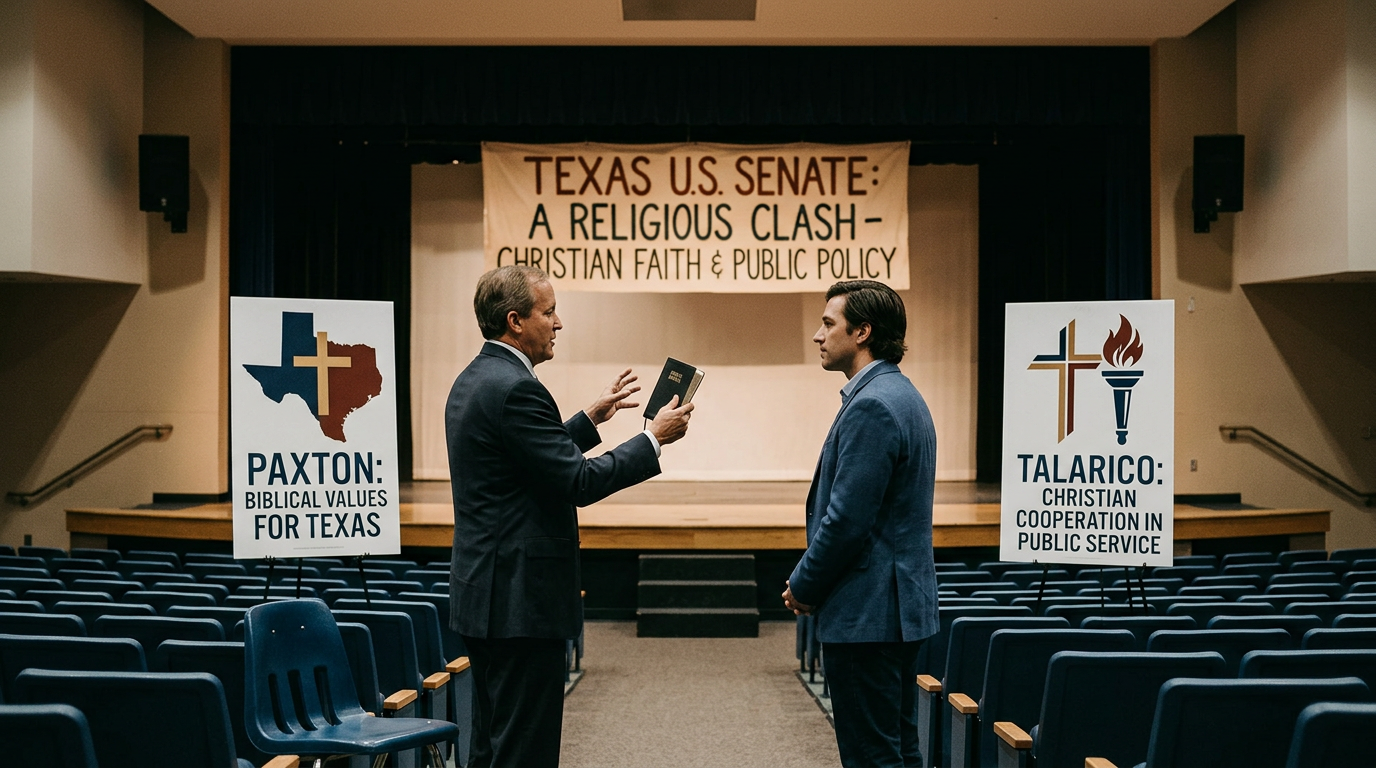
As the 2026 political season in Texas gains momentum, a sharp ideological and theological divide has surfaced between two of the state's most prominent figures vying for the U.S. Senate. Attorney General Ken Paxton has publicly distinguished himself from his challenger, State Representative James Talarico, by highlighting their differing interpretations of the Christian faith and its application to public policy. Historically, Texas political discourse has frequently intersected with religious identity, but this specific matchup brings two distinct worldviews into direct conflict on the statewide stage. Paxton’s remarks suggest that his approach to governance is rooted in a traditional, conservative theological framework that prioritizes biblical adherence within the law. Conversely, Talarico, a seminary student and progressive lawmaker, has often utilized his faith to advocate for social justice initiatives and expanded government services. This friction marks a significant departure from standard campaign rhetoric, as both candidates claim their actions are guided by spiritual convictions yet arrive at diametrically opposed legislative conclusions.
Texas relevance
This development is central to the Texas political landscape because it sets the stage for how religious voters across the state might align themselves in the upcoming primary and general elections. Texas has a long-standing tradition of electing leaders who openly discuss their faith, from the local school board level up to the Governor’s Mansion. The tension between Paxton and Talarico reflects a broader debate occurring within pews across the state, from the urban centers of Dallas and Houston to the rural expanses of West Texas. As the state’s demographics shifts and its political identity evolves, the outcome of this specific ideological battle will likely influence how future candidates across the Lone Star State message their personal beliefs to a diverse and highly engaged electorate.
The Theological Conflict in the Public Square
The core of the disagreement lies in how each candidate believes the teachings of Christianity should manifest in the halls of government. Paxton has long been a champion of religious liberty, often filing lawsuits to protect the rights of individuals and organizations to operate according to their conscience. His supporters see him as a bulwark against secularism, ensuring that the state remains a place where traditional values are not sidelined by modern social shifts.
In contrast, James Talarico has positioned his faith as a mandate for progressive reform. During his time in the Texas House, he has frequently cited scripture to argue for increased funding for public schools and more robust social safety nets. This creates a unique situation where both candidates are citing the same source material to argue for vastly different visions of Texas’s future, leaving voters to decide which interpretation better reflects the state's collective conscience.
Strategic Implications for the 2026 Primary
For Ken Paxton, emphasizing these differences is a calculated move to maintain his dominance over the Republican primary electorate. Paxton has survived various legal and political challenges by maintaining a fiercely loyal coalition of grassroots activists who prioritize cultural and religious alignment. By painting his rival as an ideological outlier, even within a religious context, Paxton reinforces his image as the authentic conservative choice.
This strategy also serves to preemptively frame the general election. By establishing these markers early, Paxton is attempting to define Talarico before the Democrat can build a broad coalition of moderate or religious voters. In a state where the 'R' suffix next to a name is historically decisive, controlling the narrative regarding religious identity can be a powerful tool in retaining power and keeping the Texas delegation in Washington firmly on the right.
A History of Faith in Texas Governance
The intersection of church and state in Texas is not a new phenomenon, but the intensity of the Paxton-Talarico rivalry brings it into sharper focus. Since the mid-20th century, Texas politicians have utilized faith to galvanize support and explain their policy priorities. From the 'Moral Majority' era to the current focus on parental rights in education, the language of the pulpit has often been the language of the podium in Austin.
What makes this cycle different is the high-profile nature of both figures. Paxton, as the state's top legal officer, has consistently placed Texas at the center of national debates regarding the role of religion in schools and businesses. Talarico, despite being in the minority party, has gained national attention for his viral speeches on the floor of the Texas House, often challenging his colleagues to harmonize their legislative votes with their stated religious tenets.
Voter Perception and Suburban Sentiment
As the election nears, the focus on faith will likely have its most significant impact in the fast-growing Texas suburbs. Areas around the 'Texas Triangle'—Dallas-Fort Worth, Houston, Austin, and San Antonio—are home to a wide array of religious communities that may not fit neatly into a single political box. Paxton’s emphasis on traditionalism is designed to resonate with those who feel their values are under threat from rapid cultural change.
Conversely, the strategy employed by challengers to Paxton often involves appealing to voters who are religious but feel that current state leadership does not reflect their priorities on issues like healthcare or the environment. This creates an environment where 'faith' becomes a broad battlefield. The winner will likely be the candidate who can convince these swing voters that their specific spiritual framework offers the best path forward for a thriving Texas economy and society.
The Legal and Legislative Backdrop
Recent sessions of the Texas Legislature have seen a flurry of bills aimed at integrating religious practices into public life, such as the placement of Ten Commandments in classrooms or the use of chaplains as school counselors. Paxton has been a vocal supporter of these measures, viewing them as a way to restore a moral foundation to the state’s youth. These policies serve as the practical examples of the 'faith' Paxton says separates him from his rival.
Opponents of these measures, including Talarico, argue that such laws violate the core principle of separation of church and state and can alienate those of different faiths or no faith at all. This legislative record provides a substantive trailer for what a Senate race between the two would look like. It is no longer just about abstract beliefs; it is about how those beliefs are codified into statutes that affect millions of Texans on a daily basis.
The National Eye on Texas Politics
Because Texas is the center of the American political universe, this regional spat has national ramifications. National donors and political action committees are closely watching how the religious angle plays out in the Lone Star State. If Paxton’s focus on faith-based distinctions proves successful, it could provide a roadmap for other conservative candidates across the country who are facing challengers attempting to reclaim the moral high ground.
Furthermore, as Texas continues to grow in influence within the federal government, the religious identity of its senators matters immensely to the national agenda. Whether the seat remains in the hands of a traditionalist conservative or flips to a candidate representing a new brand of religious progressivism could determine the fate of judicial appointments, social policy, and international relations for years to come.
Analysis
The decision by Ken Paxton to lean into faith-based distinctions reveals a strategic intent to solidify his base among traditional conservative Christians who view the current culture war as a spiritual conflict. By framing Talarico’s views as divergent from mainstream conservative theology, Paxton aims to neutralize the challenge posed by a Democrat who comfortably speaks the language of faith. For Republican voters, this isn't just about policy; it's about the moral direction of the seat currently held by John Cornyn. On the other hand, the clash highlights a growing trend where candidates are no longer content to let their opponents hold a monopoly on religious discourse. This ensures that the 2026 race will be as much about values and identity as it is about infrastructure or border security.
Source attribution
This story was reported using a public release from the r/TexasPolitics. Keep TX Red rewrote the coverage independently and links to the official statement for verification.
Frequently Asked Questions
- Why is Ken Paxton focusing on religion in his campaign?
- Attorney General Ken Paxton frequently emphasizes his faith to connect with his core conservative base. By highlighting differences between his beliefs and those of his rivals, he aims to define himself as the most authentic representative of traditional Texas values.
- What is James Talarico's religious background?
- James Talarico is a State Representative and a seminary student. He identifies as a Christian and often uses his theological training to advocate for progressive policies, arguing that faith should drive the state to better care for the marginalized.
- Is this a new strategy for Texas politicians?
- While faith has always played a role in Texas politics, the direct debate between two candidates over the 'correct' application of faith to public policy is becoming more prominent and more specific in the current political climate.
Official Sources
Take the next step
Browse the Newsroom →Read more about Keep Texas Red → Our full guide to what Keep Texas Red means and why Texans support it.
Get Texas updates delivered weekly.
Independent Texas reporting on politics, policy, and daily life. One email a week. Unsubscribe anytime.
Keep TX Red Newsroom
The Keep Texas Red Editorial Staff produces nonpartisan explainers, policy breakdowns, and educational resources to help Texans understand how their government works. All content is reviewed for accuracy and updated regularly.
About Keep TX Red →