Religious Freedom Debate Ignites in Grand Prairie After Muslim Event Cancellation at Public Facility
A Muslim youth celebration in Grand Prairie was canceled following a new Texas law, sparking a debate over religious equity and public venue usage.
Editorial disclaimer: Opinions and analysis on Keep TX Red are editorial content — not statements of fact. See our editorial standards.
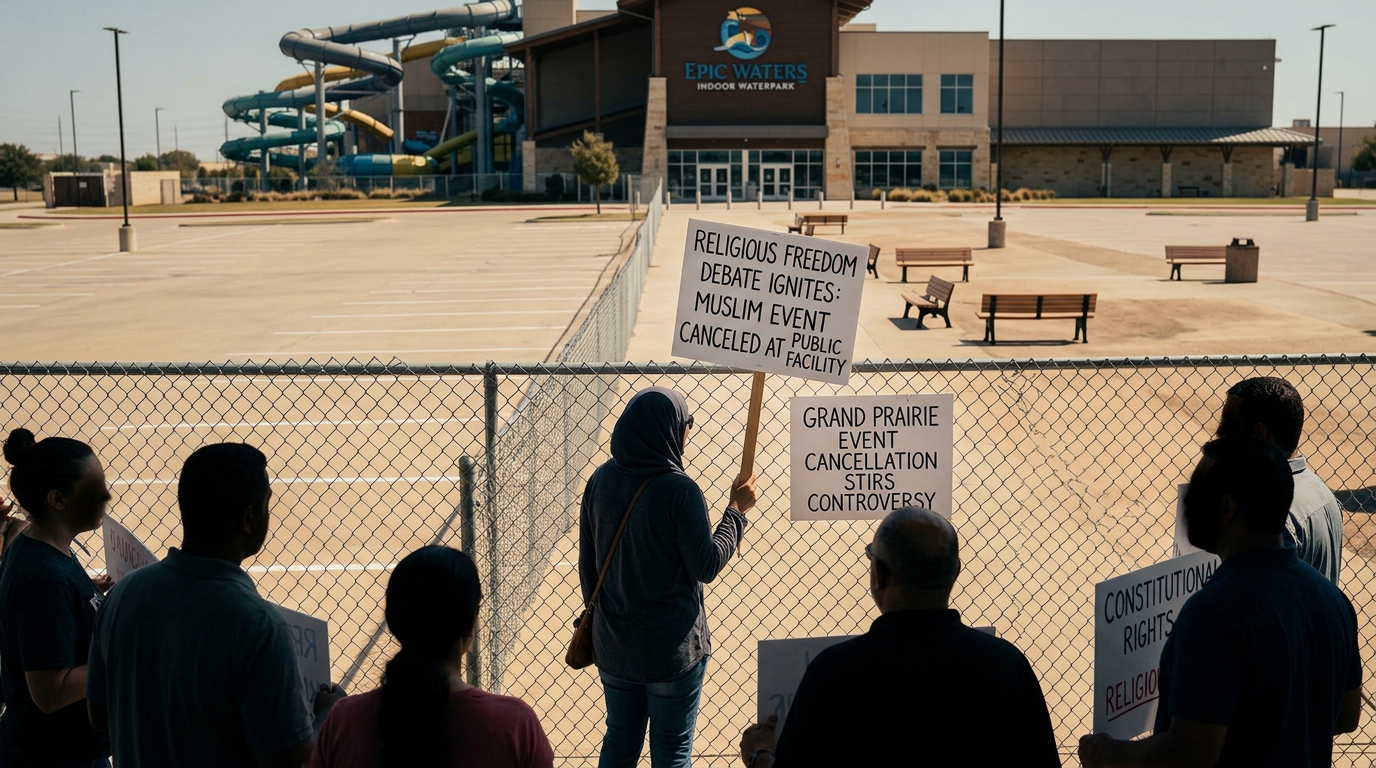
A planned community celebration for Muslim youth in Grand Prairie faced an abrupt cancellation this month, stirring significant legal and social discourse across North Texas. The event, which was scheduled to take place at the city-owned Epic Waters Indoor Waterpark, was called off by venue management who cited compliance with recently enacted state legislation. This incident marks one of the first high-profile applications of newer Texas statutes regarding the conduct and nature of events held on publicly funded property. Historically, Texas has been a battleground for defining the boundaries between state-run facilities and religious expression, often balancing the First Amendment alongside state-specific mandates aimed at regulating public performances and gatherings. The cancellation has prompted local leaders and organizers to question whether the law is being applied consistently across different religious and cultural groups. Organizers argue that Epic Waters has hosted various private religious functions in the past without interference, suggesting that the sudden pivot represents a departure from established local norms. As the situation unfolds, it serves as a litmus test for how Texas municipalities will navigate the tension between inclusive community programming and the strict adherence to state-level directives that limit certain types of public-private partnerships or event sponsorships.
Texas relevance
This situation is deeply rooted in the North Texas landscape, specifically impacting the diverse population of Grand Prairie and the broader Dallas-Fort Worth metroplex. Texas has a long history of protecting religious liberty through the Texas Religious Freedom Restoration Act, yet new legislative sessions have introduced measures that some local officials find difficult to interpret without risking legal action from the state. The outcome of this dispute could set a precedent for how other Texas cities, from Austin to Houston, manage their recreational facilities and contract with private organizations for cultural celebrations.
The Legal Catalyst Behind the Cancellation
The primary justification offered for the cancellation involves a series of new state laws passed during recent legislative sessions aimed at regulating the types of events hosted at public venues. Specifically, laws such as Senate Bill 12 have been scrutinized for their language regarding public decency and the types of performances allowed in front of minors. While the Muslim youth event was described as a standard community gathering with water activities and communal prayer, venue operators expressed concern that any gender-segregated components or specific religious rituals might run afoul of non-discrimination clauses or specific state-level prohibitions.
Legal experts in Texas note that the ambiguity of modern statutes often puts city employees in a difficult position. If a venue allows an event that is later deemed to violate state law, the city could face significant fines or loss of state funding. This 'chilling effect' is becoming more common in suburban Texas as local governments struggle to interpret the nuances of legislative intent versus the direct language of the codes.
Historical Precedent for Religious Usage of Public Space
For decades, Texas municipalities have operated under a 'non-public forum' or 'limited public forum' doctrine, which allows them to rent out spaces like community centers and waterparks to private groups. Under these rules, the city typically cannot discriminate based on the viewpoint of the group. Epic Waters, while being a premier destination in Grand Prairie, falls under this category of public infrastructure used for private commercial and social gain. The cancellation represents a significant shift in how these lease agreements are vetted by the Grand Prairie city attorney's office.
Past examples in Texas have seen Christian groups, Jewish organizations, and various secular non-profits utilize public pools and parks for baptisms, holiday festivals, and private gatherings. The organizers of the Muslim celebration pointed to these precedents, noting that the infrastructure of Texas cities has traditionally been open to all constituents who pay the rental fees and follow standard safety protocols.
The Role of Local Governance in Grand Prairie
Grand Prairie pride itself on being a 'all-America city' with a rapidly diversifying demographic. The city leadership has frequently touted its inclusive policies, making the sudden cancellation at a marquee facility like Epic Waters a point of political sensitivity. Local council members are now caught between the expectations of their constituents and the strictures placed upon them by the state capitol in Austin. This dynamic is a microcosm of the larger 'home rule' debate in Texas, where cities fight to maintain local control over their assets.
The decision to cancel was not made by a popular vote but through administrative channels within the city's parks and recreation management and legal counsel. This has led to calls for more transparency in how public venue contracts are reviewed. Residents are increasingly demanding to know if the criteria for cancellation are being applied equally to all religious denominations or if specific groups are being singled out based on the current political climate.
Economic Impact on Cultural Organizations
Events of this scale involve significant financial commitments, including security deposits, marketing costs, and vendor contracts. When a city-owned venue cancels an event with little notice, it creates a financial vacuum for the organizing non-profits. In this instance, the Muslim community had already invested resources into organizing what was intended to be a safe, family-friendly environment for youth who often feel marginalized in broader social settings.
The economic ripple effects also touch local businesses that provide catering and transportation for these large-scale events. When a 2,000-person event is removed from the calendar, the local Grand Prairie economy loses out on the secondary spending that typically accompanies such gatherings. This highlights the practical, non-political consequences of legislative uncertainty at the state level.
Safety and Community Harmony Concerns
Some proponents of the cancellation argued that the decision was based on safety and the logistics of managing a large, private group within a facility designed for the general public. However, supporters of the event argue that these concerns are often used as a pretext for exclusion. They point out that the facility is more than capable of handling large crowds, as evidenced by its high-volume summer attendance records.
The resulting tension has sparked a broader conversation about community harmony. In North Texas, where different faiths live in close proximity, the use of public resources to foster community bonds is seen as a key component of social stability. When those resources are revoked, it can lead to feelings of alienation and a breakdown in the cooperative relationship between different ethnic and religious sectors and the local government.
Future Implications for Texas Public Facilities
As this story gains national attention, other Texas cities are watching closely. The outcome may prompt a wave of contract revisions for public venues across the state. If the law is interpreted to mean that any religious event with specific behavioral requirements—such as modest dress codes or specific prayer times—is ineligible for public space, it could effectively bar many religious organizations from using city property entirely.
The controversy may eventually lead to a court challenge, where the Texas judiciary will have to weigh the state's interest in regulating public events against the constitutional protections of the First Amendment. Until then, organizers of cultural and religious events in Texas may face a more difficult path when trying to secure dates at state-funded parks and recreation centers.
Analysis
Opinion: The friction in Grand Prairie highlights a growing communication gap between the Texas Legislature and local municipal operators. While state laws are often designed to ensure that public funds and facilities are used in a manner consistent with broad public standards, the lack of specific guidance can lead to 'over-compliance' by cautious city attorneys. This administrative hesitation often results in the cancellation of benign community events out of fear of state-level litigation. For a state that prides itself on being a beacon of religious liberty, the inconsistent application of venue rules could inadvertently undermine the very freedoms the law seeks to protect.
Source attribution
This story was reported using a public release from the Texas Standard. Keep TX Red rewrote the coverage independently and links to the official statement for verification.
Frequently Asked Questions
- What specific law caused the cancellation in Grand Prairie?
- While several laws were mentioned, the primary focus has been on new regulations regarding public performances and the conduct allowed at venues that receive state funding or are owned by the city. Specifically, concerns were raised about complying with statutes that govern 'sexually oriented' or 'indecent' performances, even though organizers claim the event was a standard youth celebration.
- Has Epic Waters hosted religious events before?
- Yes, organizers and local residents report that the venue has been used for various private events by different religious groups in the past. This history is a central point of the current controversy, as the community questions why this specific event was subject to a different standard of review.
- What was the nature of the scheduled Muslim event?
- The event was described as a celebration for Muslim youth, featuring waterpark activities, communal food, and prayer. It was intended to provide a private environment where attendees could observe their cultural and religious traditions, such as modest dress, while enjoying the facility.
- How has the City of Grand Prairie responded to the criticism?
- The city administration has largely pointed to legal advice and the necessity of adhering to state law to avoid potential litigation. They have maintained that the decision was a matter of legal compliance rather than a targeted action against any specific faith or community group.
Official Sources
Take the next step
Browse the Newsroom →Read more about Keep Texas Red → Our full guide to what Keep Texas Red means and why Texans support it.
Get Texas updates delivered weekly.
Independent Texas reporting on politics, policy, and daily life. One email a week. Unsubscribe anytime.
Keep TX Red Newsroom
The Keep Texas Red Editorial Staff produces nonpartisan explainers, policy breakdowns, and educational resources to help Texans understand how their government works. All content is reviewed for accuracy and updated regularly.
About Keep TX Red →