Governor Abbott Outlines Strategic Economic Reforms to Ensure Long-Term Texas Affordability
Governor Greg Abbott visited Houston to detail new initiatives focused on maintaining Texas as a low-cost, high-opportunity state for families.
Editorial disclaimer: Opinions and analysis on Keep TX Red are editorial content — not statements of fact. See our editorial standards.
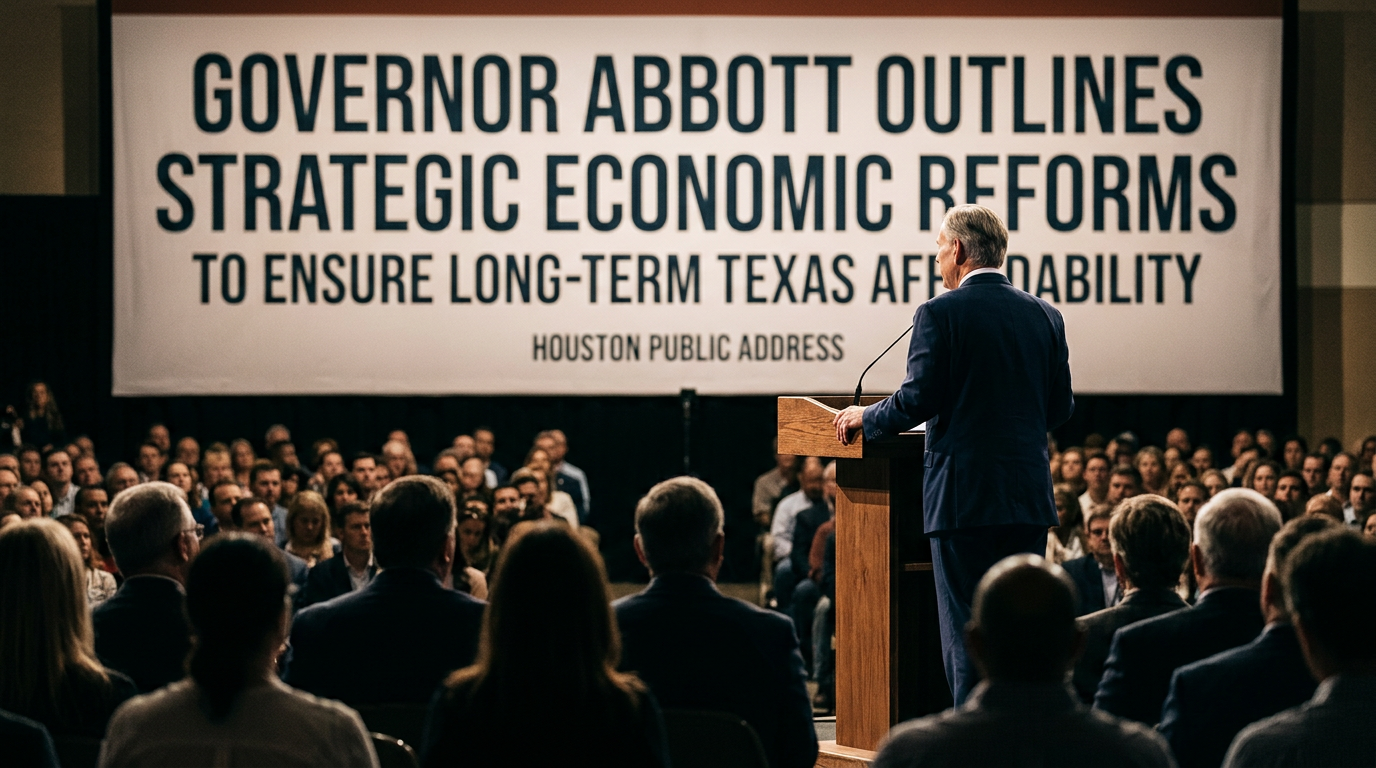
In a comprehensive address delivered in Houston, Governor Greg Abbott detailed a multi-pronged approach intended to preserve the state's reputation for economic accessibility. Historically, Texas has leveraged a combination of low taxation and minimal regulatory interference to attract both domestic migration and international investment. However, as the state experiences unprecedented population growth, the administration identifies rising living costs as a primary threat to continued prosperity. This address serves as a policy roadmap, emphasizing that the 'Texas Miracle' relies not just on job creation, but on the ability of regular citizens to afford housing and basic necessities. The governor highlighted that the state's budget surplus provides a unique opportunity to return funds to taxpayers rather than expanding the footprint of the state government. Historically, Texas lead the nation in property tax reform during the 88th Legislative Session, passing a massive $18 billion relief package. The governor now seeks to build upon that momentum by looking at structural changes to how the state evaluates its economic health. By focusing on Houston—the state’s most populous city and a major global energy hub—Abbott is signaling that the affordability crisis is most acute in metropolitan areas where demand for services and infrastructure is peaking. This initiative aims to align local municipal spending with state-level conservative fiscal priorities to ensure that gains made in wages are not liquidated by rising costs of living.
Texas relevance
As the fourth-largest city in the United States, Houston serves as the epicenter for the Texas economic engine, making it the critical battleground for affordability initiatives. The city faces unique challenges, including a complex housing market and significant infrastructure needs following recent weather events and rapid urban expansion. For residents of Southeast Texas, Abbott’s focus on affordability represents a direct intervention in the local debate over property valuations and municipal tax rates. By choosing Houston as the backdrop for these announcements, the Governor is acknowledging that if the state loses its edge in metropolitan affordability, it risks losing its competitive advantage against states like Florida and Tennessee.
The Core Pillars of the Texas Affordability Roadmap
The Governor’s plan centers on three primary pillars: property tax reduction, regulatory streamlining for housing construction, and energy cost stabilization. Abbott argued that the single greatest burden on the average Texan is the rising cost of home ownership. By doubling down on property tax compression, the state intends to buy down local tax rates using state revenue. This approach is designed to prevent homeowners from being priced out of their own communities by aggressive appraisals and local government spending sprees.
Beyond taxation, the roadmap addresses the supply side of the economy. Abbott indicated that the state would take a closer look at local zoning and permitting processes that often delay the construction of affordable housing units. By reducing the time and cost associated with building new homes, the administration believes the market can naturally lower prices through increased inventory. This move represents a potential friction point between state authority and local municipal control, but the Governor framed it as a necessary step for the broader public good.
Harnessing Energy Abundance to Lower Utility Bills
A significant portion of the Houston address focused on the energy sector. As the energy capital of the world, Houston residents are acutely aware of the fluctuations in utility costs. Abbott emphasized that a diversified energy portfolio—heavily reliant on reliable dispatchable power—is essential for keeping electricity prices low. He reiterated the state's commitment to strengthening the ERCOT grid while ensuring that thermal power generation remains a staple of the Texas energy mix to avoid the price spikes seen in other regions.
The Governor noted that affordable energy is the silent driver of the entire economy. It lowers the overhead for small businesses and provides more disposable income for families. By resisting federal mandates that would prematurely phase out fossil fuels, the Abbott administration seeks to maintain an energy surplus that keeps Texas an attractive destination for manufacturing and industrial operations. This focus on 'energy security' is presented as a direct component of the broader affordability initiative.
Workforce Development and Wage Growth
Maintaining affordability is not just about lowering costs; it is also about increasing the earning potential of the citizenry. Abbott showcased investments in vocational training and community college programs aimed at high-demand fields such as nursing, technology, and skilled trades. The goal is to ensure that Texans are not just employed, but are working in careers that provide a living wage capable of keeping pace with the modern economy.
The Governor pointed to the 'Texas Tier 1' university initiatives as a way to grow the intellectual capital of the state. By fostering an environment where innovation thrives, Texas can attract high-paying jobs that outpace national inflation averages. This dual approach of controlling costs while raising the floor for earnings is the cornerstone of the administration’s strategy to keep the state's middle class thriving.
Addressing Infrastructure and Transportation Bottlenecks
In his discussion on Houston’s growth, Abbott touched upon the necessity of efficient transportation infrastructure. Congestion in major Texas cities acts as a hidden tax on the economy, wasting time and fuel. The Governor highlighted the ongoing multibillion-dollar investments in the 'Texas Clear Lanes' initiative, which aims to decongest the state’s most clogged highways. These projects are intended to reduce the logistical costs of moving goods, which in turn helps keep the prices of consumer products stable.
Furthermore, the focus on infrastructure extends to water security and broadband access. Abbott argued that for rural and suburban Texas to remain viable alternatives to the high-density cities, they must have the foundational services required for modern life. By spreading the state's wealth into these essential systems, the government hopes to decentralize the population growth, preventing any single area from becoming prohibitively expensive due to overcrowding.
Collaborating with Local Governments for Fiscal Responsibility
One of the more assertive aspects of the Governor’s speech was his call for local governments to mirror the state’s fiscal discipline. Abbott warned that state-level tax cuts are often neutralized by local entities that raise rates or debt levels. He advocated for transparency in how local bonds are passed and how taxpayer dollars are allocated at the county and municipal levels. This signifies a push for greater state oversight into local financial management to protect the 'affordability' brand.
The Governor suggested that the state would continue to implement 'revenue caps' that require voter approval for significant tax increases. This mechanism ensures that local residents have a direct say in the growth of their government. By empowering taxpayers at the local level, Abbott believes the state can create a grassroots culture of fiscal conservatism that complements his executive initiatives.
The Competitive Landscape: Texas vs. The Nation
Throughout his remarks, Abbott frequently contrasted the Texas model with that of other states. He argued that the flight of people and capital from high-tax states like New York and California is proof that the Texas approach is fundamentally sound. However, he warned against complacency, noting that other red states are also competing for the same business relocations. To remain the top choice, Texas must not only be 'better' than blue states but must be the 'best' among its conservative peers.
This competitive spirit drives the current administration's urgency. The Governor stated that the initiatives discussed in Houston are part of a long-term vision to ensure Texas remains the premier destination for the 'American Dream.' By focusing on the tangible metrics of affordability—rent, gas, groceries, and taxes—the administration intends to maintain the state's demographic and economic momentum for the next generation.
Analysis
Governor Abbott's remarks highlight a pivot toward a more aggressive 'affordability' brand of conservatism. While previous years focused heavily on deregulation for businesses, the current political climate necessitates a focus on the consumer and homeowner. By prioritizing property tax compression and infrastructure efficiency, the administration is attempting to preempt the inflationary pressures that have historically crippled growth in states like California. This strategy serves two purposes: it solidifies the Republican base by delivering on fiscal promises, and it attracts independent voters who are increasingly concerned about their monthly expenditures. The success of these initiatives will likely depend on the willingness of the Texas Legislature to continue prioritizing tax relief over program expansion.
Source attribution
This story was reported using a public release from the Governor Abbott — Video Moments (Google News). Keep TX Red rewrote the coverage independently and links to the official statement for verification.
Frequently Asked Questions
- How does Governor Abbott plan to lower property taxes further?
- The Governor intends to use a portion of the state's budget surplus to 'compress' local school district tax rates. By providing state funds to cover educational costs, the local burden on property owners is reduced. He also supports increasing the homestead exemption and maintaining strict caps on how much local revenue can grow annually without voter consent.
- What is being done to address the high cost of housing in Houston?
- The state's approach involves reducing the regulatory 'red tape' that slows down new construction. By streamlining the permitting process and encouraging local governments to adopt more flexible zoning laws, the Governor believes that builders can bring more units to market quickly, which helps to stabilize prices through competition and increased supply.
- Why did the Governor choose Houston for this announcement?
- Houston represents the largest and most diverse economic market in Texas. By addressing affordability issues in a major metropolitan hub, the Governor is speaking directly to the millions of Texans who are most impacted by urban sprawl, traffic congestion, and rising housing market volatility. It also highlights Houston's role as a leader in state energy production.
Official Sources
Take the next step
Browse the Newsroom →Read more about Keep Texas Red → Our full guide to what Keep Texas Red means and why Texans support it.
Get Texas updates delivered weekly.
Independent Texas reporting on politics, policy, and daily life. One email a week. Unsubscribe anytime.
Keep TX Red Newsroom
The Keep Texas Red Editorial Staff produces nonpartisan explainers, policy breakdowns, and educational resources to help Texans understand how their government works. All content is reviewed for accuracy and updated regularly.
About Keep TX Red →