Buc-ee’s Legal Strategy Challenging Outdated Zoning Codes for Massive Travel Centers
Texas icon Buc-ee’s is fighting zoning hurdles as traditional building codes struggle to classify the scale of their unique travel center model.
Editorial disclaimer: Opinions and analysis on Keep TX Red are editorial content — not statements of fact. See our editorial standards.
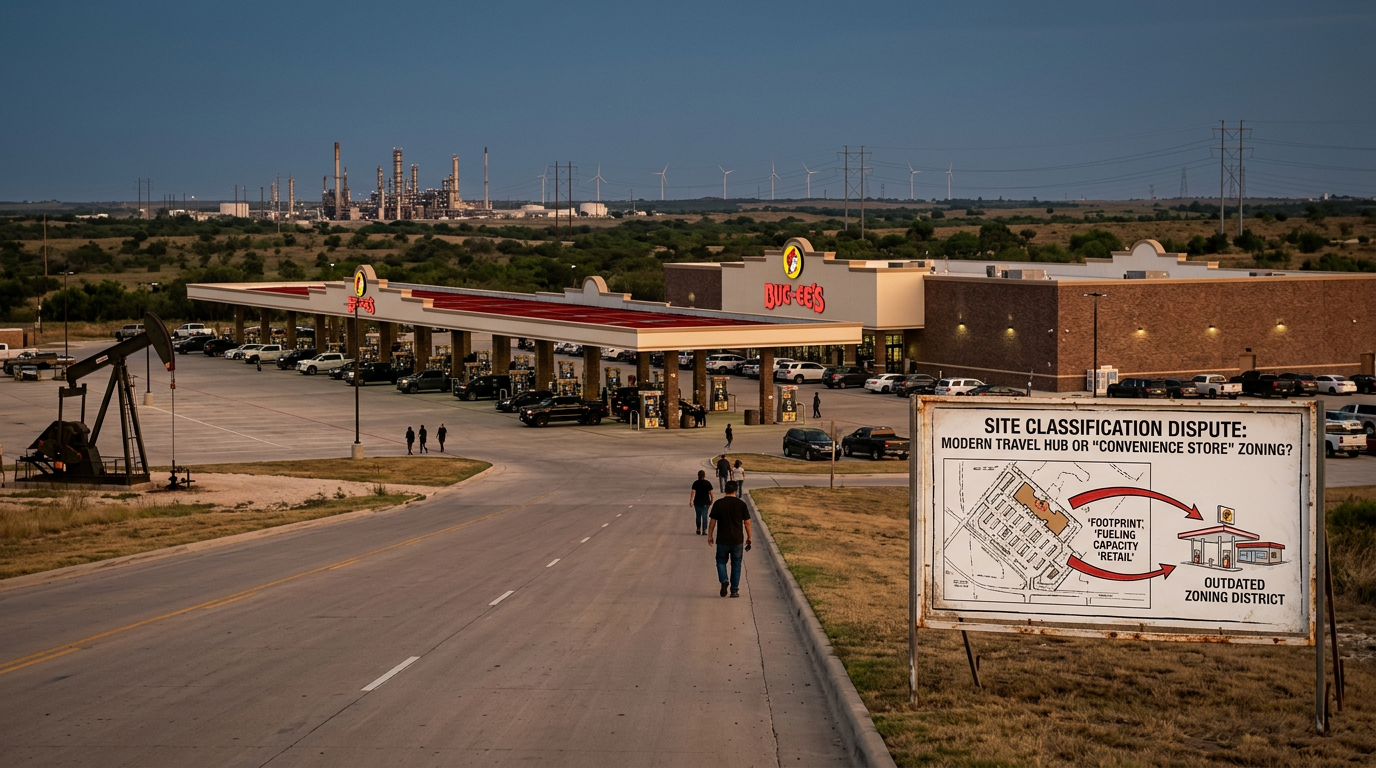
Buc-ee’s, the Lake Jackson-based juggernaut of Texas travel, has entered a legal and administrative battle regarding its physical classification within local zoning frameworks. At the heart of the dispute is a fundamental mismatch between 20th-century building codes and the massive scale of modern Texas retail hubs. While regional officials often attempt to categorize the chain under the traditional 'convenience store' umbrella, the company argues that its footprint, fueling capacity, and retail volume represent an entirely different asset class. This expansion friction often arises when the chain moves into new territories where local governments lack the regulatory vocabulary to address a site that features over a hundred fueling positions and tens of thousands of square feet of internal retail floor space. Historically, Buc-ee’s has transformed from a localized pit stop into a massive branding powerhouse, necessitating a shift in how municipalities view land use, traffic patterns, and environmental impact assessments for these sprawling facilities.
Texas relevance
As a quintessential Texas brand, the ability of Buc-ee’s to navigate regulatory hurdles is a bellwether for Texas-style economic expansion. The company’s growth strategy serves as a model for how Texas businesses export the state’s culture and commercial efficiency across the country. In its home state, Buc-ee’s has benefited from relatively flexible land-use policies that favor rapid development and massive infrastructure projects. However, when these Texas-sized expectations meet more restrictive or ill-defined zoning boards elsewhere, it creates a conflict that tests the limits of traditional commercial classification. For Texans, these legal challenges represent the growing pains of a homegrown entity becoming a national standard-bearer for large-scale travel centers. The outcome of such zoning appeals could influence how other large-scale Texas enterprises manage expansion and property tax assessments in new markets.
The Evolution of the Travel Center Model
The traditional American convenience store was designed as a small-footprint outlet intended for quick transactions, usually located on a corner lot and offering a limited selection of snacks and fuel. Buc-ee's has fundamentally disrupted this model by creating destinations that function more like retail malls with a fueling component. This shift means that a site is no longer just a place to buy gas; it is a major employer and a regional magnet for tourism. The infrastructure required to support such a facility is far more complex than what is found at a standard gas station.
Because of this complexity, the legal teams representing the Texas chain must often educate local planning commissions on the differences between a 'convenience store' and a 'travel center.' A travel center implies an expectation of longer dwell times, higher vehicle turnover, and a diverse range of merchandise that ranges from home decor to specialized food services. When a county fails to provide a specific legal category for this type of development, it creates uncertainty for investors and delays for construction crews, which eventually increases the cost of doing business.
Zoning Definitions and Economic Impact
Zoning is the primary mechanism through which local governments control the growth and character of their communities. When a project like a Buc-ee’s is proposed, it often triggers a review of the 'highest and best use' for the land. If the zoning code does not have a provision for large-scale travel centers, the developer might be forced to apply for numerous variances or conditional use permits. This often leads to public hearings and appeals processes that can last for years, as seen in recent challenges in various counties.
For a company with the capital and scale of Buc-ee’s, these delays are more than just an inconvenience. They represent millions of dollars in stalled economic activity. Proponents of the chain point out that these facilities bring hundreds of jobs with competitive pay and benefits to areas that might otherwise struggle for commercial investment. By correctly classifying these centers, counties can better plan for the accompanying infrastructure, such as road widening and sewage upgrades, ensuring the project integrates smoothly with the surrounding community.
The Legal Basis for Reclassification
The legal appeal process usually hinges on the interpretation of existing statutes regarding 'retail motor fuel outlets.' In many jurisdictions, these statutes are decades old and do not account for the sheer physical volume of a modern travel hub. Buc-ee's legal strategy often involves presenting data on average transaction times, the ratio of retail sales to fuel sales, and the specific logistics of their delivery networks. By proving they operate outside the norm of a standard convenience store, they seek to create a new precedent for their specific business model.
Successful appeals can result in the creation of new zoning tiers specifically for high-volume travel centers. This not only helps the current project but sets a clearer path for other companies that may want to build similar facilities. Without these legal challenges, businesses are often left at the mercy of subjective interpretations by county clerks or planning directors who may not have the expertise to value such unique commercial properties accurately.
Infrastructure and Traffic Management
One of the biggest concerns for local officials when a 'Texas-sized' center is proposed is the impact on local traffic. Standard convenience store zoning might only require basic entry and exit points. However, a facility that hosts over 100 pumps requires sophisticated traffic engineering, including dedicated turn lanes, traffic signals, and often the contribution of private funds toward public road improvements. If the zoning is wrong, the infrastructure requirements might be underestimated, leading to congestion and safety issues.
Buc-ee’s has built a reputation for efficiently managing these large crowds, but that efficiency starts at the planning phase. By pushing for a more accurate classification, the company is also advocating for a more rigorous and realistic planning process. This ensures that the facility can handle the forecasted volume of thousands of vehicles per day without negatively impacting the quality of life for long-time residents in the area.
Environmental and Utilities Considerations
Beyond traffic and retail, the environmental footprint of a large travel center is a major point of discussion in zoning appeals. A massive fueling site requires significantly more underground storage capacity and more robust leak detection systems than a neighborhood gas station. Zoning boards must evaluate these sites for their impact on local watersheds and noise levels. By refusing to be categorized as a simple convenience store, the developer is essentially asking for a dedicated set of regulations that acknowledge these unique environmental needs.
Water and power usage are also on a different scale. A facility that houses a massive bakery, commercial kitchen, and extensive restroom facilities (a hallmark of the Buc-ee's brand) places a significant load on local utilities. Proper classification allows utility providers to accurately forecast demand and ensure the grid and water systems are capable of supporting the business. Texas experience has shown that when these factors are managed correctly, the resulting tax revenue can fund significant community improvements elsewhere.
Future Outlook for Texas-Sized Retail
The struggle to classify Buc-ee’s is likely just the beginning of a larger trend in American commercial real estate. As retail shifts toward 'destination experiences,' more companies will find themselves outgrowing traditional zoning definitions. The Texas model—prioritizing scale, service, and brand loyalty—is being tested against the more cautious and sometimes stagnant regulatory environments of other regions. The ability of Texas companies to win these battles will determine how far the 'Texas Miracle' can expand beyond the state's borders.
Ultimately, the goal for both the business and the local government should be clarity. Clear rules allow for faster development and more predictable outcomes. For Buc-ee’s, the fight for appropriate classification is a fight for the right to operate as the unique entity they have become. As they continue to expand across the South and into the West, these legal and administrative lessons will serve as a blueprint for how to export Texas-style commerce to the rest of the nation.
Analysis
The core of this issue isn't just about labels; it's about the financial and operational implications of how a business is defined by a county. Categorizing a Buc-ee’s as a simple 'convenience store' is akin to calling a professional stadium a 'neighborhood playground.' This misclassification can lead to inappropriate traffic requirements, tax valuations, and utility assessments. From a conservative business perspective, the adaptability of local government to accommodate high-growth, high-revenue entities is vital. If counties fail to modernize their zoning codes to reflect the reality of major travel centers, they risk stifling the very economic engines that provide substantial sales tax revenue and local employment. The 'Keep TX Red' perspective favors the streamlining of these administrative processes to ensure that successful private ventures can scale without being strangled by bureaucratic red tape that was written before the concept of a 70,000-square-foot snack empire even existed.
Source attribution
This story was reported using a public release from the Buc-ee's (Google News). Keep TX Red rewrote the coverage independently and links to the official statement for verification.
Frequently Asked Questions
- Why does it matter if Buc-ee’s is called a convenience store or a travel center?
- Classification affects everything from property taxes and utility rates to the specific building codes the company must follow. A 'travel center' designation often carries different requirements for road access and environmental safeguards than a small neighborhood store.
- Does this legal battle stop Buc-ee's from opening new locations?
- While it can cause significant delays in the planning and construction phases, these legal appeals are a standard part of large-scale commercial development. They are intended to resolve disputes before the first shovel hits the ground.
- How many fueling stations do these large centers typically have?
- Most typical Buc-ee's travel centers feature between 100 and 120 fueling positions, which is vastly larger than the 4 to 12 pumps found at a standard convenience store.
Official Sources
Take the next step
Browse the Newsroom →Read more about Keep Texas Red → Our full guide to what Keep Texas Red means and why Texans support it.
Get Texas updates delivered weekly.
Independent Texas reporting on politics, policy, and daily life. One email a week. Unsubscribe anytime.
Keep TX Red Newsroom
The Keep Texas Red Editorial Staff produces nonpartisan explainers, policy breakdowns, and educational resources to help Texans understand how their government works. All content is reviewed for accuracy and updated regularly.
About Keep TX Red →