Texas Enterprise Giant Buc-ee’s Challenges Academic Norms with Massive Non-Degree Salaries
Texas-based Buc-ee’s creates national debate by offering general manager salaries up to $275,000 without requiring a four-year college degree.
Editorial disclaimer: Opinions and analysis on Keep TX Red are editorial content — not statements of fact. See our editorial standards.
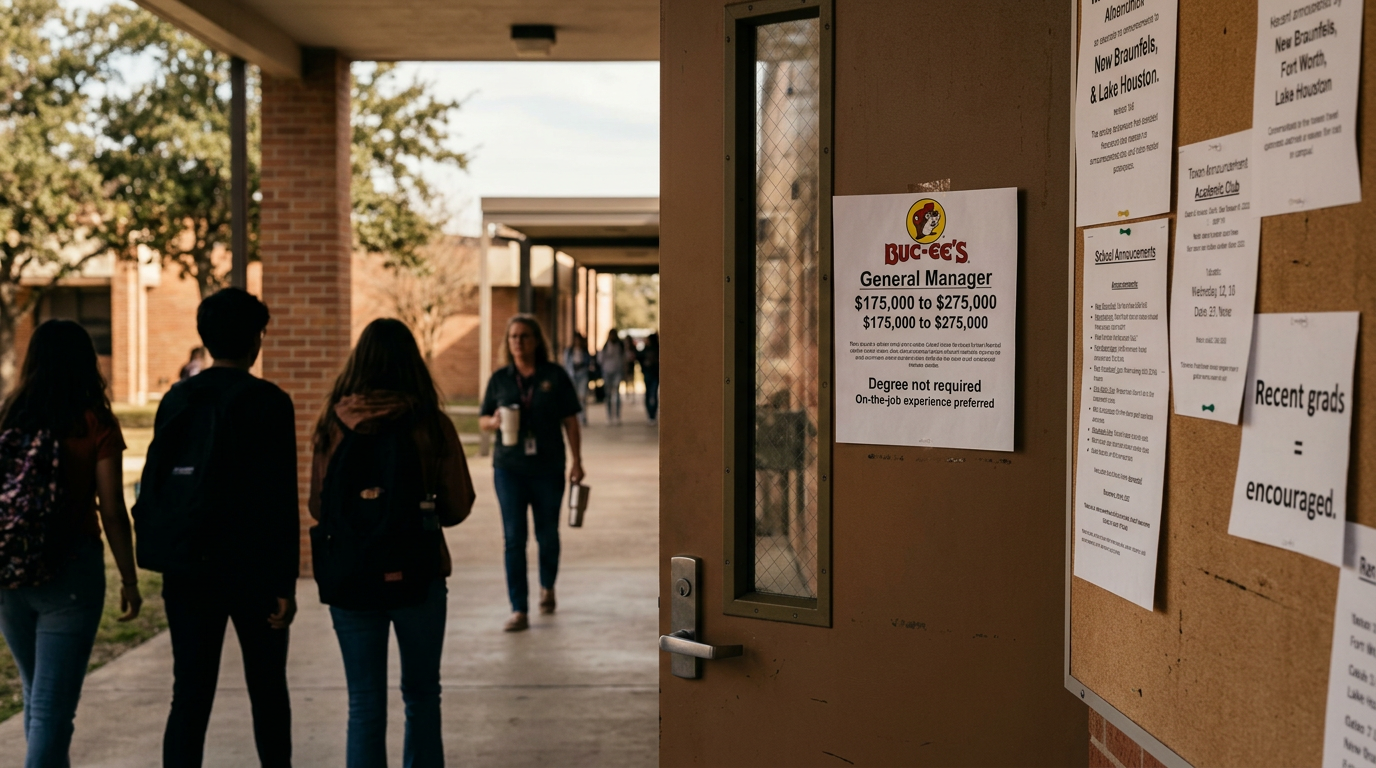
Buc-ee’s, the iconic Texas-based travel center chain, has sparked a significant nationwide conversation regarding the value of traditional higher education versus on-the-job management experience. Recent transparency in the company’s pay structure reveals that general managers at their massive convenience stores can earn upwards of $175,000 to $275,000 annually. Perhaps most striking to observers is the fact that these high-earning positions do not typically require a college degree, focusing instead on internal promotion and proven operational excellence. This development comes as many industries struggle to reconcile rising tuition costs with entry-level wages that often fall short of student loan obligations. By setting a high floor for compensation, Buc-ee’s is positioning itself as a premier employer in the retail and hospitality sector, bypassing the 'degree inflation' that has characterized American hiring practices for decades. The context of this wage strategy is rooted in the unique business model of the Lake Jackson-founded company. Historically, the retail and service industry in Texas has relied on a high-volume, low-margin approach, often leading to high turnover and low pay. Buc-ee's deviated from this path early on, choosing to invest heavily in its workforce to maintain its reputation for pristine facilities and legendary customer service. This latest revelation about executive-level pay for store managers is not a new pivot, but rather a public affirmation of a long-standing internal philosophy that prioritizes logistical mastery and leadership over academic credentials. In the broader landscape of the Texas workforce, this represents a significant shift where localized corporate powerhouses are effectively competing with white-collar career paths for the state's top talent.
Texas relevance
As a quintessential Texas brand born in Lake Jackson, Buc-ee’s is a primary driver of local economies across the Lone Star State. From the massive travel centers along I-45 and I-10 to the sprawling locations in New Braunfels and Fort Worth, these stores serve as major regional hubs for employment. The impact on Texas is twofold: it provides a viable path for the state’s non-degree-holding workforce to reach the upper-middle-class income bracket, and it forces other Texas retailers to reconsider their own compensation models. Because Buc-ee’s anchors so many small to medium-sized Texas communities, their ability to pay six-figure salaries creates a localized economic boost that benefits nearby housing markets and small businesses. The company's recent expansion beyond Texas borders has only amplified the national spotlight on their distinctly Texan way of doing business.
The Economics of the Beaver Nugget Empire
Running a Buc-ee’s is not a typical retail management job; it is a complex exercise in logistics and supply chain management. A general manager is responsible for overseeing dozens of fueling stations, massive retail departments, and fresh food operations that serve thousands of people per hour. The scale of these operations necessitates a high level of compensation to attract talent capable of maintaining the company’s rigorous standards for cleanliness and efficiency.
The pay scale is transparently posted at many locations, serving as both a recruiting tool and a statement of brand values. While entry-level roles start well above the minimum wage, the steep trajectory toward management roles incentivizes employee retention. This reduction in turnover saves the company millions in training costs, justifying the higher salary outlays at the top of the store hierarchy.
Furthermore, the economic ripple effects are undeniable. In rural Texas counties where Buc-ee's often sets up shop, a few dozen families earning well over $100,000 can significantly alter the local tax base. This 'Buc-ee's Effect' turns a gas station into a primary economic engine for the surrounding area, elevating the standard of living for employees who might otherwise have had to move to major metro areas like Houston or Dallas to find similar pay.
Shattering the College Degree Myth
The internet debate sparked by these salary figures often centers on the 'fairness' of a retail worker earning more than a teacher, an architect, or a mid-level corporate executive. However, this comparison ignores the fundamental laws of supply and demand. There is a high demand for leaders who can handle high-stress, high-volume physical environments, but a limited supply of people willing to commit to the grueling hours and operational demands of a 24-hour travel center.
Buc-ee's success proves that certificates on a wall are not always a prerequisite for professional success. By focusing on aptitude and work ethic, the company has created an alternative to the traditional collegiate path, which often leaves young Texans with tens of thousands of dollars in debt. This 'earn-while-you-learn' model is gaining traction as more families question the ROI of a four-year university experience.
The psychological impact of seeing a $275,000 salary posted on a hiring board cannot be overstated. It challenges the stigma associated with 'blue-collar' or service-sector work. When a store manager can out-earn a lawyer or an engineer, the societal hierarchy shifts, placing a higher value on the essential services that keep the state moving and feeding the traveling public.
Operational Rigor and the Cost of High Pay
While the salaries are eye-popping, they come with a set of expectations that would intimidate many office workers. Buc-ee’s is famous for its strict 'no phones' policy for employees and a high expectation of constant activity during shifts. The company does not offer typical 'slow periods'; the travel centers are designed to be destinations in themselves, meaning the workload remains consistent throughout the day and night.
Management responsibilities include ensuring the world-famous restrooms stay spotless, coordinating the arrival of dozens of supply trucks, and managing a workforce that often exceeds 200 people per location. This is a high-stakes environment where a single service failure can tarnish a brand that prides itself on perfection. The $275,000 salary is less a gift and more a reflection of the intense level of responsibility required to keep the gears turning.
This model also emphasizes the importance of 'soft skills' and emotional intelligence. Managers must handle customer disputes, employee relations, and emergency situations with a level of poise that isn't always taught in a classroom. The company's preference for internal promotion ensures that by the time someone reaches the general manager level, they have mastered every facet of the operation from the ground up.
The National Expansion and Brand Identity
As Buc-ee’s expands into states like Alabama, Florida, Georgia, and Tennessee, it is taking its high-wage Texas philosophy with it. This is disrupting local labor markets in the Southeast, where wages have historically been lower than in the Texas 'Golden Triangle.' By exporting these high salaries, Buc-ee’s is becoming a standard-bearer for a new kind of American retail powerhouse.
The brand's identity is inextricably linked to this idea of 'bigger and better.' Just as the stores are the largest in the world, the paychecks are among the largest in the industry. This consistency reinforces the consumer perception of quality. Customers understand that the reason the service is so efficient is because the people behind the counter are being compensated as true professionals.
This expansion also serves as a soft-power export for Texas values. The focus on individual achievement, the rejection of unnecessary bureaucratic credentials, and the emphasis on a hard-work-reward-culture are all hallmarks of the Texas spirit. As Buc-ee's spreads across the map, it challenges the national retail industry to keep up or lose their best people to the beaver-branded giant.
The Future of Texas Employment Standards
What Buc-ee’s is doing today may become the blueprint for other major Texas employers tomorrow. As 'quiet quitting' and labor shortages plague various sectors, the solution may lie in radical wage transparency and the removal of artificial barriers to entry. If a convenience store can find and retain top-tier talent without requiring a degree, it begs the question of why other industries continue to insist on one.
Looking ahead, this trend could influence state policy regarding workforce development. Instead of focusing solely on university funding, Texas might see a greater push for industry-specific certifications and apprenticeship programs that mirror the internal training used by companies like Buc-ee’s. The goal is to create a workforce that is nimble, debt-free, and ready to meet the demands of a rapidly growing state economy.
Ultimately, the Buc-ee's salary story is a testament to the health of the Texas economy. It shows a marketplace that is vibrant enough to support high wages for those willing to put in the work, regardless of their academic background. It remains a shining example of how private enterprise, when left to innovate, can solve labor challenges more effectively than any government mandate or traditional academic path.
Analysis
The discourse surrounding Buc-ee’s pay scale reflects a maturing understanding of the American labor market. For critics who argue that these salaries are 'excessive' for retail, the market response suggests otherwise; managing a 75,000-square-foot facility with hundreds of employees and thousands of daily customers requires a level of logistical competence comparable to running a small airport. From a policy perspective, this trend supports the argument that vocational and experiential training can often yield better economic outcomes for workers than traditional liberal arts degrees. By removing the degree barrier, Buc-ee's is effectively democratizing access to high-earning careers, which aligns with the rugged, meritocratic values often championed in Texas. This movement may signal the beginning of a broader 'de-credentialing' of the American workforce as companies prioritize specific skill sets over diplomas.
Source attribution
This story was reported using a public release from the Buc-ee's (Google News). Keep TX Red rewrote the coverage independently and links to the official statement for verification.
Frequently Asked Questions
- Do you really need a college degree to manage a Buc-ee's?
- No, Buc-ee's frequently hires and promotes individuals into high-level management positions based on their operational experience and performance within the company, rather than their formal education. While a degree doesn't hurt, the company prioritizes 'on-the-ground' expertise and leadership skills.
- What are the requirements for these high-paying manager roles?
- General managers are expected to have several years of experience in high-volume retail or food service management. They must be able to lead a team of hundreds, maintain strict cleanliness standards, and manage complex inventory and logistics across multiple departments, including the gas pumps, deli, and retail sections.
- Are benefits included in these salary figures?
- Buc-ee’s is known for offering a robust benefits package in addition to high base pay. This typically includes a 401(k) with a high company match, affordable health insurance, and three weeks of paid time off. The total compensation package is designed to be one of the most competitive in the retail industry.
Official Sources
Take the next step
Browse the Newsroom →Read more about Keep Texas Red → Our full guide to what Keep Texas Red means and why Texans support it.
Get Texas updates delivered weekly.
Independent Texas reporting on politics, policy, and daily life. One email a week. Unsubscribe anytime.
Keep TX Red Newsroom
The Keep Texas Red Editorial Staff produces nonpartisan explainers, policy breakdowns, and educational resources to help Texans understand how their government works. All content is reviewed for accuracy and updated regularly.
About Keep TX Red →