Texas Data Centers Exploit Air Quality Permit Loophole for Massive Power Expansion
A new investigation reveals AI data centers in Texas are using small-business air permits meant for dry cleaners to build massive industrial power plants.
Editorial disclaimer: Opinions and analysis on Keep TX Red are editorial content — not statements of fact. See our editorial standards.
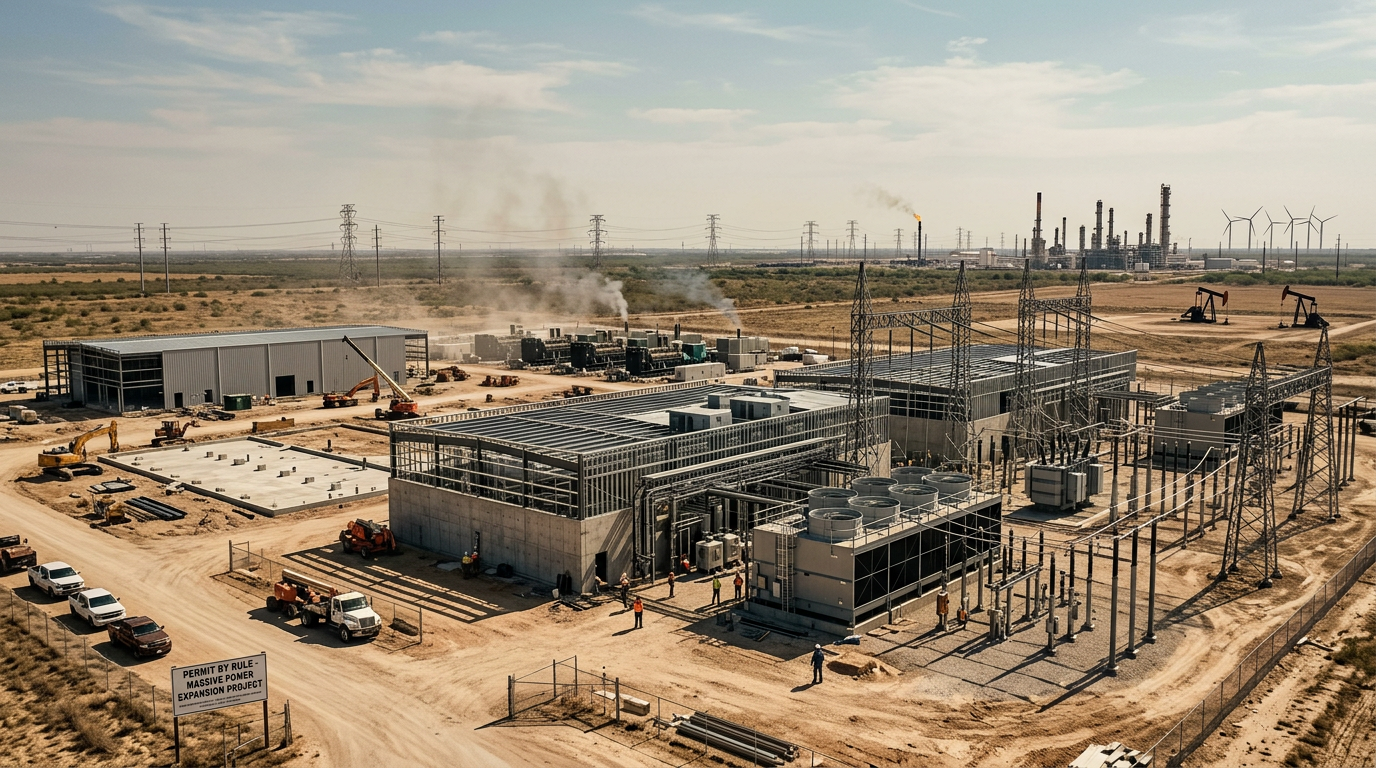
Recent investigations into the rapidly expanding artificial intelligence and data center sectors in Texas have uncovered a significant regulatory trend regarding how these facilities procure power. As the demand for 24/7 electricity grows, many developers are bypassing traditional, rigorous environmental reviews by utilizing a regulatory mechanism known as 'Permit by Rule' (PBR). Historically, this pathway was designed for low-impact businesses such as dry cleaners, small auto body shops, or retail bakeries whose emissions fall below a specific threshold. However, as AI facilities require massive amounts of dedicated energy to support their processing units, they are increasingly building on-site gas-fired power plants that are being approved under these simplified standards rather than the more stringent 'New Source Review' process required for major industrial polluters. Contextually, this shift comes as Texas struggles to balance a booming tech economy with the stability of its independent electrical grid managed by ERCOT. Over the last decade, the Lone Star State has marketed itself as a premier destination for big tech, offering low taxes and a deregulated energy market. While large-scale utility power plants usually face months or years of public testimony, environmental impact studies, and federal oversight under the Clean Air Act, the PBR loophole allows these new, smaller-scale but high-output energy centers to begin operations with significantly less transparency. This strategy creates a fragmented landscape where hundreds of small emission sources cumulatively impact air quality without the holistic oversight typically applied to the energy sector.
Texas relevance
This issue is central to the future of the Texas energy landscape, particularly in the 'Silicon Prairie' corridors between North Texas, Austin, and San Antonio. Because Texas operates its own power grid, the surge in data center installations puts unprecedented pressure on local resources. The Texas Commission on Environmental Quality (TCEQ) is the primary agency overseeing these permits, making the state's regulatory environment the front line for how AI infrastructure will be managed nationally. The proliferation of these facilities in suburban areas near Dallas and Houston means that local residents are often unaware that industrial-grade gas turbines are being installed nearby under permits originally intended for small commerce.
The Rise of On-Site Generation in Texas
Data centers require an immense amount of cooling and electricity to keep high-performance servers running. In many parts of Texas, the existing grid is already stretched to its limits during peak summer and winter months. To ensure 'five-nines' reliability, many AI companies are no longer relying solely on ERCOT's general supply. Instead, they are installing massive rows of natural gas generators directly on their campuses to act as either primary power sources or emergency backups.
The problem arises when these clusters of generators are permitted individually. By keeping each unit's emissions just below the threshold of a 'major source,' developers can apply for the PBR status. This allows them to avoid the lengthy public notice periods that would otherwise allow neighbors to voice concerns over noise pollution, nitrogen oxide emissions, and long-term health impacts. In recent months, dozens of these applications have quietly moved through the TCEQ pipeline.
Understanding the Permit by Rule Mechanism
The 'Permit by Rule' system was created to streamline bureaucracy for businesses that pose a negligible risk to public health. By acknowledging that a small business lacks the legal and financial resources of a major corporation, the state allows for a fast-track notification process. The applicant simply certifies that they meet specific pre-defined criteria regarding their equipment and projected emissions.
Critics argue that applying this to multimillion-dollar tech facilities is a perversion of the rule’s intent. While a single generator might meet PBR criteria, a data center facility might host twenty or thirty such units. Current regulations often look at these sources in isolation rather than as a combined industrial complex, which allows the total volume of emissions to far exceed what the PBR system was designed to manage safely.
ERCOT and the Growing Energy Deamnd
The Electric Reliability Council of Texas (ERCOT) has noted that data centers and AI processing are among the fastest-growing segments of energy demand in the state. Projections indicate that tech-related loads could double within the next several years. This puts the state in a difficult position: it needs the tax revenue and innovation these companies bring, but it cannot risk the stability of the grid for residential consumers.
When data centers use PBR to build their own power plants, they effectively become 'behind-the-meter' generators. While this reduces their immediate pull from the public grid, the environmental and regulatory footprint remains. There is also a concern that if these facilities are not properly regulated, they may not meet the same emissions-control technology standards required of larger, utility-scale gas plants that contribute to the state's general power supply.
Impact on North Texas and Suburban Corridors
Regions like Fort Worth, Plano, and Irving have seen a massive influx of data center construction due to their proximity to fiber optic trunks. These areas are also residential hubs. When a data center uses a PBR to install a power plant, the local community often finds out only after construction has begun. Because the PBR process does not require a public comment period, there is no formal mechanism for homeowners to protest the proximity of industrial equipment to schools or parks.
This lack of transparency has led to growing friction between local city councils and state regulators. While cities can use zoning laws to manage where data centers are built, they have little power over the air permits issued by the TCEQ. This jurisdictional gap is what allows the PBR loophole to thrive, as state-level rules supersede local preferences for higher environmental transparency.
The Search for Regulatory Reform
State lawmakers and environmental advocates are beginning to call for a review of how the TCEQ categorizes energy-intensive tech facilities. Suggestions include creating a new permit tier specifically for data centers that recognizes their unique role as both heavy energy consumers and potential pollutants. This middle-ground approach would aim to maintain the speed of business while reintroducing the public oversight currently missing from the PBR process.
Without reform, the cumulative effect of these 'micro-plants' could impact Texas's compliance with federal air quality standards. As major metro areas like Dallas-Fort Worth already struggle with ozone levels, the addition of hundreds of unmonitored gas engines could push the region into stricter federal 'non-attainment' status, harming all industrial growth in the state. Addressing the PBR loophole is therefore not just an environmental issue, but an economic necessity for long-term stability.
Analysis
OPINION: The use of the 'Permit by Rule' shortcut for industrial-scale energy generation represents a failure of the current regulatory framework to evolve alongside technology. While Texas must remain open for business and lead the AI revolution, the integrity of our air quality standards and the transparency of our industrial growth should not be sacrificed for corporate speed. If large-scale data centers are effectively operating as private power plants, they should be held to the same scrutiny as any other utility provider. Allowing them to hide behind rules meant for neighborhood dry cleaners undermines public trust and could lead to unforeseen cumulative environmental strain on our growing metropolitan hubs.
Source attribution
This story was reported using a public release from the Texas Standard. Keep TX Red rewrote the coverage independently and links to the official statement for verification.
Frequently Asked Questions
- What is a 'Permit by Rule' in Texas?
- A Permit by Rule (PBR) is a streamlined authorization from the Texas Commission on Environmental Quality (TCEQ) for types of facilities that the commission has determined will not make a significant contribution of air contaminants to the atmosphere. It is intended for small businesses to avoid the expensive and lengthy process of a full New Source Review permit.
- Why are data centers building their own power plants?
- High-performance AI chips require massive amounts of electricity and constant cooling. To ensure they have 100% uptime and to avoid straining the public ERCOT grid, many data centers install natural gas turbines or backup generators on-site to handle their own power needs.
- How does this affect air quality in Texas cities?
- While one generator may have low emissions, the cumulative effect of dozens of generators running at a single site can be substantial. Because they are permitted individually under PBR rules, they may not be required to use the advanced pollution-scrubbing technology found in larger power plants, potentially increasing nitrogen oxide and ozone levels in urban areas.
Official Sources
Take the next step
Browse the Newsroom →Read more about Keep Texas Red → Our full guide to what Keep Texas Red means and why Texans support it.
Get Texas updates delivered weekly.
Independent Texas reporting on politics, policy, and daily life. One email a week. Unsubscribe anytime.
Keep TX Red Newsroom
The Keep Texas Red Editorial Staff produces nonpartisan explainers, policy breakdowns, and educational resources to help Texans understand how their government works. All content is reviewed for accuracy and updated regularly.
About Keep TX Red →