Governor Abbott Sets New Standards for Power Independence Among Incoming Texas Data Centers
Gov. Abbott announces that new data centers must provide their own power to protect the Texas ERCOT grid while supporting infrastructure growth.
Editorial disclaimer: Opinions and analysis on Keep TX Red are editorial content — not statements of fact. See our editorial standards.
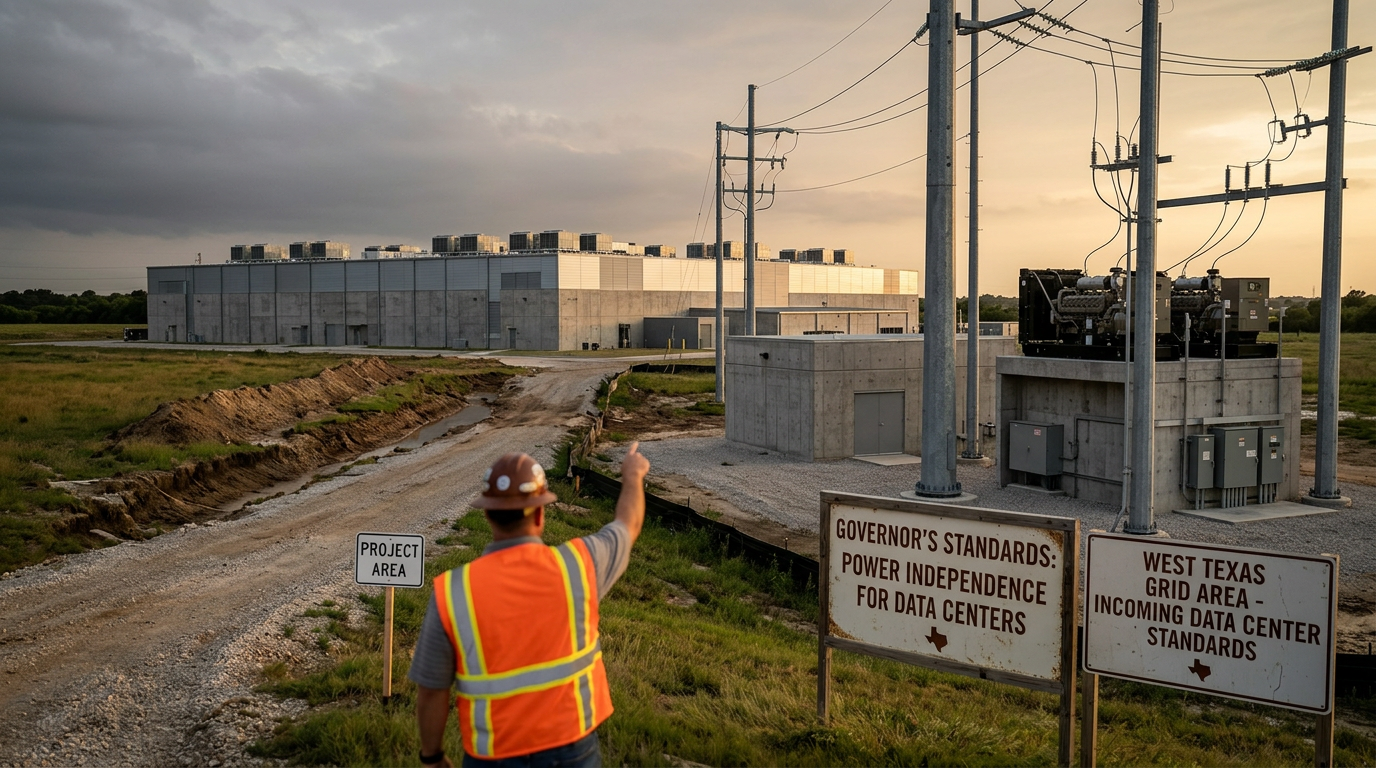
Governor Greg Abbott has issued a clear directive regarding the expansion of data centers across the Lone Star State, mandating that these high-capacity facilities secure their own independent power sources rather than relying solely on the existing state grid. Historically, Texas has attracted tech giants and cryptocurrency miners with its business-friendly climate and deregulated energy market. However, the rapid proliferation of these energy-intensive hubs has raised concerns about the long-term stability of the Electric Reliability Council of Texas (ERCOT) network. The Governor's recent statements emphasize a shift toward self-sufficiency in industrial development. This policy shift marks a departure from the traditional model where the state aggressively recruited large-scale energy consumers without stringent requirements for on-site generation. In recent years, Texas has navigated extreme weather events that tested the resilience of its utility infrastructure, leading to a more cautious approach to onboarding massive new electrical loads. By requiring data centers to bring their own power, the administration aims to decouple certain technological growth from the immediate residential and commercial demand that peaks during summer heatwaves and winter freezes.
Texas relevance
As the energy capital of the world, Texas is uniquely positioned to handle massive industrial growth, but the scale of modern data centers presents a specific challenge for urban areas like North Texas and West Texas. Large facilities in the Dallas-Fort Worth metroplex and the vast digital mining operations in the Permian Basin have significantly increased the baseline demand for electricity statewide. This new mandate ensures that residents in Houston, Austin, and San Antonio are not competing with sprawling server farms for the same pool of kilowatt-hours during emergency grid conditions. The directive serves to protect the local Texas ratepayer while maintaining the state's status as a premier destination for the global technology sector.
The Rise of Energy-Intensive Computing in Texas
The influx of data centers and cryptocurrency operations into Texas has been unprecedented over the last five years. Companies are drawn by the state's relatively low real estate costs and the lack of corporate income tax. However, these facilities operate 24/7/365, creating a 'flat' yet massive load on the grid that does not fluctuate like residential usage. This consistency allows the grid to function predictably during normal times but adds substantial pressure when every available megawatt is needed for home heating or cooling.
Governor Abbott noted that the sheer volume of power requested by pending data center applications exceeds the current surplus capacity of many local delivery systems. The pivot to self-generation is not just an environmental or sustainability goal; it is a logistical necessity to prevent infrastructure bottlenecks. This ensures that the state can continue to welcome high-paying tech jobs without compromising the reliability of the light switch for the average Texan family.
Technological Solutions for Private Power Generation
To meet the Governor's new requirements, incoming firms are expected to explore a diverse array of power solutions. This includes the implementation of large-scale natural gas turbines located on-site, which can offer lower-emission alternatives to coal while remaining more reliable than solar or wind during calm or dark periods. By keeping this generation 'behind the meter,' companies can ensure their servers stay online even if the broader ERCOT market faces a shortfall.
Furthermore, advancements in Small Modular Reactors (SMRs) are increasingly viewed as the future of data center power in Texas. These compact nuclear units can provide carbon-free, baseload electricity for decades. By pushing companies in this direction, the Texas government is incentivizing a private-sector nuclear renaissance that could ultimately benefit the entire state’s energy portfolio through technological spillover and workforce development in the advanced energy sector.
Balancing Economic Growth with Grid Reliability
The tension between economic expansion and utility stability is a central theme of the 88th and upcoming 89th Legislative Sessions. Texas leaders have realized that a booming economy requires a backbone of steel and concrete, not just digital code. The challenge lies in making sure that the physical infrastructure—the power lines, transformers, and generation plants—keeps pace with the digital demand. Governor Abbott’s mandate acts as a filter, ensuring that only the most serious and self-sufficient players enter the Texas market.
This policy also serves to mitigate costs for the average Texas taxpayer. When a massive data center hooks into the public grid, it often necessitates multi-million dollar upgrades to transmission lines. If the company provides its own power, these costs are internalized by the corporation rather than being socialized through higher monthly utility bills for residents. This alignment of cost and benefit is a key pillar of the Governor's conservative economic strategy.
The Impact on the Cryptocurrency Mining Sector
Cryptocurrency miners, who have found a welcoming home in Texas due to the state's 'demand response' programs, will be among the most impacted by this shift. While miners currently help balance the grid by shutting down during peak demand, the scale of future growth requires a more permanent solution. Moving from a 'demand-side' participant to a 'supply-side' generator is a significant hurdle that may thin the ranks of smaller operations while favoring well-capitalized industry leaders.
The Governor's directive implies that the honeymoon phase of unregulated energy consumption for digital assets is evolving into a more mature phase of partnership. This move reinforces the idea that Texas is open for business, but only for businesses that contribute to the state's overall resilience. It sets a precedent that the right to operate in Texas comes with the responsibility of contributing to the state's foundational resource needs.
Long-Term Infrastructure Planning and Permitting
For this new mandate to succeed, the state must also streamline the permitting process for private power plants. If a data center is required to build its own natural gas or nuclear facility, the state must ensure that regulatory red tape does not prevent that facility from coming online simultaneously with the data center. This will require coordination between the Public Utility Commission of Texas (PUC) and various environmental regulatory bodies.
The timeline for building a data center is often much shorter than the timeline for building a power plant. To avoid orphaning investments, the Texas government will likely need to create 'fast-track' lanes for companies that are answering the Governor's call to bring their own power. This holistic approach ensures that the directive results in actual infrastructure rather than just being a barrier to entry for the tech world.
Future Outlook for the Texas Energy Landscape
Looking ahead, the Governor's plan could transform Texas into a patchwork of 'energy islands' that are interconnected with the main grid but capable of independent operation. This distributed generation model is inherently more resilient to physical or cyber-attacks. If a central node of the ERCOT grid fails, these self-powered data centers could continue to operate, or even better, feed their surplus power back into the grid to assist local communities during a crisis.
This vision aligns with the broader Texas goal of energy dominance. By requiring the tech sector to innovate, the state is effectively forcing a multi-billion dollar investment into the Texas energy sector. This not only secures the digital economy but also ensures that the Texas power grid remains the most dynamic and versatile in the United States, independent of federal oversight and capable of sustaining the massive population growth projected for the next decade.
Analysis
The Governor’s stance represents a pragmatic evolution of the 'Texas Model.' While the state remains committed to being a haven for innovation and low regulation, the vulnerability of the grid has become a significant political and economic flashpoint. By placing the burden of energy generation on the private companies themselves, the state is effectively creating a meta-market for microgrids and small modular reactors (SMRs). This move likely signals a future where Texas becomes a testing ground for private-sector energy innovation, forcing companies to move beyond being mere consumers to becoming active partners in power generation. Critically, this protects the political capital of the administration by heading off potential grid failures attributed to 'Big Tech' consumption.
Source attribution
This story was reported using a public release from the Governor Abbott — Video Moments (Google News). Keep TX Red rewrote the coverage independently and links to the official statement for verification.
Frequently Asked Questions
- Does this mean data centers can no longer use the Texas power grid?
- Not necessarily. While the mandate requires them to 'bring their own power,' they may still maintain a connection to the grid for backup or to sell surplus energy. However, the primary supply for their massive operations is now expected to be generated independently on-site or through dedicated private facilities.
- How will this affect electricity prices for Texas residents?
- By requiring large industrial users to generate their own electricity, there is less competition for the state's existing supply. This should ideally help stabilize prices for residential consumers, as it prevents sudden surges in demand that often drive up wholesale electricity costs during extreme weather.
- Which industries are most impacted by this Governor's directive?
- The primary industries impacted are large-scale cloud computing providers, AI development hubs, and cryptocurrency mining companies. These sectors are the largest consumers of consistent, high-volume electricity in the state's emerging tech economy.
Official Sources
Take the next step
Browse the Newsroom →Read more about Keep Texas Red → Our full guide to what Keep Texas Red means and why Texans support it.
Get Texas updates delivered weekly.
Independent Texas reporting on politics, policy, and daily life. One email a week. Unsubscribe anytime.
Keep TX Red Newsroom
The Keep Texas Red Editorial Staff produces nonpartisan explainers, policy breakdowns, and educational resources to help Texans understand how their government works. All content is reviewed for accuracy and updated regularly.
About Keep TX Red →