East Texas Water War Escalates as Landowner Kyle Bass Challenges Piney Woods Groundwater Rules in Federal Court
A federal lawsuit filed by investor Kyle Bass challenges the Piney Woods Groundwater Conservation District's moratorium on high-capacity water wells.
Editorial disclaimer: Opinions and analysis on Keep TX Red are editorial content — not statements of fact. See our editorial standards.
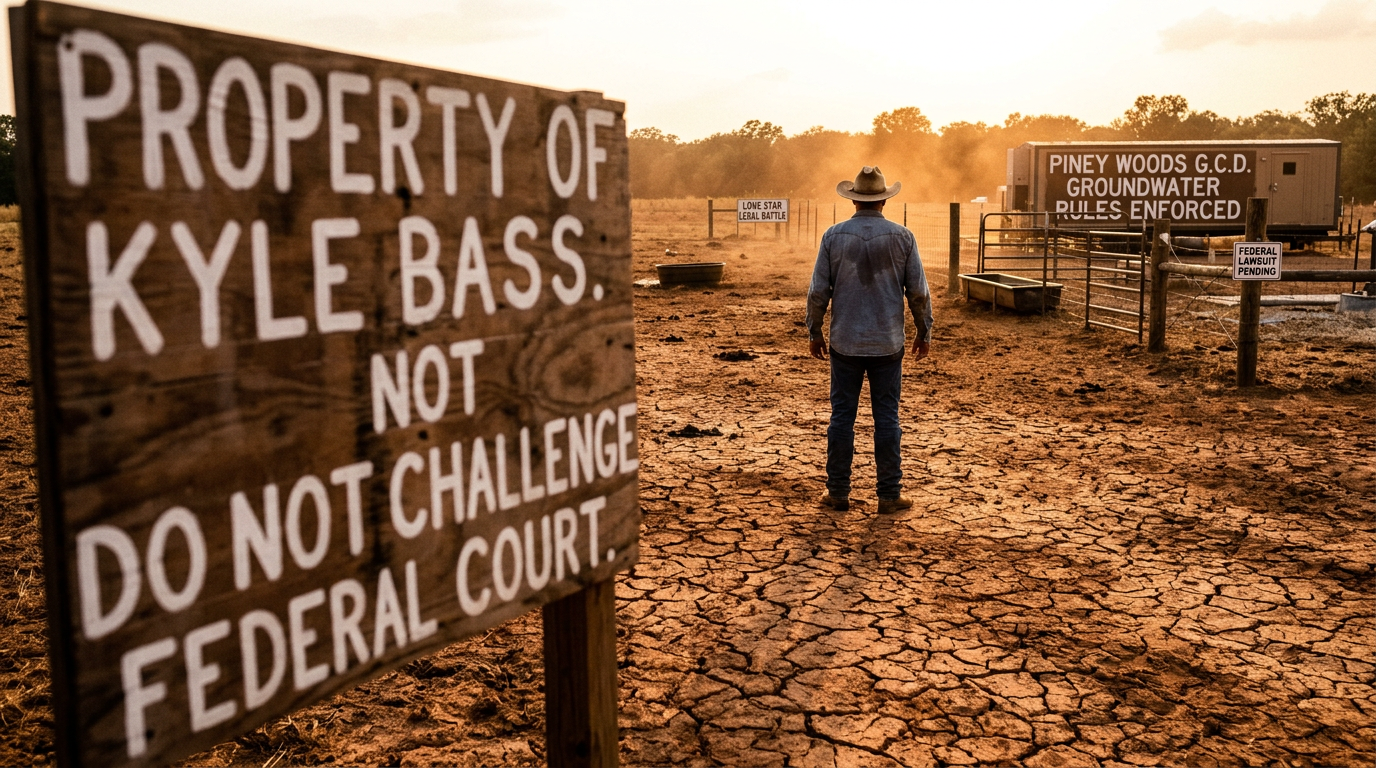
The legal landscape for Texas groundwater management is facing a significant challenge following a federal lawsuit filed by Dallas-based investor Kyle Bass. The conflict centers on a moratorium enacted by the Piney Woods Groundwater Conservation District, which currently prevents the drilling of high-capacity water wells within its jurisdiction. Bass, through his entity Conservation Equity Management, argues that the restriction unconstitutionally infringes upon his private property rights and prevents him from utilizing the natural resources beneath his land in East Texas. Historically, Texas water law has been governed by the 'Rule of Capture,' a principle that generally allows landowners to pump water from beneath their property without liability to neighbors, provided the use is not wasteful. However, the state legislature has also empowered local groundwater conservation districts (GCDs) to regulate this extraction to prevent aquifer depletion. This lawsuit represents a direct collision between these two legal pillars of the Lone Star State, as the plaintiff contends that the local board has overstepped its regulatory authority by imposing an indefinite freeze on new high-capacity permits. The dispute began when Bass sought permits to develop water resources on a 3,000-acre ranch property in the region. The intent behind the high-capacity wells was purportedly for a mix of conservation and potential commercial use, but the Piney Woods district implemented a moratorium shortly after interest in large-scale pumping increased. The district maintains that such measures are vital to ensuring the long-term sustainability of the Carrizo-Wilcox Aquifer, which supplies water to numerous East Texas municipalities and agricultural operations. Bass’s legal team asserts that the district is essentially 'locking' the water in place, which they characterize as a regulatory taking without just compensation. This case follows a series of high-profile water disputes in Texas where the state Supreme Court has previously affirmed that groundwater is a vested property right, yet the extent to which local districts can limit that right remains a fiercely debated battleground in the halls of justice and the state capitol.
Texas relevance
Texas is the absolute epicenter of this dispute because the state’s legal framework for water is unique compared to most other jurisdictions in the United States. Unlike many Western states that follow a 'prior appropriation' model, Texas maintains a hybrid system that recognizes private ownership of groundwater while allowing for regional management. For residents of East Texas, particularly those in the Piney Woods region, the outcome of this case could dictate the future of both their property values and their water security. If the federal court sides with Bass, it could set a precedent that limits the power of conservation districts across the state, potentially leading to a 'race to the bottom' where landowners compete to pump as much as possible. Conversely, a victory for the district would solidify the power of local boards to halt development in the name of resource preservation. This case touches on the core Texan values of property rights versus the collective necessity of resource management, affecting every rancher, farmer, and homeowner from the Panhandle to the Gulf Coast.
The Legal Basis of the Moratorium
The Piney Woods Groundwater Conservation District enacted the moratorium as a defensive measure to study the potential impacts of high-volume water exports. District officials argue that their primary mandate is to protect the aquifer from over-extraction, which can lead to land subsidence and the permanent loss of water storage capacity. In their view, allowing one developer to pump massive quantities could jeopardize the water supply for thousands of existing residents who rely on smaller, shallow wells.
The moratorium acts as a temporary freeze on new applications for high-capacity wells while the district updates its management plan. However, the definition of 'temporary' is a major point of contention in the lawsuit. Bass argues that the moratorium has been extended indefinitely, effectively creating a permanent ban without the proper legislative or public oversight. This administrative stalling, the lawsuit claims, is a violation of the due process and equal protection clauses of the Constitution.
The Rise of Water as a Commodity
As Texas experiences record-breaking population growth, the demand for water has transformed it into a lucrative commodity. Investors like Kyle Bass see groundwater not just as a resource for irrigation, but as a strategic asset that can be sold to thirsty urban centers or used to support large-scale industrial projects. This commercialization of water has caused friction in rural communities that fear their local resources will be drained to support the growth of distant cities like Dallas or Houston.
The suit highlights a growing trend of private equity and high-net-worth individuals purchasing large tracts of Texas land specifically for the water rights. This shift from traditional ranching to 'water ranching' has forced local groundwater districts to reconsider their traditional permitting processes. The legal challenge seeks to determine whether a district can discriminate against a landowner based on the intended scale or commercial nature of the water use, provided the pumping remains within the technological limits of the aquifer.
Historical Context of Groundwater Management
Groundwater districts in Texas were created by a constitutional amendment in 1917, but it wasn't until the late 20th century that they gained significant regulatory teeth. The landmark 2012 Texas Supreme Court decision in Edwards Aquifer Authority v. Day established that landowners have a constitutionally protected interest in the groundwater beneath their property. This ruling made it significantly harder for government entities to restrict pumping without potentially owing the landowner compensation for a 'taking.'
The Bass lawsuit builds on the Day decision by arguing that a moratorium is effectively a total taking of the water's value. In East Texas, where the Piney Woods are traditionally water-rich, the sudden imposition of restrictive rules has caught many property owners off guard. The historical precedent in Texas has largely favored the landowner, but the state's growing scarcity is pushing the judiciary to decide exactly how much 'regulation' is allowed before it becomes 'confiscation.'
Potential Impact on Local Municipalities
Local leaders in East Texas are watching the federal case with extreme caution. Many small towns in the region do not have the financial resources to dig deeper wells if the water table drops significantly. If the Piney Woods district is forced to lift its moratorium, these towns fear that large-scale pumping operations will force them into expensive infrastructure upgrades or leave them with dry taps during drought seasons.
Conversely, some economic development advocates argue that the moratorium hampers regional growth. They suggest that the ability to secure reliable water permits is essential for attracting new industries and large-scale agricultural projects to East Texas. The clash between local municipal stability and broader economic development is a central theme that the court will have to navigate as it weighs the merits of the Bass lawsuit.
The Path Forward in Federal Court
Because the lawsuit was filed in federal court rather than a state court, it introduces a different layer of scrutiny regarding constitutional rights. The plaintiff is seeking not just an injunction against the moratorium, but also a declaration that his rights as a landowner have been violated under the U.S. Constitution. This move could potentially bypass some of the state-level administrative hurdles that groundwater districts typically use to delay litigation.
If the federal judge issues a preliminary injunction, it could immediately force the Piney Woods district to begin processing Bass’s well applications. However, a lengthy trial is more likely, involving expert testimony from hydrologists and legal scholars specializing in property law. The ultimate decision could move the needle on how all 98 groundwater conservation districts in Texas operate, making this perhaps the most consequential water law case of the decade.
Analysis
The Kyle Bass lawsuit is more than just a local zoning dispute; it is a fundamental challenge to the way Texas has managed its most precious resource for over a century. From a pro-property rights perspective, the argument is clear: if a Texan owns the land, they own everything from the sky to the center of the earth, including the water. By blocking a landowner from even attempting to utilize his sub-surface assets, the district is arguably devaluing the land and overreaching in its administrative capacity. However, the conservationist and neighbor-centric view suggests that water is a shared pool; one large straw can dry up the smaller straws of every surrounding family farm. The political tension here is palpable. It pits the 'Rule of Capture' tradition against the modern reality of a rapidly growing Texas population that requires a stable and managed water supply. Given Bass’s financial resources and the legal expertise at his disposal, this case is likely headed for higher appellate courts, where it could force the Texas Legislature to finally provide more concrete definitions of where a district’s regulatory power ends and a Texan’s property rights begin.
Source attribution
This story was reported using a public release from the Texas Standard. Keep TX Red rewrote the coverage independently and links to the official statement for verification.
Frequently Asked Questions
- What is the Rule of Capture in Texas?
- The Rule of Capture is a legal principle in Texas that grants landowners the right to pump as much water as they want from beneath their land, regardless of the impact on neighboring wells, as long as the water is not wasted or used maliciously. However, this right is subject to regulations by local groundwater conservation districts.
- Why did the Piney Woods district issue a moratorium?
- The district issued the moratorium to pause the development of high-capacity wells. They claim this is necessary to conduct environmental studies and ensure that large-scale pumping does not deplete the aquifer or harm the water supply of existing local users.
- How does this lawsuit affect other Texas landowners?
- If Kyle Bass wins, it could make it much harder for local groundwater districts across Texas to block or limit well permits. This would likely strengthen individual property rights but could lead to increased competition for groundwater resources in areas where supplies are limited.
- What is a 'regulatory taking'?
- A regulatory taking occurs when a government regulation is so restrictive that it effectively robs a property owner of the use or value of their land. Under the Fifth Amendment, the government may be required to compensate the owner for this loss, which is a central argument in the Bass lawsuit.
Official Sources
Take the next step
Browse the Newsroom →Read more about Keep Texas Red → Our full guide to what Keep Texas Red means and why Texans support it.
Get Texas updates delivered weekly.
Independent Texas reporting on politics, policy, and daily life. One email a week. Unsubscribe anytime.
Keep TX Red Newsroom
The Keep Texas Red Editorial Staff produces nonpartisan explainers, policy breakdowns, and educational resources to help Texans understand how their government works. All content is reviewed for accuracy and updated regularly.
About Keep TX Red →