Texas Attorney General Faces Questions Over Election Law Compliance During Voting Crackdown
Recent reports raise questions about whether AG Ken Paxton followed the same Texas election laws he has pledged to strictly enforce.
Editorial disclaimer: Opinions and analysis on Keep TX Red are editorial content — not statements of fact. See our editorial standards.
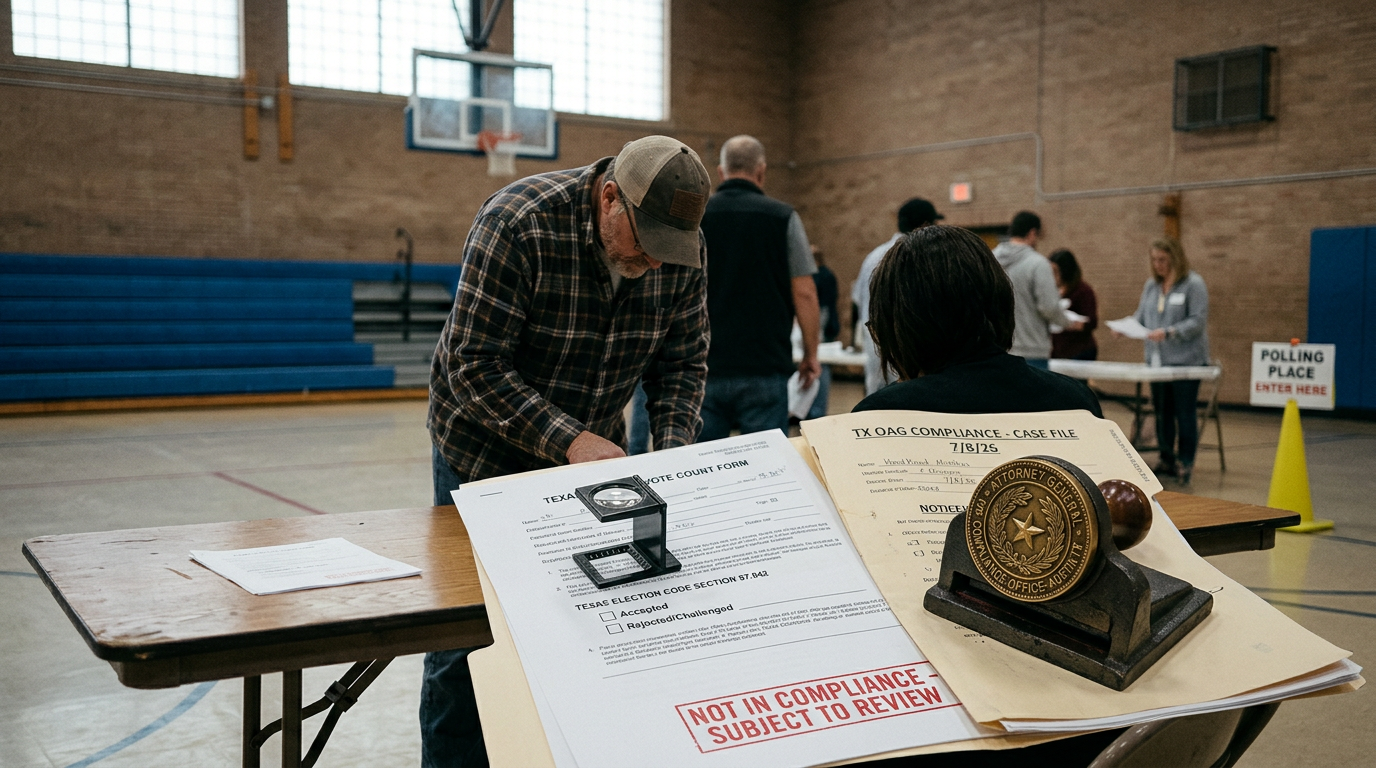
On July 8, 2026, reports surfaced indicating that Texas Attorney General Ken Paxton may have personally run afoul of the state’s election statutes. This development comes as Paxton has maintained a highly visible public stance against what he terms "illegal voting" across the Lone Star State. Historically, the Office of the Attorney General has aggressively pursued litigation against local jurisdictions to ensure tight adherence to the Texas Election Code, making these new allegations particularly significant for state oversight. Texas has a long history of rigorous debate over voting procedures, and the Attorney General’s role in these disputes is central to how the state manages its democratic processes.
Texas relevance
This situation is critically relevant to the people of Texas as the Attorney General serves as the state's highest law enforcement officer. In Austin and across all 254 counties, the administration of elections depends on clear guidance and lawful conduct from state leaders. If the individual tasked with prosecuting election crimes is himself accused of violating the rules, it creates a unique legal scenario for Texas courts and the state legislature. The integrity of the Texas Election Code is the foundation for all local contests, from school board seats to the governorship, making any potential breach by a high-ranking official a matter of statewide concern.
Historical Context of Election Enforcement in Texas
Texas has spent decades refining its election laws to balance accessibility with security. Since the passage of various omnibus election bills in recent legislative sessions, the Attorney General has gained expanded roles in investigating reported irregularities. This oversight typically involves auditing county voter rolls and challenging local ordinances that the state deems are in conflict with centralized statutes.
The current tension arises from the Attorney General's own actions within this framework. When a state leader focuses so heavily on the granular details of election compliance, their own adherence to those details becomes a matter of public record. Texas has previously seen legal challenges regarding where and how candidates register to vote, often leading to protracted court battles in Travis County and beyond.
The Specifics of the Alleged Violations
While the full details of the investigation are pending, the allegations center on procedural requirements outlined in the Texas Election Code. These laws govern everything from residency requirements for voters to the specific methods by which voter registration materials are filed. In Texas, the law is designed to ensure that every participant in the electoral process is clearly identified and legally eligible to contribute at a specific location.
Reports suggest that the Attorney General's conduct may have diverged from these requirements during recent activities. Because Texas law is stringent regarding the documents needed to verify residency and intent, even minor errors can lead to accusations of illegal voting. The irony noted by many observers is that these types of technical failures are exactly what the Attorney General has previously prosecuted in other contexts.
Impact on Local Election Officials
For election administrators in Houston, Dallas, and San Antonio, the clarity of state law is paramount. These officials often look to the Attorney General’s office for interpretations of new legislation. If the guidance provided by the office is seen as inconsistent with the actions of the Attorney General himself, it may lead to confusion during future election cycles.
Furthermore, local district attorneys in Texas have the authority to investigate election-related matters within their jurisdictions. While the Attorney General’s office often takes the lead, the decentralized nature of Texas law enforcement means that multiple agencies could potentially review the facts of this case. This creates a multi-layered accountability structure unique to the Texas legal system.
The Role of the Texas Legislature
The Texas Legislature has recently moved to clarify the Attorney General's power in election cases following various court rulings. These legislative sessions have emphasized the need for a uniform application of election law across all counties. Should investigations into the Attorney General continue, lawmakers may feel compelled to review existing statutes to ensure they adequately cover the conduct of state-level officials.
The political environment in Austin is highly sensitive to issues of voter integrity. Members of both chambers have historically prioritized the security of the vote, and any credible allegation of misconduct by a high-ranking official is likely to be discussed in upcoming committee hearings. This ensures that the matter will remain in the public eye as the state prepares for future cycles.
Legal Precedents and Challenges
Legal scholars in Texas point to several precedents where public officials faced scrutiny over their voting records or registration details. In those instances, the courts have generally held that technical compliance with the Texas Election Code is mandatory, regardless of the person's intent. This strict interpretation means that investigations often focus on documentation and timelines rather than just verbal testimony.
Moving forward, the Attorney General may seek to defend his actions by providing evidence of his compliance with the code. The burden of proof in these matters typically rests on the government when prosecuting individuals, but the public nature of the Attorney General’s role creates a different level of accountability in the court of community opinion.
Analysis
The scrutiny currently facing the Attorney General highlights the complex intersection of public policy and personal action. For years, the AG’s office has utilized a platform focused on rooting out inconsistencies in how ballots are cast and processed. By positioning himself as the primary defender of the ballot box, Paxton has set a high standard for conduct. If it is proven that he bypassed or ignored specific provisions of the law he is sworn to protect, the political ramifications could be significant. This situation underscores the importance of transparency in government and the egalitarian application of the law, where even the top law enforcement officer must submit to the same regulations as every other Texas citizen.
Source attribution
This story was reported using a public release from the AG Ken Paxton — Video Moments (Google News). Keep TX Red rewrote the coverage independently and links to the official statement for verification.
Frequently Asked Questions
- What specific law is the Attorney General accused of violating?
- The reports mention potential violations of the Texas Election Code, a massive set of statutes that govern how Texans register to vote and cast their ballots. Specific focus is often placed on residency requirements and the accuracy of voter registration information.
- Can the Attorney General be prosecuted for election law violations?
- Yes, all citizens in Texas, including elected officials, are subject to the Texas Election Code. Investigations can be handled by local district attorneys or, in certain circumstances, other state-level law enforcement agencies.
- How does this affect Paxton's 'illegal voting' crackdown?
- While the Attorney General’s office continues its operations, these allegations may lead to increased legal challenges from those he prosecutes, as defendants may argue that the laws are being applied inconsistently.
Official Sources
Take the next step
Browse the Newsroom →Read more about Keep Texas Red → Our full guide to what Keep Texas Red means and why Texans support it.
Get Texas updates delivered weekly.
Independent Texas reporting on politics, policy, and daily life. One email a week. Unsubscribe anytime.
Keep TX Red Newsroom
The Keep Texas Red Editorial Staff produces nonpartisan explainers, policy breakdowns, and educational resources to help Texans understand how their government works. All content is reviewed for accuracy and updated regularly.
About Keep TX Red →