Houston Family Seeks Answers Following Fatal Encounter with Federal Immigration Agents
The shooting of Lorenzo Salgado Araujo by ICE agents in Houston has sparked a debate over enforcement protocols and the status of long-term residents.
Editorial disclaimer: Opinions and analysis on Keep TX Red are editorial content — not statements of fact. See our editorial standards.
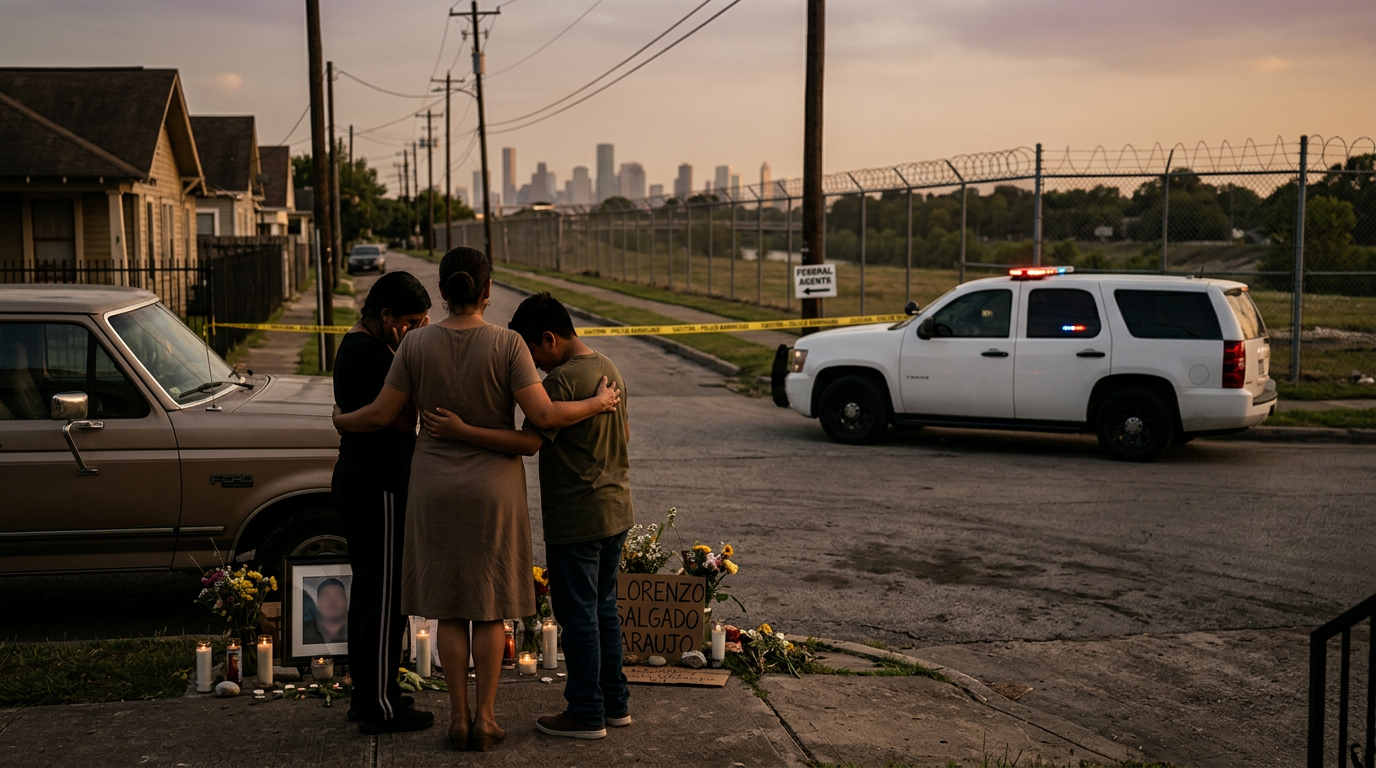
Operations conducted by U.S. Immigration and Customs Enforcement (ICE) in late June 2026 resulted in a lethal confrontation on the streets of Houston, claiming the life of Lorenzo Salgado Araujo. The incident occurred during what officials described as a targeted enforcement action, though the specific details regarding the immediate threat posed to officers remain under investigation. Araujo, a resident of the United States for over three decades, was reportedly in the midst of navigating the complex federal immigration system to secure permanent legal status at the time of his death. Historically, Houston has served as a central hub for ICE enforcement due to its proximity to the border and its large immigrant population, frequently putting local communities at the center of national debates regarding federal authority and use of force. Contextually, this incident follows years of tension between local Houston law enforcement and federal immigration authorities. While Texas has passed legislation such as SB 4 to compel local cooperation with ICE, the physical execution of arrests by federal agents continues to be a point of high friction. Previous instances of federal discharge of weapons in residential neighborhoods have prompted calls for increased transparency from the Department of Homeland Security. This latest event adds to a growing catalog of lethal encounters that highlight the dangers inherent in high-stakes enforcement actions within densely populated urban environments.
Texas relevance
As the largest city in Texas and a primary gateway for international commerce and residency, Houston sits at the epicenter of the Texas immigration debate. The fate of long-term residents who have deep roots in the Texas economy—like Araujo, who worked in the local construction sector—directly impacts the communal stability of Harris County. Texas law often finds itself at odds with federal discretion, and how these investigations are handled by Texas-based medical examiners and district attorneys sets a precedent for the entire state’s relationship with the federal government.
The Circumstances of the Confrontation
On the day of the incident, federal agents were reportedly conducting a planned operation to apprehend individuals with outstanding administrative warrants. According to preliminary reports, the encounter with Araujo escalated rapidly into a lethal shooting. While the agency maintains that its officers acted in response to a perceived threat, the family of the deceased has challenged this narrative, pointing to his history as a non-violent worker with no criminal record that would justify such a response.
The physical location of the shooting in a Houston neighborhood has also raised concerns regarding bystander safety. In urban Texas environments, ICE operations are often conducted in public spaces or residential areas where the risk of collateral damage is high. The investigation is currently analyzing body camera footage, if available, and coordinating with the local medical examiner to determine the exact sequence of events that led to the discharge of the weapon.
Three Decades of Residency in Texas
Lorenzo Salgado Araujo was not a newcomer to the Houston area. His three-decade residency is a testament to the long-term presence of many non-citizens within the Texas workforce. During his time in Houston, he established himself as a provider for his family, working primarily in trades that support the city's massive infrastructure and housing growth. His family describes him as a 'hard-working' individual whose primary focus was the well-being of his children and grandchildren.
This long-term residency is significant because it highlights a specific demographic within the Texas population: those who have lived the majority of their lives in the state but remain in a precarious legal position. Araujo’s attempts to finalize his legal status through official channels suggest a desire to integrate fully into the American legal framework, a process that many find is fraught with delays and sudden interruptions by enforcement actions.
Impact on Houston’s Construction Industry
The death of a long-term worker also resonates within the Houston business community, particularly the construction and labor sectors. Houston’s rapid expansion relies heavily on a dedicated labor force, much of which is composed of individuals in various stages of the immigration process. When enforcement actions result in fatalities, it often creates a ripple effect of fear and instability among the workforce, potentially stalling projects and affecting local economic output.
Industry leaders in Texas have often called for more predictable and transparent immigration policies to ensure that their workers are protected from sudden disruptions. The loss of a veteran worker like Araujo is not just a personal tragedy for his family but also a loss of human capital for the Houston economy, which prides itself on its 'can-do' spirit and rapid development.
Comparing Federal Enforcement and Local Policy
Texas has been a primary battleground for the debate over where federal authority ends and state sovereignty begins. Under current Texas law, local officials are required to assist federal agents when requested, but the actual conduct of federal agents remains under the jurisdiction of the Department of Justice and Homeland Security. This creates a dual-layered system of accountability that can sometimes leave local families in a vacuum when seeking details about a federal incident.
In similar past cases across San Antonio and Dallas, the lack of immediate public information from federal agencies has led to protests and legal challenges. Houston’s local government has often attempted to balance its legal obligations under state law with the need to protect its diverse residents from what some local leaders describe as overly aggressive federal tactics. This incident is likely to renew those political divisions in the coming months.
The Legal Path Toward Status
According to legal representatives for the Araujo family, the deceased was actively pursuing an adjustment of status. This is a common but arduous legal path for residents who have lived in the country for decades. The process frequently involves background checks, interviews, and the payment of significant fees. The irony of being targeted by an enforcement agency while simultaneously seeking to formalize one's presence with that same government is a point of contention for many advocates.
Legal experts suggest that such confrontations can occur when there is a disconnect between the administrative side of immigration—which handles applications—and the enforcement side—which executes warrants. If the agency was unaware of his pending legal filings, it points to a systemic failure in data sharing within the federal government, a problem that has plagued the immigration system for several administrations.
Community Reaction and Future Oversight
In the wake of the shooting, Houston-based advocacy groups have organized vigils and called for an independent investigation. The demand is not just for justice for one man, but for a revision of how ICE conducts itself in Texas neighborhoods. There is a growing movement to require federal agencies to provide more detailed public accounting for every discharge of a firearm, similar to the requirements placed on the Houston Police Department.
As the case moves forward, the scrutiny will likely fall on the internal review board of ICE. Critics argue that internal investigations rarely result in meaningful change or discipline for the agents involved. However, the high profile of this case, given Araujo's long history in the community and his efforts to become a legal resident, may force a different outcome this time.
Analysis
The intersection of federal enforcement and the lives of long-term residents presents a persistent challenge for Texas policy. While the necessity of border security and interior enforcement is a cornerstone of state politics, the death of a resident who was actively utilizing the legal system to adjust their status introduces a layer of complexity. If federal agents are perceived as utilizing excessive force against individuals who are attempting to comply with bureaucratic requirements, it may undermine the very legal pathways that many conservatives argue should be the exclusive method for immigration. Transparency from ICE will be essential to maintain public trust in the rule of law within Houston.
Source attribution
This story was reported using a public release from the Texas Standard. Keep TX Red rewrote the coverage independently and links to the official statement for verification.
Frequently Asked Questions
- What was the official reason for the ICE operation?
- ICE officials stated the operation was part of a targeted enforcement action aimed at individuals with administrative warrants. However, they have not yet released specific details regarding why Araujo was the focus of the encounter on that particular day.
- Was Lorenzo Salgado Araujo a documented resident?
- He had lived in Houston for over 30 years and, according to his family, was in the process of applying for a change in his immigration status to become a legal permanent resident. He was not a recent arrival and had deep ties to the community.
- Who is investigating the shooting?
- Standard procedure for a federal officer-involved shooting involves an internal investigation by the agency (ICE/DHS), often coordinated with local law enforcement agencies like the Houston Police Department and the Harris County District Attorney's Office to ensure compliance with both federal and state laws.
Official Sources
Take the next step
Browse the Newsroom →Read more about Keep Texas Red → Our full guide to what Keep Texas Red means and why Texans support it.
Get Texas updates delivered weekly.
Independent Texas reporting on politics, policy, and daily life. One email a week. Unsubscribe anytime.
Keep TX Red Newsroom
The Keep Texas Red Editorial Staff produces nonpartisan explainers, policy breakdowns, and educational resources to help Texans understand how their government works. All content is reviewed for accuracy and updated regularly.
About Keep TX Red →