Voter Integrity Scrutiny Intensifies Following Residency Questions Involving Texas Attorney General
Investigations into residency requirements for Texas voters highlight potential legal inconsistencies regarding the Attorney General's recent ballots.
Editorial disclaimer: Opinions and analysis on Keep TX Red are editorial content — not statements of fact. See our editorial standards.
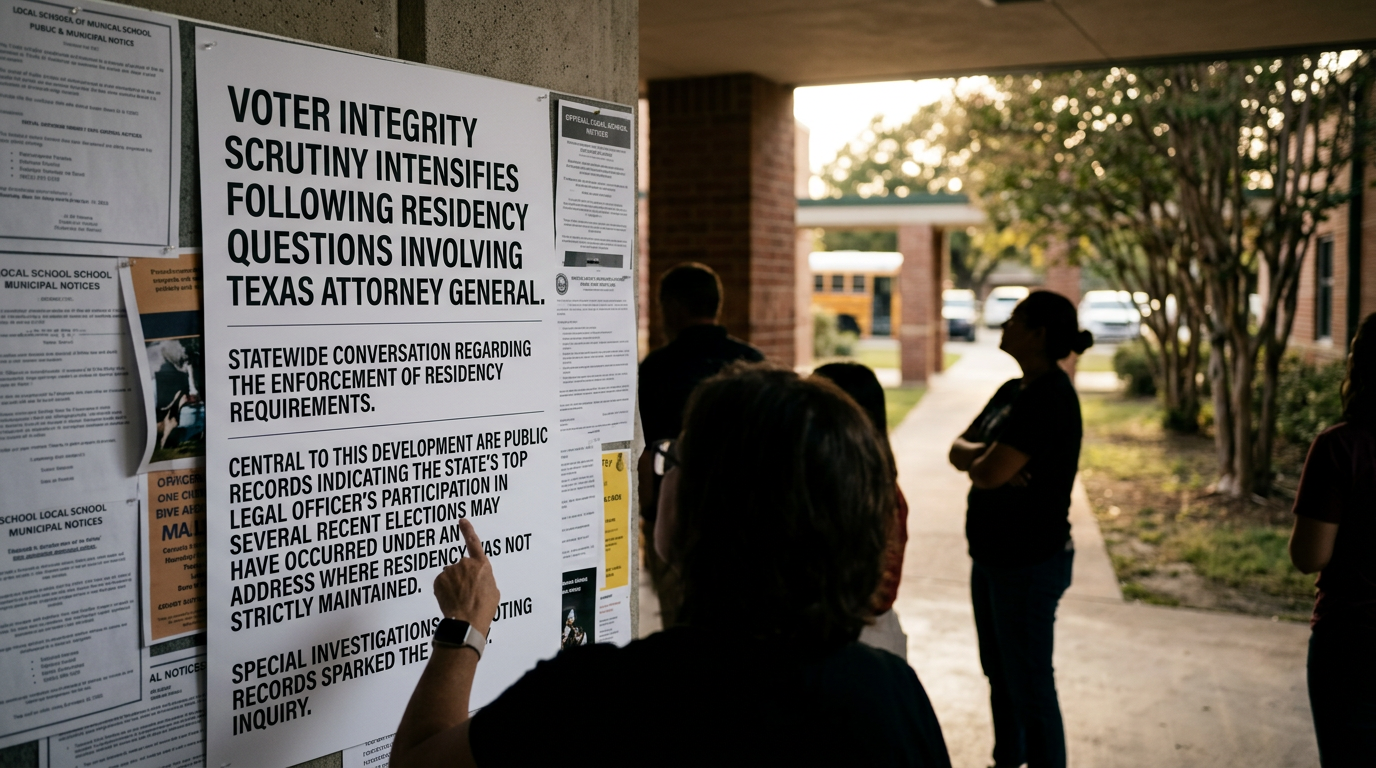
A series of recent investigations into voting records have sparked a statewide conversation regarding the enforcement of residency requirements for registered voters. Central to this development are public records indicating that the state's top legal officer participation in several recent elections may have occurred under an address where residency was not strictly maintained. Historically, Texas has maintained some of the most stringent voter identification and residency standards in the country, often championed by the very office now under the microscope. This situation brings to the forefront the complexities of state statutes that define a 'residence' not merely as a piece of property owned, but as the actual home where a person habitually sleeps and maintains their primary domestic existence for legal purposes. Professional scrutiny of these records suggests that in at least six separate instances over a two-year period, ballots were cast utilizing a registration tied to an Austin condominium while the official’s primary homestead and long-term residence remained in McKinney, located in Collin County. While the legal definitions allow for some flexibility regarding temporary absence for public service, the intersection of homestead tax exemptions and voter registration addresses creates a significant point of legal friction that is currently being debated among legal analysts and election experts throughout the Lone Star State.
Texas relevance
The integrity of the Texas voting system is a pillar of state governance, and this particular story highlights how laws passed by the Texas Legislature apply across all levels of citizenship and leadership. For voters in Austin and McKinney, the specific application of residency rules affects local bond elections, school board races, and municipal leadership choices. Texas law requires that a person vote in the precinct where they actually reside, ensuring that those who shape local policy are the ones who truly live within those boundaries. This development serves as a critical case study for election officials across all 254 Texas counties, from the Rio Grande Valley to the Panhandle, as they navigate the enforcement of the state's Election Code and the Texas Constitution's requirements for public office holders.
The Legal Definition of Residence in Texas
Under the Texas Election Code, 'residence' is defined as the place where a person inhabits and to which the person intends to return after any absence. This definition is central to maintaining the localized nature of Texas elections, ensuring that representatives are chosen by the communities they actually live in. When a voter registers at an address other than where they physically dwell, it can lead to challenges regarding the validity of their participation in specific district-level contests.
In the case currently being debated, the distinction between a 'secondary residence' used for work purposes in Austin and a 'primary homestead' in North Texas is more than just a matter of paperwork. Texas law generally ties the right to vote to the location of a person's permanent home. Legal experts point out that holding a homestead tax exemption on a property—which requires an oath that the home is one’s primary residence—creates a strong legal presumption that the person lives at that specific location for all legal purposes, including exercising the right to vote.
Impact on Local Representative Balance
When high-profile individuals cast ballots in districts where they may not spend the majority of their time, it can skew the results of razor-thin local elections. In municipalities like Austin, where property tax rates and local ordinances are frequently on the ballot, the residency of voters is a sensitive topic. Residents who live, work, and pay taxes in a specific precinct expect that their neighbors are the only ones influencing those outcomes.
Conversely, the McKinney community in Collin County loses the input of a resident when they choose to cast their ballot elsewhere. If the Attorney General’s primary ties, property investments, and long-term residency are anchored in North Texas, his participation in Travis County elections represents a shift in political influence that some legal advocates argue undermines the intent of precinct-based voting systems established by the Texas Legislature.
Historical Precedents and Prosecutorial Consistency
Texas has a long history of strictly interpreting election statutes, particularly under the leadership of recent administrations that have prioritized the elimination of voter irregularities. In years past, individuals have faced significant legal consequences for providing incorrect address information or voting in precincts where their residency was questioned or had lapsed. This creates a standard of expectation that the laws will be applied with an even hand regardless of the voter's status.
Critics of the current situation argue that if an average Texan were to use a temporary work address to vote in six consecutive elections while maintaining a primary home in another county, they would likely face an investigation from the Secretary of State's office. The conversation now shifts toward whether the Attorney General's office will face the same scrutiny it has applied to others, or if the demands of state-level service provide a unique exemption that hasn't been clearly codified for the general public.
Administrative Procedures for Voter Registration
The process of updating voter registration in Texas is designed to be straightforward, yet it requires a proactive effort from the citizen. Whenever a Texan moves, they are expected to update their registration with the county tax assessor-collector or the elections administrator. This ensures that the voter rolls remain accurate and that individuals are slotted into the correct congressional, legislative, and local districts.
When a voter maintains multiple properties, the decision of which address to use for registration is a legal commitment. Discrepancies between the address listed on a driver's license, a homestead exemption, and a voter registration card are often the first red flags in an audit of election integrity. Analysts suggest that the current oversight may have stemmed from a failure to reconcile these different state records, highlighting a need for better data integration between the Department of Public Safety and the Secretary of State.
Response from State Election Officials
The Secretary of State’s office, which oversees the administration of elections in Texas, has historically emphasized that every vote must be cast according to the statutes laid out in the Election Code. While they do not typically comment on specific individual investigations, the office has released general guidance in the past stating that residency is a matter of both fact and intent. However, a homestead exemption is often viewed as the most concrete 'fact' of residency available in public records.
Moving forward, there are calls from various non-partisan groups for a clarification of these rules. They argue that if the state's highest attorney can reside in one city but vote in another, then the rules for all Texans should be clarified to allow similar flexibility. Alternatively, if the rules are to remain rigid, they must be enforced without regard to the political rank of the individual behind the ballot.
Future Implications for Voter Integrity Legislation
The Texas Legislature often takes up election-related bills during every biennial session. This controversy is expected to fuel future debates regarding the 'Election Integrity' bills that have become a hallmark of the Texas political landscape. Lawmakers may look to close loopholes that allow for residency ambiguity or, conversely, create specific protections for state officials who must maintain residences in both their home districts and the capital city of Austin.
The outcome of this scrutiny could lead to a modernization of how Texas tracks residency, potentially linking homestead data directly to voter rolls. As the state grows and more people move between major metros like Dallas, Houston, and San Antonio, the clarity of residency laws will remain a top priority for those concerned with the sanctity of the Texas ballot box.
Analysis
The irony of this situation is not lost on political observers who have watched the Attorney General’s office aggressively prosecute cases of alleged voter fraud over the last decade. By centering a legal platform on the absolute necessity of following the letter of the law in the voting booth, any perceived deviation by the state’s chief prosecutor becomes a significant political liability. This serves as a reminder that the administrative complexities of the Texas Election Code—often criticized as being too cumbersome for the average citizen—can also trip up those who draft and defend them. If the standard for 'illegal voting' is to be applied strictly, the consistency of its application will determine the public's trust in future election security initiatives. The debate now moves from a matter of administrative oversight to a broader question of whether the spirit of the law aligns with the technicalities of residency for high-ranking public servants who split their time between their homes and the state capital.
Source attribution
This story was reported using a public release from the Texas Standard. Keep TX Red rewrote the coverage independently and links to the official statement for verification.
Frequently Asked Questions
- What is the legal definition of 'residence' for voting in Texas?
- In Texas, a residence is defined as the place where you live and to which you intend to return after an absence. It is not just a building you own; it must be your primary home where you actually dwell.
- Can I vote using my work or business address in Texas?
- Generally, no. You must register to vote at the address where you reside. Using a business or temporary work address can be considered a violation of the Texas Election Code unless that location is your primary, permanent home.
- Why does the homestead exemption matter for voter registration?
- A homestead exemption is a legal claim that a specific property is your primary residence for tax purposes. Because it requires a sworn statement, it is often used as evidence of where a person legally resides for other purposes, including voting.
- Who investigates potential voter residency violations in Texas?
- Voter registration is handled at the county level by the registrar or tax assessor-collector. Potential criminal violations of the Election Code are typically investigated by the Texas Secretary of State and can be referred to the Attorney General's office or local district attorneys.
- Does the Attorney General have special residency rules?
- State law requires certain officials to spend significant time in Austin, but it does not explicitly change the general residency requirements for voting purposes. They are generally expected to follow the same Election Code as all other Texas citizens.
Official Sources
Take the next step
Browse the Newsroom →Read more about Keep Texas Red → Our full guide to what Keep Texas Red means and why Texans support it.
Get Texas updates delivered weekly.
Independent Texas reporting on politics, policy, and daily life. One email a week. Unsubscribe anytime.
Keep TX Red Newsroom
The Keep Texas Red Editorial Staff produces nonpartisan explainers, policy breakdowns, and educational resources to help Texans understand how their government works. All content is reviewed for accuracy and updated regularly.
About Keep TX Red →