University of North Texas Rejects Travel Reimbursement for Divisive Journalism Conference
UNT officials denied a reimbursement request for an employee attending a controversial journalism conference, citing policy and content concerns.
Editorial disclaimer: Opinions and analysis on Keep TX Red are editorial content — not statements of fact. See our editorial standards.
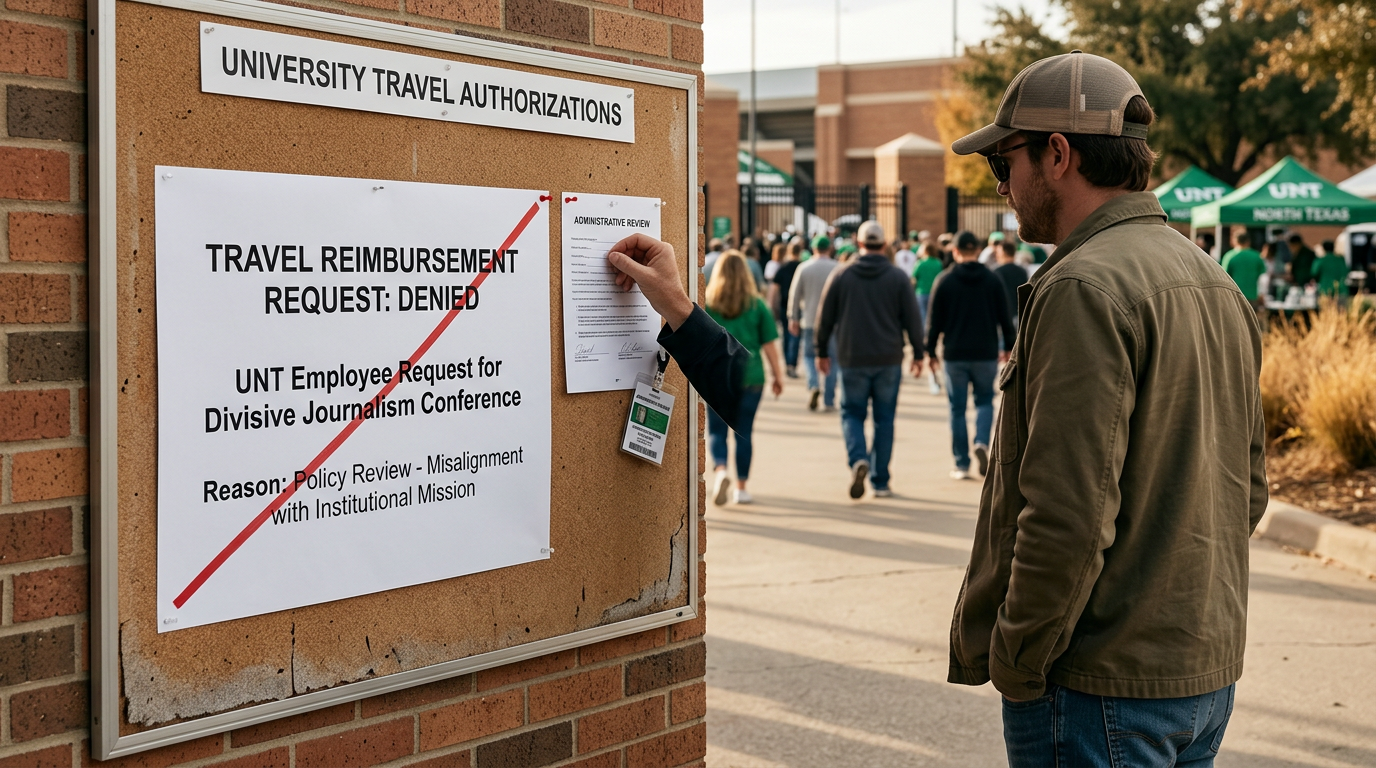
Officials at the University of North Texas (UNT) have reportedly declined a request for travel reimbursement from an employee who attended a specialized journalism conference. The decision highlights a growing scrutiny of how public funds are utilized for professional development that may fall outside the traditional scope of academic or institutional missions. This move follows internal reviews of travel expenditures and heightened awareness regarding the types of external organizations public university staff engage with on the taxpayer's dime. The conference in question has been described by critics as more activist-oriented than objective, prompting university leadership to evaluate whether the expense aligned with state and institutional standards for educational value. Contextually, this situation arises amidst a broader shift in Texas higher education. In recent years, the Texas Legislature has taken a more active role in overseeing the budgetary and ideological leanings of public universities. From the elimination of certain administrative offices to the tightening of faculty tenure rules, the climate for public spending in Denton and across state campuses has become increasingly rigorous. This specific denial marks a departure from previous years when academic travel was rarely scrutinized for its thematic content, signaling a new era of fiscal and administrative oversight for the Mean Green administration.
Texas relevance
This incident is deeply relevant to the North Texas region, specifically Denton, where UNT serves as a primary state employer and educational hub. As a public institution funded by Texas taxpayers, UNT's spending habits are under constant observation by both the state government and local residents. The decision to deny reimbursement reflects a potential shift in how Texas universities interpret 'professional development' in an era where the public is increasingly skeptical of institutional bias. For Texans, this case serves as a litmus test for how state laws regarding university transparency and administrative accountability are being implemented on the ground.
Administrative Review and Policy Enforcement
The administrative process for travel reimbursement at a major institution like UNT involves multiple layers of approval, beginning at the departmental level and moving toward the provost or financial services offices. In this instance, the review process apparently flagged the conference as inconsistent with the university's fiduciary responsibilities. Standard university policy dictates that any travel funded by the state must provide a direct benefit to the university's core mission of education and research. When an event is perceived to lean more toward social advocacy than academic instruction, administrators face pressure to protect the institution's budget.
Internal communications indicate that the decision-making process was not instantaneous but followed a thorough evaluation of the conference program. Evaluators looked at the workshops offered and the stated goals of the organizing body. If the curriculum was found to be lacking in traditional pedagogical value, the institution reserves the right to withhold funds. This serves as a reminder to all university employees that the 'pre-approval' process for travel does not always guarantee that final expenditures will be covered if the event deviates from its initial description or if institutional priorities shift.
The Context of Modern Journalism Education
In the digital age, the definition of journalism has expanded, often blurring the lines between reporting and advocacy. Some modern conferences cater to niche demographics or specific social causes, which can create a conflict for public universities. UNT’s Mayborn School of Journalism has a long-standing reputation for excellence, and maintaining that pedigree requires a focus on ethical, objective reporting standards. By rejecting the reimbursement for this specific event, the university may be making a statement about the type of journalistic training it considers legitimate for its faculty and staff.
Critics of the conference argue that such gatherings often prioritize narrative over fact-telling, which puts them at odds with the values of a taxpayer-supported journalism program. For UNT, ensuring that their staff are trained in a way that respects the principles of neutrality is essential for maintaining the trust of the Texas public. This decision reflects a broader national conversation about whether journalism schools are preparing students for the industry as it is, or if they are fostering a culture of activism that may not serve the public interest.
Legislative Pressure and State Oversight
The Texas Legislature has been increasingly vocal about the use of state funds for agendas that do not align with the broader interests of the Texas citizenry. With the passage of several bills aimed at reforming higher education, university boards of regents and presidents are under the microscope. This denial of travel funds can be seen as a direct response to the legislative atmosphere in Austin. University leaders recognize that their biennial funding requests are contingent upon demonstrating that they are responsible stewards of the money they receive.
Furthermore, Texas state law prohibits the use of public funds for political lobbying or activities that could be construed as such. If a conference is viewed as a training ground for political messaging rather than a professional skill-building seminar, it falls into a gray area of state law. UNT's conservative approach to this reimbursement request suggests they would rather err on the side of caution than face a legislative audit or a public inquiry into their discretionary spending habits.
Impact on Faculty and Staff Relations
Denying reimbursement can create friction within a university community, particularly if the employee feels the decision was based on the content of the event rather than administrative technicalities. Faculty members often view professional travel as a vital part of their career development and academic freedom. However, the university must balance the individual interests of its staff with its collective obligation to the public. This tension is common in large state systems where the boundaries of what constitutes 'professional development' are being redrawn.
Moving forward, UNT and other Texas institutions may need to provide clearer guidelines on which types of organizations and events qualify for public funding. Transparency in the denial process will be key to maintaining morale while adhering to state expectations. If the university continues to reject such requests, it could lead to a shift in how faculty choose their professional affiliations, perhaps steering them toward more traditional or objectively-focused industry groups.
Financial Stewardship in the University System
University budgets are currently facing pressures from multiple angles, including inflation, shifting enrollment numbers, and a demand for lower tuition rates. Every dollar spent on travel is a dollar taken away from student services or classroom instruction. By scrutinizing travel requests more closely, UNT is demonstrating a commitment to fiscal responsibility that is being demanded by both the state government and the parents of students who attend the institution.
This incident also brings to light the role of independent watchdogs and media organizations in monitoring university spending. Groups that track state expenditures have become more adept at filing public information requests to see how tax dollars are being allocated. The knowledge that their financial transactions will be made public and scrutinized by external parties acts as a powerful incentive for university administrators to practice rigorous oversight before signing off on any reimbursement checks.
The Evolution of Texas Campus Culture
The cultural landscape of Texas campuses is undergoing a significant transformation. What was once considered routine—such as attending niche professional conferences—is now being evaluated through the lens of public value and ideological neutrality. UNT’s decision is a microcosm of this change. It shows that the influence of the 'Great State of Texas' transcends the classroom and enters the realm of administrative logistics, influencing who the university associates with and what messages it supports by proxy.
As other universities across the state observe UNT’s lead, we may see a domino effect where similar travel requests are denied elsewhere. This could lead to a more centralized vetting process for all professional development activities, ensuring that Texas public wealth is invested in a way that aligns with the values and laws of the state. The era of unchecked administrative spending appears to be coming to a close in the Lone Star State.
Analysis
The refusal to reimburse these travel costs suggests that UNT leadership is becoming more risk-averse regarding public perception. By distancing themselves from a conference that critics labeled as 'activist' rather than 'journalistic,' the university is likely attempting to avoid the ire of state lawmakers in Austin. This represents a pragmatic pivot; institutions are beginning to realize that the 'everything goes' approach to academic travel is no longer sustainable in a political environment that demands clear educational ROI and ideological neutrality.
Source attribution
This story was reported using a public release from the Texas Travel Stories (Google News). Keep TX Red rewrote the coverage independently and links to the official statement for verification.
Frequently Asked Questions
- Why was the reimbursement denied by UNT?
- While specific personnel reasons are often confidential, the denial appears to stem from a determination that the conference did not meet the university's criteria for professional development that benefits the institution's core mission. Concerns about the activist nature of the event likely played a role in the administrative review.
- How does Texas state law affect university travel spending?
- Texas law requires that any state funds used for travel must be for authorized purposes that serve a public interest. Additionally, recent legislative sessions have emphasized that public funds should not support ideological agendas or activities that fall outside traditional academic scopes.
- Can UNT employees still attend these conferences?
- Yes, employees are generally free to attend any conference they choose on their own time and at their own expense. The issue at hand is whether the university—and by extension, the taxpayer—is required to foot the bill for the registration, travel, and lodging.
- Does this decision affect all UNT departments?
- Yes, travel policies and the scrutiny of reimbursement requests apply across the entire university. However, departments that involve journalism, social sciences, or political studies may find their requests more closely examined due to the nature of the topics often covered in those fields.
Official Sources
Take the next step
Browse the Newsroom →Read more about Keep Texas Red → Our full guide to what Keep Texas Red means and why Texans support it.
Get Texas updates delivered weekly.
Independent Texas reporting on politics, policy, and daily life. One email a week. Unsubscribe anytime.
Keep TX Red Newsroom
The Keep Texas Red Editorial Staff produces nonpartisan explainers, policy breakdowns, and educational resources to help Texans understand how their government works. All content is reviewed for accuracy and updated regularly.
About Keep TX Red →