Texas Governor Joins Kerrville Community to Commemorate Anniversary of Deadly Hill Country Floods
Governor Abbott honors 119 victims of the Kerr County Fourth of July floods during a remembrance ceremony at the Cailloux Theater.
Editorial disclaimer: Opinions and analysis on Keep TX Red are editorial content — not statements of fact. See our editorial standards.
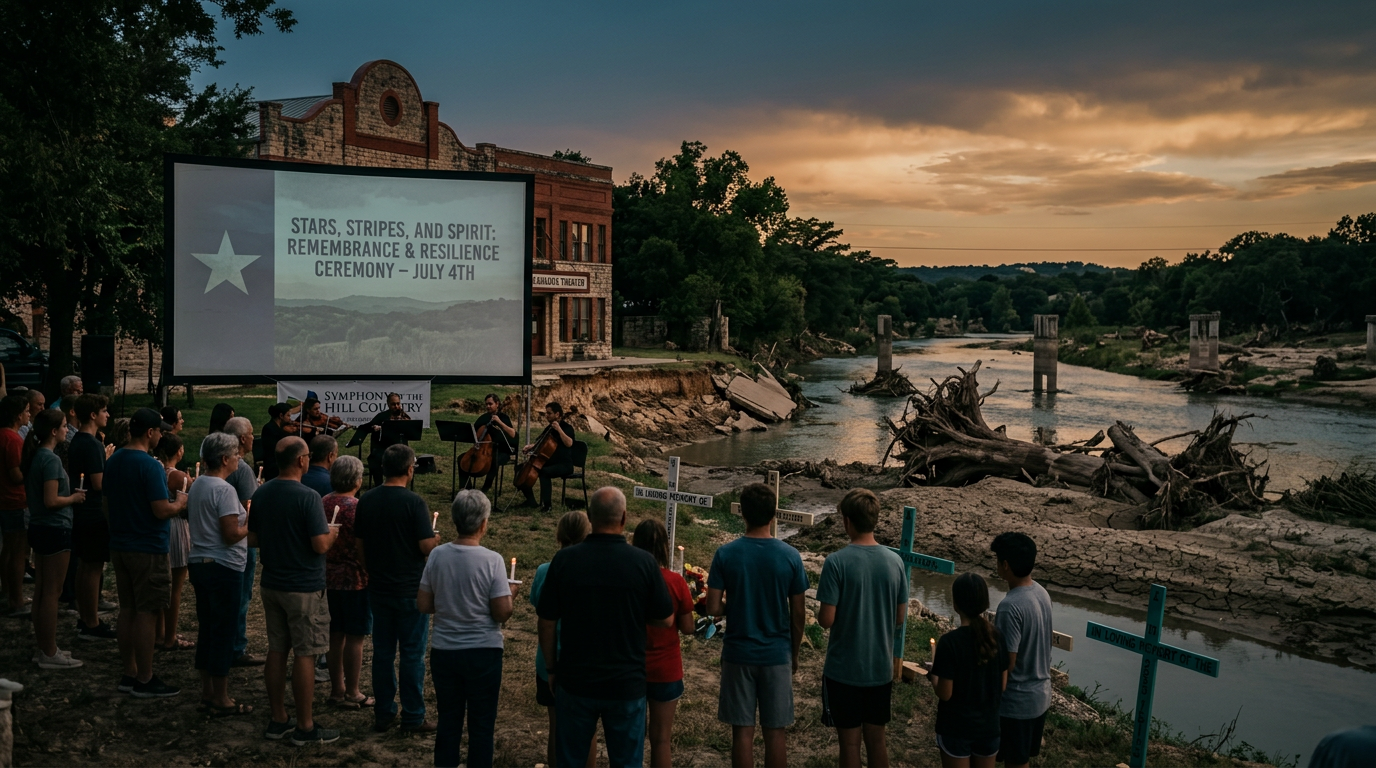
On the one-year anniversary of one of the most devastating natural disasters in the history of the Texas Hill Country, Governor Greg Abbott joined local officials and families at the Cailloux Theater in Kerrville. The gathering, titled the Stars, Stripes, and Spirit Remembrance & Resilience Ceremony, served as a somber tribute to the lives lost during the massive flash flooding that struck the region on July 4, 2025. The event combined traditional orchestral performance by the Symphony of the Hills with a formal memorial service, focusing on the names and legacies of those swept away by the rising waters. Texas has a long history of dealing with volatile weather patterns, particularly in the Balcones Escarpment region, which is often cited by meteorologists as 'Flash Flood Alley.' Historical precedents like the 1978 Guadalupe River flood and the 2015 Wimberley floods have shaped state emergency responses. This latest memorial emphasizes a continuing commitment to local recovery and the psychological healing of communities that face the sudden, violent power of Hill Country river swells. Governor Abbott's participation highlights the state's role in supporting small-town infrastructure and disaster resilience in the wake of catastrophic loss.
Texas relevance
The events in Kerrville are deeply relevant to all Texans, particularly those residing in the Hill County and Central Texas corridors. Because the geography of the area features steep terrain and rocky soil that does not easily absorb water, urban and rural centers alike are at constant risk during the hurricane and thunderstorm seasons. This ceremony underscores the specific vulnerability of Kerr County and the importance of state-level support for local recovery efforts. For residents of Kerrville, Hunt, and Ingram, the state's attention serves as an acknowledgment of the scale of their specific tragedy and the ongoing need for improved flood mitigation strategies along the Guadalupe River basin.
A Heavy Toll: Recalling the 2025 Disaster
The flooding that occurred exactly one year ago was unprecedented even by Texas standards. Rapid rainfall upstream led to a vertical wall of water that descended upon Kerr County campsites and residential areas during the peak of holiday celebrations. The geographical bottleneck near Kerrville exacerbated the damage, leaving little time for evacuations in low-lying zones along the riverbanks.
In the months following the disaster, the community has struggled to reconcile the loss of 119 neighbors. The demographic of the victims ranged from lifelong Kerrville residents to out-of-town tourists who were visiting the Hill Country for the Fourth of July weekend. This diversity of victims has made the recovery process a multi-state conversation about safety in Texas recreation areas.
The Names of the Lost
During the ceremony, Governor Abbott took the stage to perform the difficult task of reading each of the 119 names. This act of naming is a tradition in Texas memorial services, intended to ensure that the individual identities of the victims are not lost to a mere statistical count. Family members in the audience were visibly moved as the roll call proceeded through the theater.
The Governor emphasized that these individuals were the backbone of the local community—parents, children, and friends. By focusing on the personal loss, the event shifted from a political gathering to a communal wake. This gesture is part of a broader effort by the First Lady and the Governor to maintain a presence in areas still undergoing the slow process of rebuilding homes and businesses.
Symphony of the Hills: Resilience Through Art
The inclusion of the Symphony of the Hills provided a cultural backdrop to the mourning process. Under the direction of the organization's leadership, the music was selected to evoke both the sorrow of the past year and the hope for the future. The 'Stars, Stripes, and Spirit' theme aimed to reclaim the Fourth of July holiday for the community, which had been synonymous with trauma since the previous year's events.
Dr. Tim Summerlin, President of the Symphony, noted that music serves as a unique medium for healing in the Hill Country. The arts have often been used in Texas to bridge the gap between tragedy and recovery, providing a space for collective reflection that speeches alone cannot achieve. The performance was a testament to the fact that Kerrville’s cultural institutions remain intact despite the physical damage to the region.
Local Leadership and State Cooperation
Kerrville Mayor Joe Herring Jr. and State Representative Andrew Murr were also in attendance, highlighting the bipartisan and multi-level government response to the floods. Local officials have been working closely with the Texas Division of Emergency Management (TDEM) to secure grants for updated warning systems and physical barriers. The presence of state leadership at the theater signaled that these requests remain a priority in Austin.
The cooperation between the city of Kerrville and the Governor’s office has been essential for the distribution of recovery funds. Residents have seen a steady increase in infrastructure surveys along the Guadalupe River. The ceremony served as a public progress report, showing that while the grief remains, the administrative machinery of the state is functioning to prevent a repeat of the 2025 casualty count.
The Geography of 'Flash Flood Alley'
To understand the significance of this memorial, one must look at the unique topography of Kerr County. The region sits atop the Edwards Plateau, where thin soils and limestone bedrock lead to immediate runoff during heavy downpours. This 'funnel effect' can turn a peaceful stream into a raging torrent in under thirty minutes, a recurring nightmare for Texas Hill Country inhabitants.
The 2025 flood was a 'hundred-year event' that tested the limits of existing floodplains. As the Governor noted in his remarks, the bravery of first responders who 'ran toward the danger' saved hundreds of others, but the environmental factors were simply too overwhelmed by the volume of water. This reality has sparked new debates in the Texas Legislature regarding land use and residential development near river corridors.
Infrastructure and Future Preparedness
Looking forward, the remembrance event in Kerrville is not just about the past; it is a catalyst for future policy. Texas has recently invested billions into a statewide flood plan, the first of its kind, which seeks to treat drainage basins as single units rather than fragmented city properties. The tragedy in Kerr County has accelerated the timeline for several of these regional projects.
Governor Abbott’s administration has faced pressure to ensure that rural counties receive an equitable share of the Texas Water Development Board’s resources. By standing in the Cailloux Theater, the Governor reaffirmed that 'remembrance' includes a commitment to better engineering. The goal is to ensure that future Fourth of July celebrations are defined by fireworks and community, rather than sirens and search-and-rescue boats.
Analysis
The Governor’s decision to personally read the names of the 119 victims suggests a strategic shift toward more localized, personal engagement in disaster aftermaths. By spending the Fourth of July period in Kerrville rather than a larger metropolitan area, the administration signals a priority on the 'heartland' of Texas. This move likely resonates with rural voters who often feel overlooked by state-wide infrastructure projects. Furthermore, the collaboration with the Symphony of the Hills suggests a desire to frame Texas resilience through the lens of high culture and community unity, rather than just tactical emergency management statistics.
Source attribution
This story was reported using a public release from the Office of the Governor. Keep TX Red rewrote the coverage independently and links to the official statement for verification.
Frequently Asked Questions
- Why was the Fourth of July specifically mentioned in the ceremony?
- The July 4th holiday in 2025 was the date when record-breaking rainfall caused the Guadalupe River to swell, leading to the flash floods that claimed 119 lives in Kerr County.
- What is the significance of the Symphony of the Hills participating?
- The symphony is a staple of Kerrville's cultural identity. Their participation in the 'Remembrance & Resilience' ceremony was intended to provide a dignified and healing atmosphere for the grieving community.
- What state resources are being used for Kerrville's recovery?
- Following the floods, the Texas Division of Emergency Management and the Texas Water Development Board have been active in the area, providing disaster relief funds and working on a regional flood plan to prevent future loss of life.
Official Sources
Take the next step
Browse the Newsroom →Read more about Keep Texas Red → Our full guide to what Keep Texas Red means and why Texans support it.
Get Texas updates delivered weekly.
Independent Texas reporting on politics, policy, and daily life. One email a week. Unsubscribe anytime.
Keep TX Red Newsroom
The Keep Texas Red Editorial Staff produces nonpartisan explainers, policy breakdowns, and educational resources to help Texans understand how their government works. All content is reviewed for accuracy and updated regularly.
About Keep TX Red →