Caterpillar Injects Five Million Dollars into Seguin Manufacturing Jobs Program
Governor Abbott joins Caterpillar in Seguin to announce a $5 million initiative aimed at training the next generation of Texas manufacturing professionals.
Editorial disclaimer: Opinions and analysis on Keep TX Red are editorial content — not statements of fact. See our editorial standards.
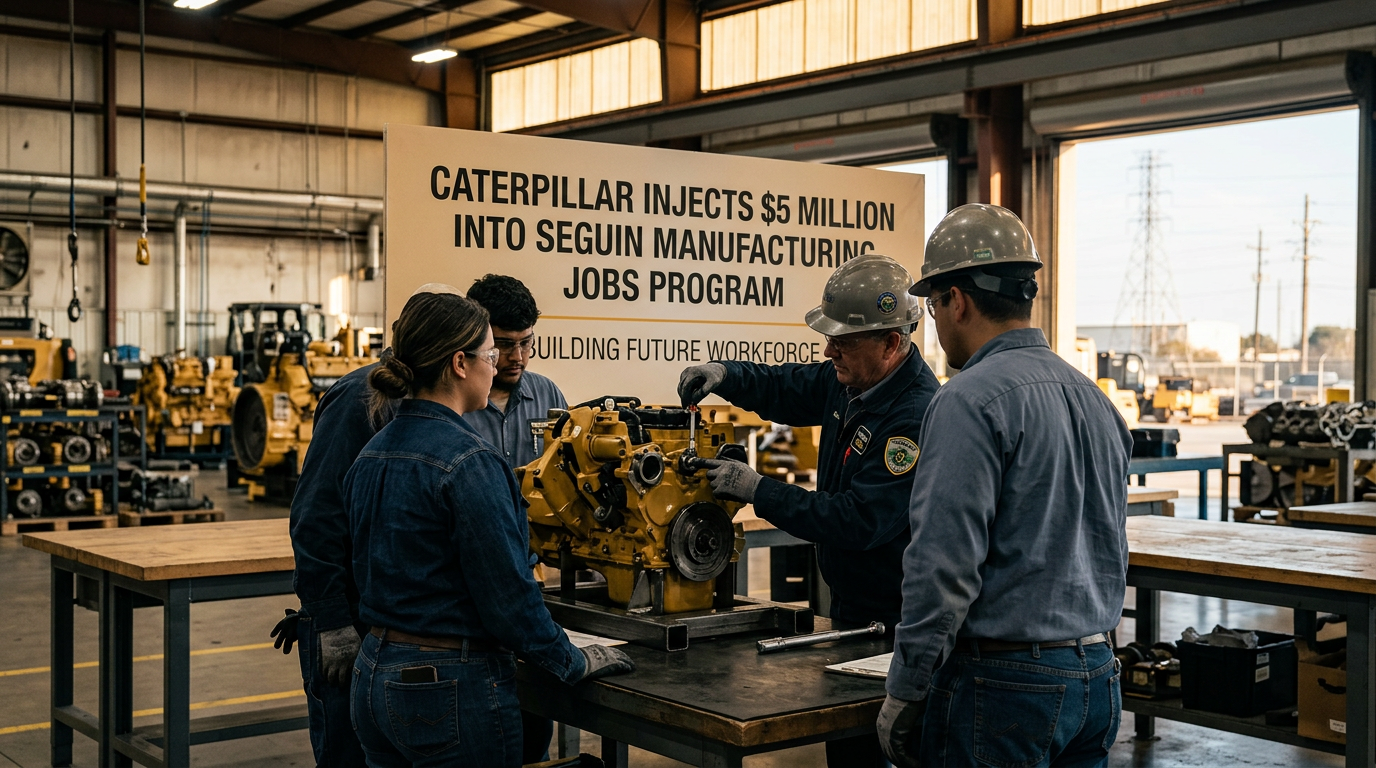
Governor Greg Abbott visited the city of Seguin this week to participate in a ceremonial announcement regarding a significant financial commitment to the state’s industrial labor force. Caterpillar Inc., a global leader in construction and mining equipment, has designated up to $5 million for Texas as part of a broader national effort to modernize vocational training. This investment, centered at the company’s engine manufacturing hub in Guadalupe County, represents a portion of a larger $100 million 'Building the Future Workforce Initiative' that spans half a decade. The primary objective is to cultivate a deep pool of talent capable of operating complex machinery and managing advanced technical roles in the local economy. Historically, Texas has relied on its robust vocational infrastructure to attract major industrial players, and this new funding serves as an extension of the state's long-standing strategy to pair private capital with public workforce readiness. This specific financial injection is designed to address the tightening labor market by enhancing recruitment and training protocols for specialized technician roles. By targeting barriers that often prevent prospective workers from entering the manufacturing sector—such as lack of foundational skills or limited access to certification programs—Caterpillar aims to create a sustainable pipeline of employees. The announcement took place at the company's local facility, which already serves as a cornerstone of the Seguin industrial corridor. State officials emphasized that the decision to prioritize Texas for these funds was driven by the state's existing economic climate and the high demand for manufacturing expertise within the region.
Texas relevance
The investment is a direct win for Central Texas and the San Antonio-New Braunfels metropolitan area, reinforcing Seguin's reputation as a manufacturing powerhouse. For decades, Texas has aggressively marketed its business-friendly environment and lack of state income tax to lure large-scale manufacturing firms away from traditional rust-belt or coastal hubs. However, once these companies arrive, the challenge shifts to sustaining a specialized workforce that can keep pace with technological advancements in heavy machinery. This $5 million commitment directly addresses that challenge by ensuring that workers in Guadalupe County and the surrounding school districts have the resources necessary to compete for high-paying technical careers within their own communities. Furthermore, this move by Caterpillar mirrors previous large-scale workforce investments seen in North Texas and the Gulf Coast regions, where energy and aerospace firms have partnered with local community colleges. In the context of the Texas economy, the expansion of the Seguin facility's training capabilities means more than just temporary jobs; it signals a permanent integration of global corporate interests with local education systems. As the state continues to see an influx of residents from other parts of the country, programs like these are essential for maintaining the high standard of living and low unemployment rates that have characterized the Texas economic miracle of the 21st century.
Strengthening the Seguin Industrial Hub
Seguin has long outpunched its weight class in terms of industrial output, and the latest infusion of capital from Caterpillar solidifies its status as a critical node in the state's manufacturing network. The advanced engine manufacturing facility located here is not merely an assembly line; it is a center for high-value engineering that supports global supply chains. By designating millions of dollars specifically for workforce development within this facility, the company is ensuring that the local labor pool remains insulated from broader economic shifts that might otherwise impact less-skilled regions.
Local leaders in Seguin have spent years cultivating a business environment that supports heavy industry, and the Governor’s presence at this announcement underscores the importance of this mission to the state's overall health. The partnership is expected to involve close coordination with local educational entities to identify and recruit residents who are looking to pivot into technical manufacturing roles. This proactive approach is intended to prevent labor shortages that could otherwise hinder production schedules and jeopardize future expansions.
Breaking Down Barriers to Technical Employment
One of the primary pillars of the 'Building the Future Workforce Initiative' is the removal of structural barriers that prevent qualified individuals from entering the manufacturing field. These barriers often include a lack of awareness regarding the career paths available within heavy industry, as well as the initial costs associated with obtaining the necessary certifications. The $5 million investment will be used to streamline these pathways, making it easier for students and mid-career professionals to transition into technician roles that offer competitive wages and benefits.
The funding will specifically support the development of a 'future-ready skills framework.' This framework is intended to standardize the competencies required for modern manufacturing, ensuring that a worker trained in Seguin is capable of operating the most advanced technologies in the world. By focusing on technician roles—which require a blend of physical labor and sophisticated computer literacy—the initiative addresses the most critical 'middle-skill' gap currently facing the Texas economy.
The Evolution of Advanced Manufacturing in Texas
The manufacturing landscape in Texas has undergone a radical transformation over the last decade, transitioning from traditional fabrication to highly automated processes. Caterpillar’s investment is a response to this evolution, recognizing that the tools used to build engines today are far more complex than those used just a generation ago. The funding will help update training equipment and software, ensuring that the apprentices and workers are learning on the same machinery they will encounter on the factory floor.
This evolution is also reflected in the types of jobs being created. The roles targeting this funding include specialized technician positions that involve diagnostics, robotics maintenance, and precision engineering. As Texas continues to attract firms from the tech and automotive sectors, the competition for this specific type of labor is fierce. Caterpillar’s decision to invest early in training indicates a desire to secure its own domestic supply of talent rather than relying on scouting from other states.
Impact on the Local Educational Ecosystem
While the funding originates from a private corporation, its impact will be felt throughout the local educational system in Seguin and Guadalupe County. Historically, such initiatives involve collaboration with local high schools and community colleges to align vocational curricula with actual industry needs. This prevents a mismatch where students graduate with skills that are already obsolete, a common problem in rapidly changing sectors like advanced manufacturing.
By integrating the 'Building the Future Workforce Initiative' with local schools, Caterpillar is essentially creating a 'classroom-to-career' pipeline. This model has proven successful in other parts of Texas, particularly in the Houston energy corridor and the Dallas tech hub. For students in the Seguin area, this means access to high-level training and clear career trajectories without the need to relocate to a larger urban center or take on massive student debt for a traditional four-year degree.
Governor Abbott’s Vision for the Texas Brand
During his visit to the facility, Governor Abbott framed the investment as a key component of the 'Texas brand.' He argued that the state's economic success is built on a foundation of self-reliance and skilled labor, and that private investments like Caterpillar’s are what allow the state to remain competitive on a global scale. The Governor’s office has consistently prioritized workforce development through programs like the Texas Enterprise Fund and various vocational grants, but partnerships with industry giants are viewed as the gold standard for sustainable growth.
The Governor also emphasized that this initiative is part of a broader strategy to ensure that every Texan has the opportunity to participate in the state's prosperity. By focusing on manufacturing—a sector that has traditionally provided a path to the middle class for those without university degrees—the state is doubling down on its commitment to blue-collar and ‘new-collar’ workers. This focus on vocational excellence is intended to make Texas the premier destination for any company looking to relocate or expand its industrial footprint.
Economic Sustainability and Long-Term Goals
The $5 million earmarked for Texas is part of a five-year strategy, indicating that this is not a one-time publicity stunt but a sustained effort to improve the industrial labor market. Over the next half-decade, the impact of these funds will be measured by the number of certifiable technicians entering the workforce and the overall efficiency gains at the Seguin plant. For Caterpillar, the investment reduces turnover and increases productivity; for the state, it increases the tax base and reduces the burden on public unemployment systems.
Looking ahead, this model of corporate-led workforce development is likely to be replicated by other major employers in the state. As the federal government and other states grapple with labor shortages, Texas is positioning itself as a state that takes a proactive, industry-aligned approach to the problem. The long-term goal is to create an ecosystem where the skills of the workforce are always one step ahead of the requirements of the machinery they operate.
Analysis
This partnership highlights a shift in how the state government views economic development. Rather than focusing solely on direct tax incentives or land grants, the Abbott administration is increasingly betting on human capital as its primary competitive advantage. By leveraging Caterpillar’s global brand and internal training resources, the state can offload some of the costs associated with vocational education while ensuring the curriculum meets modern industry standards. This also serves a political purpose, reinforcing the narrative that Texas is not just a hub for low-skilled labor, but a refined center for high-tech industrial engineering. The $5 million may seem modest relative to Caterpillar's global revenue, but its concentration in a single regional facility suggests a deep tactical commitment to the Seguin workforce.
Source attribution
This story was reported using a public release from the Office of the Governor. Keep TX Red rewrote the coverage independently and links to the official statement for verification.
Frequently Asked Questions
- Where is the primary Caterpillar facility receiving this investment located?
- The investment is centered at Caterpillar's advanced engine manufacturing facility in Seguin, Texas, which is located in Guadalupe County.
- What is the 'Building the Future Workforce Initiative'?
- It is a $100 million, five-year program launched by Caterpillar to strengthen the manufacturing labor pipeline, develop new training frameworks, and connect workers to high-demand careers.
- Why was Texas chosen for this specific $5 million allocation?
- Texas was selected due to its existing reputation for high-skilled job training, a business-friendly environment, and the strategic importance of the Seguin facility to Caterpillar's global operations.
- How will the funds be used to help workers?
- The money will be directed toward reducing barriers to entry for training, establishing a new skills framework for technicians, and creating clearer pathways from the educational system to manufacturing jobs.
Official Sources
Take the next step
Browse the Newsroom →Read more about Keep Texas Red → Our full guide to what Keep Texas Red means and why Texans support it.
Get Texas updates delivered weekly.
Independent Texas reporting on politics, policy, and daily life. One email a week. Unsubscribe anytime.
Keep TX Red Newsroom
The Keep Texas Red Editorial Staff produces nonpartisan explainers, policy breakdowns, and educational resources to help Texans understand how their government works. All content is reviewed for accuracy and updated regularly.
About Keep TX Red →