Austin Robotics Hub Launches Major Manufacturing Expansion for Humanoid Tech
Apptronik opens a 90,000 square-foot facility in Austin to accelerate the mass production of its Apollo humanoid robots for industrial and home use.
Editorial disclaimer: Opinions and analysis on Keep TX Red are editorial content — not statements of fact. See our editorial standards.
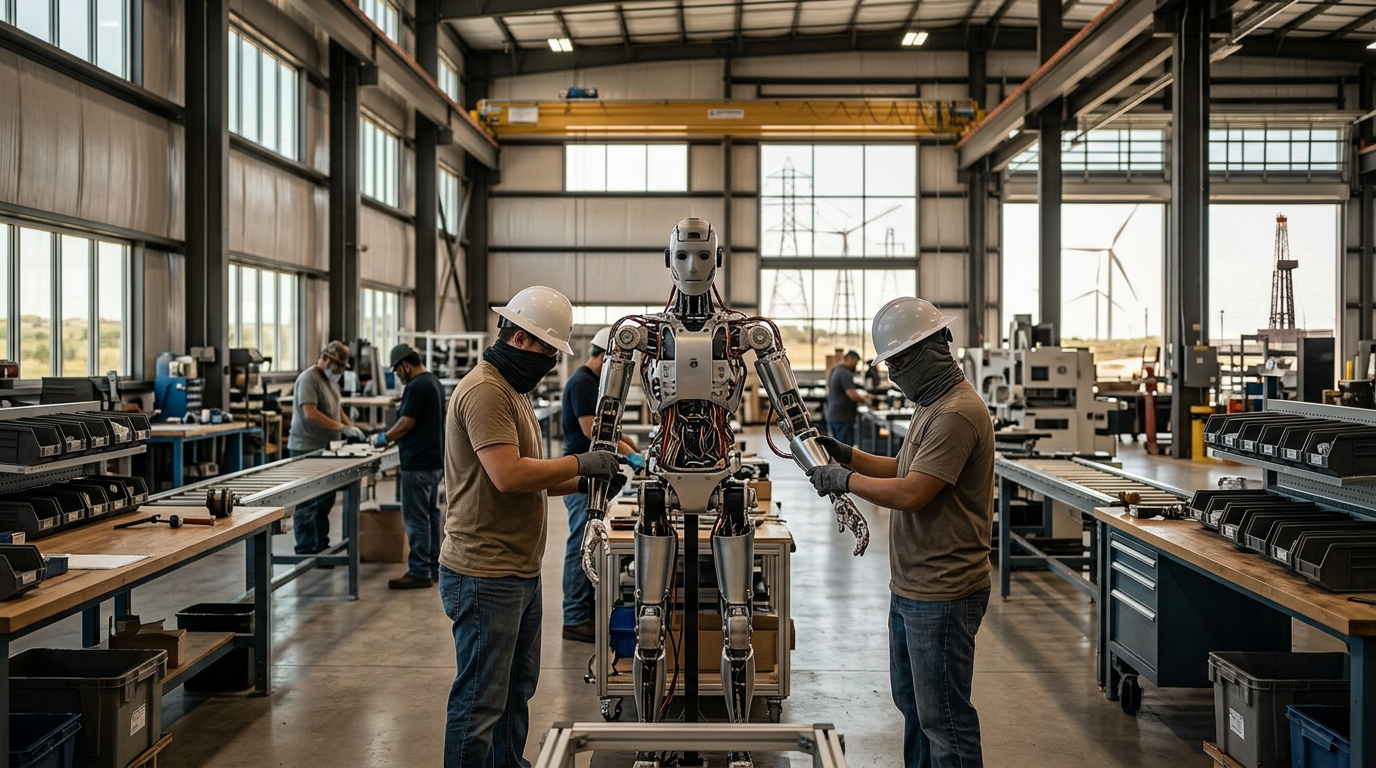
The technological landscape in Central Texas is undergoing a significant transformation with the opening of a massive new robotics corridor in Austin. Apptronik, a local leader in humanoid robotics, has officially debuted its 90,000 square-foot facility, colloquially referred to as a 'robot park.' This expansion represents a pivotal shift for the company, moving from the prototype and design phase into full-scale industrial commercialization. Historically, Austin has served as a fertile testing ground for semi-conductor and computer hardware firms; however, the emergence of a physical robotics manufacturing hub marks a new chapter in the city's identity as a hardware powerhouse. The new site will serve as the primary assembly and testing grounds for the Apollo model, a general-purpose bipedal robot designed to operate alongside humans in diverse environments. This facility is not merely a warehouse but a sophisticated engineering center where the latest version of the Apollo robot will undergo rigorous stress testing and refinements. The goal is to streamline the production line to meet the growing demand from logistics and manufacturing sectors. By establishing such a large footprint in the state, the company is betting on the regional talent pool and the business-friendly regulatory climate that has increasingly attracted tech firms away from California's Silicon Valley. The move signals a long-term commitment to keeping the next generation of automated labor development firmly rooted within the Texas borders, ensuring that the state remains at the vanguard of the global AI and robotics race.
Texas relevance
Austin's standing as the 'Silicon Hills' is reinforced by this development, as it brings high-tech manufacturing jobs back to the local economy. For decades, Texas has leveraged its energy and aerospace sectors to drive innovation; now, Apptronik's expansion places the state at the center of the burgeoning humanoid robotics market. This project aligns with the broader Texas trend of diversifying the industrial base beyond traditional oil and gas. Residents and local businesses in Central Texas can expect a ripple effect, as the growth of such a large robotics hub typically attracts secondary suppliers, specialized maintenance services, and academic partnerships with institutions like the University of Texas at Austin. The presence of this facility ensures that the intellectual property and manufacturing tax revenue associated with the future of labor stay within the state's jurisdiction.
The Evolution of the Apollo Robot
The Apollo project began as an ambitious attempt to create a humanoid robot that was both versatile and approachable. Unlike specialized industrial arms found in automotive plants, Apollo is designed with a bipedal form factor, allowing it to navigate spaces originally built for human workers. The hardware has evolved through multiple iterations, focusing on power density and balance, ensuring the machine can lift heavy loads without tipping in a dynamic warehouse environment.
Engineering teams in Austin have focused specifically on the 'human-centric' aspect of the robot. This means the limbs are designed with safety sensors and soft-stop capabilities to prevent accidents when working in close proximity to human staff. The release of the newest version at the new facility represents the transition from a laboratory curiosity to a reliable tool capable of performing repetitive tasks that often lead to strain or injury for human operators.
The software architecture powering Apollo is equally significant. Utilizing advanced machine learning algorithms, the robot is capable of learning new tasks through observation and digital twin simulation. This flexibility is what separates the Texas-made robot from its predecessors, making it a viable solution for businesses that require more than a single-use automated machine.
Scaling Production in Central Texas
The move to a 90,000 square-foot facility addresses the primary bottleneck facing the robotics industry today: the scale of manufacturing. While many companies can build a single impressive prototype, few have the infrastructure to produce thousands of units. The 'robot park' is designed with modular assembly lines that can be expanded as orders increase, providing a blueprint for high-tech domestic manufacturing that many thought had permanently migrated overseas.
Logistically, Austin provides a strategic advantage for a company like Apptronik. The proximity to major interstate corridors and the growing cargo capacity at Austin-Bergstrom International Airport allows for efficient shipping of finished units to clients across North America. Furthermore, the state's lower cost of operations compared to coastal tech hubs allows more capital to be reinvested into research and development.
The facility also serves as a showcase for potential investors and enterprise clients. By operating the robots in a real-world setting within the park, the company can demonstrate reliability and uptime statistics that are critical for corporate adoption. This local 'proof of concept' strategy is essential for moving the technology into the mainstream commercial market.
Impact on the Local Labor Market
The opening of this facility is expected to create a variety of high-skilled positions ranging from mechanical engineering and software development to specialized assembly and quality control. This further solidifies the career pipeline for graduates from Texas universities, who can now find cutting-edge roles without leaving the state. The growth of the 'robot park' is likely to trigger a surge in the local service sector as well, catering to the influx of tech professionals.
There is also the question of how these robots will interact with the existing Texas workforce. Industry analysts suggest that rather than replacing workers, robots like Apollo will take over 'dull, dirty, and dangerous' tasks. This shift allows human employees to move into supervisory or maintenance roles, which generally command higher wages and offer safer working conditions.
As the facility reaches full capacity, the demand for local vocational training in robotics maintenance is expected to rise. This presents an opportunity for Texas community colleges to develop new curricula focused on the upkeep of bipedal electronics, ensuring that the local workforce remains competitive in an increasingly automated economy.
The Vision for Home Integration
While the current focus of the Austin facility is industrial application, the long-term vision includes bringing these robots into residential settings. The founders believe that as costs decrease through mass production at the 'robot park,' humanoid assistants will become as common as dishwashers or vacuum cleaners. These future models would assist with household chores, elderly care, and basic maintenance.
Transitioning from a warehouse to a living room requires significant advancements in haptic feedback and object recognition. The testing labs within the new facility are already exploring these challenges, simulating home environments to see how the robots handle delicate objects and unpredictable human movements. This forward-looking research is a key component of the company's growth strategy over the next decade.
If successful, this transition could position Texas as the primary exporter of consumer-grade humanoid robots. The intellectual property developed during this phase would be invaluable, potentially leading to a massive tech ecosystem in the state dedicated to the 'robotics of things,' mirroring the explosion of the smartphone industry in the early 2010s.
Economic Implications for the State
Texas has consistently championed policies that encourage capital investment and industrial growth. The expansion of Apptronik's operations serves as a validation of these policies, demonstrating that high-tech firms can thrive outside of traditional coastal enclaves. The state's lack of a personal income tax and its robust infrastructure continue to be significant draws for the leadership of emerging technology companies.
The 'robot park' also contributes to the local property tax base and generates significant logistical activity, which in turn fuels the state's transportation and trade sectors. As the facility scales, it will likely attract a cluster of satellite businesses, including sensor manufacturers and battery suppliers, creating a self-sustaining robotics ecosystem in Central Texas.
In the broader context of national security and economic independence, domestic manufacturing of advanced robotics is a high priority. By hosting one of the world's most advanced humanoid production facilities, Texas is playing a critical role in ensuring that the United States maintains its technological edge over international competitors who are also investing heavily in automated labor.
Analysis
Opinion: The rapid development of humanoid technology in Austin is a double-edged sword that promises immense economic growth while challenging traditional labor concepts. While some critics fear the displacement of manual warehouse workers, the pro-business Texas model suggests that these robotic innovations will actually fill chronic labor shortages in the logistics sector. By fostering an environment where companies like Apptronik can build massive 'robot parks,' Texas is effectively creating a new industry category that could eventually rival the state's energy sector in economic importance. This is a strategic move to insulate the Texas economy from future downturns in other industries.
Source attribution
This story was reported using a public release from the Texas Standard. Keep TX Red rewrote the coverage independently and links to the official statement for verification.
Frequently Asked Questions
- What is the purpose of the 'robot park' in Austin?
- The facility is a dedicated space for the assembly, testing, and refinement of Apptronik’s Apollo humanoid robots. It serves as both a manufacturing center and a corporate headquarters designed to scale production for commercial clients.
- What tasks is the Apollo robot capable of performing?
- Apollo is a general-purpose robot designed to handle tasks such as moving boxes, unloading trailers, and palletizing goods in warehouses. Because it is bipedal, it can operate in spaces designed for humans, unlike many other stationary industrial robots.
- When will these robots be available for home use?
- While the current focus is on industrial applications (B2B), the company aims to eventually produce a consumer version for home assistance. However, a specific timeline for residential availability has not yet been finalized as the technology continues to mature.
- Why did the company choose to expand in Austin?
- Austin offers a unique combination of a highly skilled technical workforce, proximity to research institutions like UT Austin, and a business-friendly environment characterized by lower regulatory hurdles and taxes compared to other tech hubs.
Official Sources
Take the next step
Browse the Newsroom →Read more about Keep Texas Red → Our full guide to what Keep Texas Red means and why Texans support it.
Get Texas updates delivered weekly.
Independent Texas reporting on politics, policy, and daily life. One email a week. Unsubscribe anytime.
Keep TX Red Newsroom
The Keep Texas Red Editorial Staff produces nonpartisan explainers, policy breakdowns, and educational resources to help Texans understand how their government works. All content is reviewed for accuracy and updated regularly.
About Keep TX Red →