Governor Abbott Extends Commissioner Mike Morath's Term on Southern Regional Education Board
Texas Education Commissioner Mike Morath will continue his role on the SREB through 2030, shaping interstate educational benchmarks and policy.
Editorial disclaimer: Opinions and analysis on Keep TX Red are editorial content — not statements of fact. See our editorial standards.
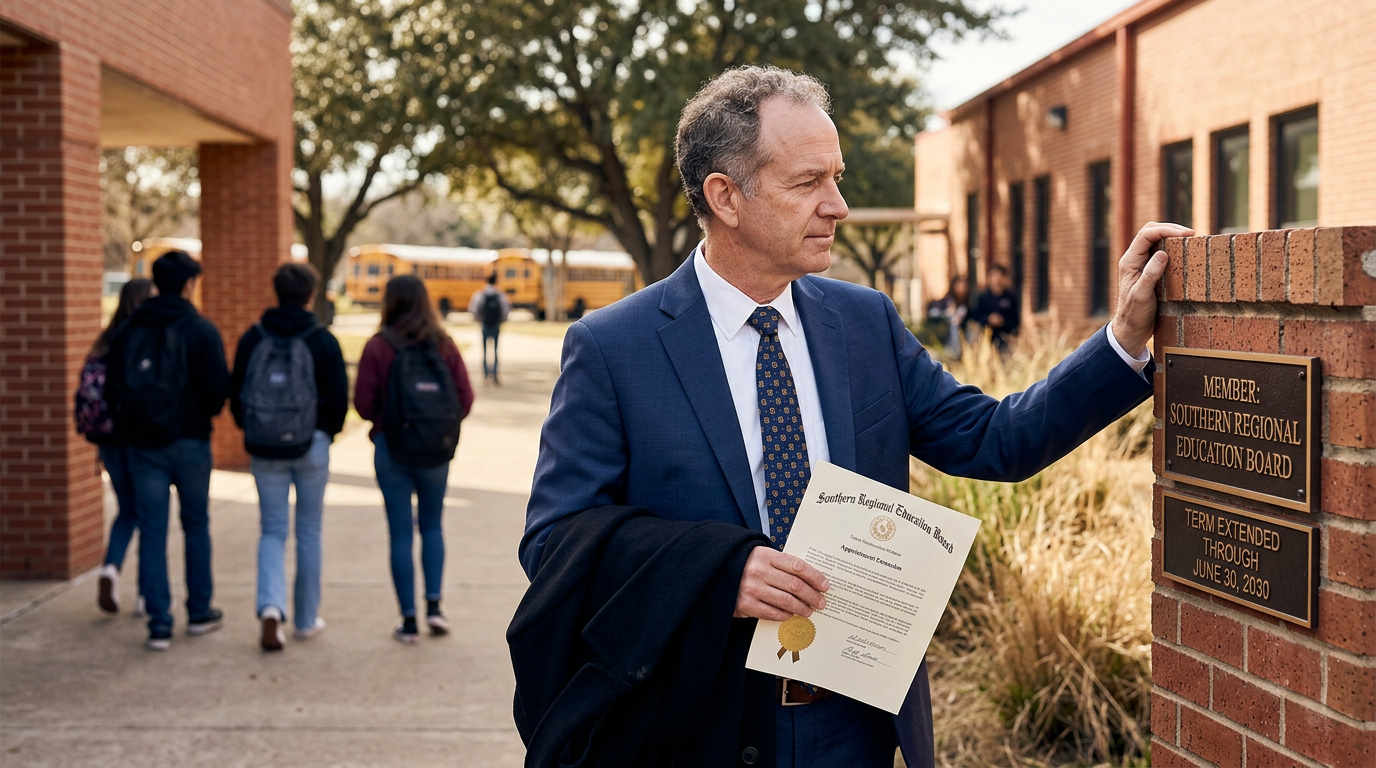
Governor Greg Abbott has officially reappointed Mike Morath, the sitting Texas Commissioner of Education, to the Southern Regional Education Board (SREB). This decision ensures that Morath will remain a leading voice in regional education policy through June 30, 2030. Morath, who has led the Texas Education Agency (TEA) since 2016, brings a decade of administrative experience to this interstate compact. The appointment comes at a critical juncture for Texas schools as the state navigates shifting curriculum standards, funding debates, and post-pandemic recovery efforts. The Southern Regional Education Board is a foundational pillar of American educational cooperation, having been established in 1948. It was the first interstate compact of its kind in the United States, formed by a coalition of governors and lawmakers who understood that the economic health of the South was directly tied to the quality of its schools. For over 75 years, the SREB has functioned as a non-partisan bridge between 16 member states, providing data-driven insights and policy recommendations that span from pre-kindergarten initiatives to post-doctoral research standards.
Texas relevance
As the leader of the Texas Education Agency, Mike Morath’s continued involvement in the SREB is highly significant for the state. Texas represents one of the largest and most complex educational systems in the country, and its participation in regional compacts allows the state to both influence and adopt best practices from neighboring jurisdictions. This reappointment signals Governor Abbott's ongoing confidence in Morath’s data-centric approach to school management, which has often focused on accountability ratings and performance-based interventions within local districts from El Paso to Beaumont. Historically, Texas has used its position within regional boards to align vocational training and higher education goals with the needs of the state's booming labor market. By maintaining a seat at the SREB table, Texas ensures that its unique workforce demands—particularly in tech, energy, and medical sectors—are reflected in the broader regional educational strategy. The decision reinforces the state's commitment to the SREB's founding principle that academic rigor is the primary driver of economic growth in the Sun Belt.
The Evolution of the Southern Regional Education Board
The SREB was born in an era when the American South faced significant economic hurdles compared to the industrialized North. Lawmakers recognized that without a standardized and improved educational infrastructure, the region would consistently lag behind in attracting high-paying industries. This realization led to the 1948 compact, which pioneered the idea that states could achieve more by sharing resources and research rather than competing in isolation.
Over the decades, the board has expanded its focus to include modern challenges like digital literacy, teacher shortages, and the integration of career and technical education (CTE). Today, the SREB provides critical services such as the Academic Common Market, which allows students to pursue out-of-state degrees at in-state tuition rates if their home state does not offer the program. Morath's role involves overseeing how these regional benefits are leveraged for Texas students.
Mike Morath’s Professional Background and Tenure
Before his appointment as Commissioner by Governor Abbott in early 2016, Mike Morath was a key player in the Dallas Independent School District (DISD). During his time on the DISD Board of Trustees, he was known for advocating for 'Home Rule' and performance-based pay for educators. His transit from local governance to state-level leadership was marked by a desire to apply business-style analytics and finance principles to the public sector.
Morath’s academic background in business administration from George Washington University has heavily influenced his approach to the TEA. He has prioritized fiscal transparency and data collection, arguing that local school boards must be held to high standards to protect the state's investment in the next generation. His reappointment to the SREB reflects his stature as a seasoned administrator who understands the intersection of state law and classroom outcomes.
Strategic Goals for Texas Education through 2030
With a term extending to 2030, Morath is positioned to oversee several long-term transformations within the Texas school system. One of the primary goals of the TEA under his leadership has been the improvement of literacy rates through the 'Science of Reading' initiative. By coordinating with the SREB, Texas can compare its progress in early childhood literacy with other large states like Florida and Georgia, which have implemented similar reforms.
Additionally, the next several years will likely see an increased focus on the connectivity between high school diplomas and the Texas workforce. The TEA has been working to revitalize vocational pathways, ensuring that students who do not pursue traditional four-year degrees are still equipped with high-value certifications. The SREB’s research into regional labor trends will be an essential tool for Morath as he fine-tunes these programs for Texas residents.
Collaboration and Interstate Standards
One of the major benefits of the SREB is the ability for member states to collaborate on teacher quality and preparation. As Texas continues to deal with localized teacher shortages, especially in rural areas, the data provided by regional partners can offer a roadmap for effective recruitment and retention strategies. Morath’s presence on the board allows Texas to share its own successes, such as the Teacher Incentive Allotment, while learning from other states' experiments with educator compensation.
Furthermore, the SREB plays a role in higher education policy. By working with other Southern leaders, Morath can help ensure that Texas universities remain competitive and that the transfer of credits between regional institutions is seamless. This level of cooperation is vital for a mobile workforce and for families who may move across state lines for employment but wish to keep their children on a consistent educational track.
Navigating Political and Educational Challenges
The role of the Education Commissioner is often fraught with political tension, as the TEA must balance the directives of the state legislature with the autonomy of over 1,000 independent school districts. Morath has navigated several high-profile challenges, including the implementation of the A-F rating system and the management of school districts during natural disasters and public health crises. His reappointment indicates that the Governor views his performance as a stabilizer for the state’s massive educational apparatus.
Looking ahead, the SREB will likely tackle emerging issues such as the ethical use of artificial intelligence in the classroom and the ongoing debate over statewide curriculum standards. As a member of the board, Morath will have first-hand access to the research being used to draft model policies for these issues. This keeps Texas at the forefront of national education trends while allowing the state to maintain its independence in how those trends are locally applied.
Economic Impact of Educational Policy
The core mission of the SREB remains the link between learning and earning. In Texas, where the economy is increasingly reliant on high-tech manufacturing and aerospace, the quality of the K-12 and collegiate pipeline is a primary concern for the TEA. Morath's business background provides a unique lens through which to view these educational requirements as human capital investments that must yield a high return for the taxpayers of Texas.
Ultimately, the success of Morath’s tenure on the SREB will be measured by the state's ability to produce a workforce that can compete globally. By engaging with other Southern states, Texas can leverage collective bargaining power for educational technology and share the costs of developing innovative assessment tools. This collaborative spirit, spearheaded by leaders like Morath, is intended to create a more resilient and prosperous regional economy.
Analysis
The reappointment of Mike Morath is more than just a routine administrative update; it is a strategic move by Governor Abbott to maintain continuity in educational leadership. Morath has often been a lightning rod for debate regarding state takeovers of underperforming districts and the implementation of rigorous testing standards. His extended tenure on the SREB suggests that the Abbott administration intends to stay the course on these policy fronts. By locking in this appointment until 2030, the Governor is ensuring that Morath's specific philosophy on school accountability will remain a component of the regional dialogue long after the current legislative session concludes.
Source attribution
This story was reported using a public release from the Office of the Governor. Keep TX Red rewrote the coverage independently and links to the official statement for verification.
Frequently Asked Questions
- What exactly is the Southern Regional Education Board (SREB)?
- Founded in 1948, the SREB is a non-profit, non-partisan organization that partners with 16 southern states to improve education at all levels. It focuses on policy research, data collection, and providing a framework for states to share educational goals and resources to boost the regional economy.
- How long has Mike Morath been the Education Commissioner in Texas?
- Mike Morath was appointed to the position of Commissioner of Education by Governor Greg Abbott in January 2016. Before this, he served as a member of the Dallas ISD Board of Trustees, where he focused on accountability and reform.
- What is the significance of the 2030 expiration date?
- A term ending in 2030 represents a long-term commitment to Morath's leadership on the board. It allows for a stable presence in regional educational planning, ensuring that Texas's voice remains consistent over the next six years of policy development.
- Does this appointment affect local Texas school districts?
- Indirectly, yes. As a member of the SREB, Commissioner Morath will have access to regional data and policy trends that often inform the guidelines and recommendations the TEA provides to local Texas school districts. It helps align Texas schools with regional standards.
Official Sources
Take the next step
Browse the Newsroom →Read more about Keep Texas Red → Our full guide to what Keep Texas Red means and why Texans support it.
Get Texas updates delivered weekly.
Independent Texas reporting on politics, policy, and daily life. One email a week. Unsubscribe anytime.
Keep TX Red Newsroom
The Keep Texas Red Editorial Staff produces nonpartisan explainers, policy breakdowns, and educational resources to help Texans understand how their government works. All content is reviewed for accuracy and updated regularly.
About Keep TX Red →