Unstoppable Momentum: Texas Secures Best Business Climate Title for Fourth Consecutive Year
Business Facilities magazine names Texas the #1 state for business again, citing economic strength, low taxes, and a top-tier workforce.
Editorial disclaimer: Opinions and analysis on Keep TX Red are editorial content — not statements of fact. See our editorial standards.
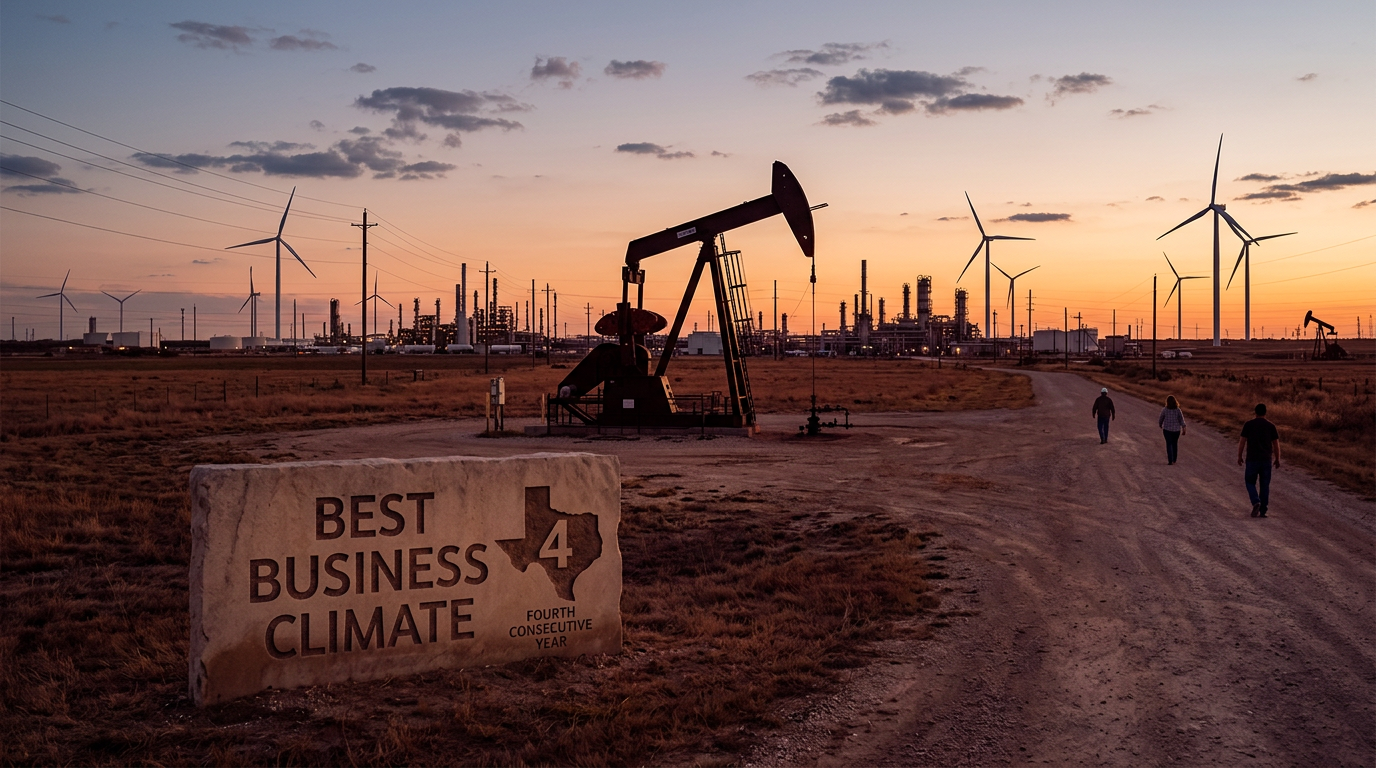
For the fourth year running, Texas has been crowned as the premier destination for commerce in the United States. Following the release of the 2026 Annual Rankings Report by Business Facilities magazine, the Lone Star State successfully defended its title as the nation's Best Business Climate. This consistent dominance highlights a decade of policy-driven growth that has transformed the state into a global powerhouse for corporate relocation and industrial expansion. Historically, Texas has leveraged a combination of legislative incentives and constitutional protections to create an environment where private enterprise can operate with fewer hurdles than in coastal competitor states. Governor Greg Abbott officially acknowledged the achievement, attributing the victory to the state's foundational commitment to economic liberty and innovation. The ranking reflects a comprehensive evaluation of several critical metrics, including total economic output, the stability of the regulatory environment, and the efficiency of the tax structure. In recent years, Texas has capitalized on a massive influx of technology and manufacturing firms, creating a virtuous cycle of high-paying jobs and increased state revenue, even as it maintains its status as a state without personal or corporate income taxes. This latest accolade serves as a validation of the state's aggressive strategy to outpace national growth trends through fiscal restraint and pro-growth legislation.
Texas relevance
The significance of this ranking for the people of Texas cannot be overstated, as it directly impacts local property values, school funding, and household income levels across the diverse regions of the state. From the high-tech corridors of Austin to the industrial hubs of the Gulf Coast and the logistics centers of North Texas, every corner of the state experiences the benefits of being perceived as the most business-friendly jurisdiction in the country. The state's history of prioritizing infrastructure development, such as the expansion of the Texas Department of Transportation's budget and the modernization of the electrical grid, has laid the groundwork for this continued recognition. Since the mid-2000s, Texas has consistently modeled its policy after the 'Texas Model'—a philosophy centered on the idea that limited government intervention allows for maximum individual and corporate prosperity, a precedent that other states are now attempting to replicate with varying degrees of success.
The Evaluation Metrics Behind the Top Ranking
Business Facilities magazine utilizes a complex methodology to determine which state offers the most conducive environment for commercial success. The 2026 report scrutinized several core pillars, including the state’s overall economic strength and the predictability of its legal system. For Texas, the primary drivers of the top score include its robust infrastructure network and a tax climate that is widely regarded as one of the least burdensome in the industrialized world.
Furthermore, the magazine evaluated the effectiveness of economic development organizations at both the state and local levels. The collaboration between the Governor’s Office of Economic Development and local chambers of commerce across cities like Houston, Dallas, and San Antonio provides a unified front that simplifies the relocation process for Fortune 500 companies and small startups alike. This synergy ensures that when a business chooses Texas, it has a clear roadmap for permitting and hiring.
Infrastructure also played a pivotal role in this year's assessment. Texas has invested billions into port expansions and highway improvements to facilitate international trade, particularly through its southern border and Gulf ports. By ensuring that goods can move rapidly across the state and into global markets, Texas provides a unique logistical advantage that landlocked or high-traffic coastal states struggle to match.
Workforce Development and Educational Alignment
A critical component of maintaining the best business climate is the availability of a highly skilled and adaptable workforce. Texas has made significant strides in aligning its higher education and vocational programs with the needs of the modern economy. The state's investment in community colleges and specialized trade schools ensures that industries ranging from aerospace to biochemical engineering have access to a deep pool of local talent.
The influx of new residents—often referred to as the 'Great Migration' to Texas—has also bolstered the labor market. Professionals from states with higher taxes and more restrictive regulations continue to relocate to Texas in search of a lower cost of living and greater career mobility. This human capital influx provides a steady stream of intellectual property and labor potential that sustains long-term economic expansion.
State leaders have emphasized that the Texas workforce is not just large, but uniquely productive. Recent legislative sessions have focused on expanding broadband access to rural areas, ensuring that the labor force in smaller communities can participate in the digital economy. This focus on inclusivity and technological readiness further distinguished Texas in the 2026 rankings from states that focus primarily on urban development.
Taxation and the Regulatory Landscape
One of the most frequently cited reasons for the Texas economic boom is the absence of a personal income tax. This policy serves as a powerful magnet for high-earners and business owners who wish to keep more of their revenue for reinvestment. By constitutional design, the state remains committed to a low-tax philosophy that favors private spending over public sector expansion.
On the regulatory front, Texas has earned a reputation for having a 'common sense' approach to oversight. While maintaining environmental and safety standards, the state has actively worked to reduce 'red tape' that often delays construction and operational permits in other jurisdictions. This lean regulatory framework allows companies to go from groundbreaking to operations in a fraction of the time required in states like California or New York.
The state’s judicial climate is also a factor in the Business Facilities ranking. Legal reforms over the past two decades have limited frivolous litigation, providing businesses with a level of legal certainty that protects them from predatory lawsuits. This stability allows for better long-term financial planning and encourages capital-intensive industries to anchor their headquarters in Texas permanently.
Global Markets and Trade Infrastructure
Texas remains the nation's leading exporter, a title it has held for over two decades. The 2026 ranking acknowledges the state's superior access to global trade routes. With 16 deep-water ports and numerous international airports, including DFW International and Bush Intercontinental, Texas serves as the primary gateway for goods moving between North America, South America, and Europe.
The proximity to Mexico and the trade lanes established by the USMCA (United States-Mexico-Canada Agreement) provide a massive tailwind for the Texas economy. Manufacturing clusters along the border and in the 'Texas Triangle' utilize these trade links to manage complex supply chains efficiently. This geographic and logistical advantage makes Texas an indispensable hub for the global manufacturing sector.
Investment in the Port of Houston and other maritime facilities has also allowed Texas to dominate the energy export market. As the world’s energy needs evolve, Texas has positioned itself at the forefront of both traditional oil and gas exports and emerging hydrogen and carbon capture technologies. This diversification ensures that the business climate remains resilient regardless of global shifts in the energy landscape.
Future Outlook and Sustaining the Momentum
While a four-year winning streak is historic, state officials and economic experts suggest that the work of maintaining this position is constant. Challenges such as the rising costs of housing in major metropolitan areas and the need for continued power grid reliability are at the top of the legislative agenda. To remain number one, Texas must continue to balance its growth with sustainable infrastructure projects.
Governor Abbott has indicated that the next phase of the Texas economic strategy will involve even greater emphasis on emerging technologies such as artificial intelligence and semiconductor fabrication. With the passage of the Texas CHIPS Act and similar initiatives, the state is proactively courting the next generation of industrial leaders to ensure that the 2030s are as prosperous as the previous decade.
The competition from other states is intensifying as they attempt to emulate the Texas success story. However, by maintaining its core principles of low taxes, limited regulation, and a focus on workforce readiness, Texas is well-positioned to continue its streak. The 2026 ranking is not just a trophy; it is a signal to global investors that the Lone Star State remains the safest and most profitable place to deploy capital in the Western Hemisphere.
Analysis
Texas’s continued dominance in the Business Facilities rankings is more than just a political talking point; it is a measurable result of a specific governing philosophy. By rejecting the high-tax, high-regulation model favored by blue states, Texas has created a sanctuary for capital and labor alike. The four-year streak demonstrates that the 'Texas Miracle' is not a temporary fluke but a sustainable structural advantage. Critics often point to the state’s rapid growth as a source of strain on public resources, yet the influx of corporate tax revenue—even without a state income tax—provides the very capital needed to address these infrastructure needs. Moving forward, the challenge for Texas leadership will be resisting the urge to increase government spending as the budget grows, ensuring that the state remains lean and competitive for the next generation of entrepreneurs.
Source attribution
This story was reported using a public release from the Office of the Governor. Keep TX Red rewrote the coverage independently and links to the official statement for verification.
Frequently Asked Questions
- What specific criteria did Business Facilities use for this ranking?
- The magazine utilizes a comprehensive set of data points including the overall strength of the state's economy, the simplicity and burden of the regulatory environment, the competitiveness of the tax code, the robustness of physical and digital infrastructure, and the availability of a skilled workforce.
- How does Texas maintain such a high ranking without a state income tax?
- Texas funds its operations through sales taxes and property taxes, but more importantly, its low-regulation environment stimulates enough economic activity that the sheer volume of business transactions provides sufficient revenue for state needs without needing to tax personal earnings.
- When did Texas first start winning this award?
- The current winning streak began four years ago, though Texas has historically placed at or near the top of similar business climate rankings for the better part of the last two decades under successive pro-growth administrations.
- Which industries are driving the Texas economic success in 2026?
- While oil and gas remain foundations of the economy, the 2026 success is driven heavily by the tech sector, semiconductor manufacturing, aerospace, biomedical research, and a massive logistics and distribution network.
Official Sources
Take the next step
Browse the Newsroom →Read more about Keep Texas Red → Our full guide to what Keep Texas Red means and why Texans support it.
Get Texas updates delivered weekly.
Independent Texas reporting on politics, policy, and daily life. One email a week. Unsubscribe anytime.
Keep TX Red Newsroom
The Keep Texas Red Editorial Staff produces nonpartisan explainers, policy breakdowns, and educational resources to help Texans understand how their government works. All content is reviewed for accuracy and updated regularly.
About Keep TX Red →