Governor Abbott Selects Sean Mason to Lead Texas State-Federal Relations Office in Washington
Governor Greg Abbott has named Sean Mason as the new Director of the Office of State-Federal Relations to advocate for Texas interests in Washington, D.C.
Editorial disclaimer: Opinions and analysis on Keep TX Red are editorial content — not statements of fact. See our editorial standards.
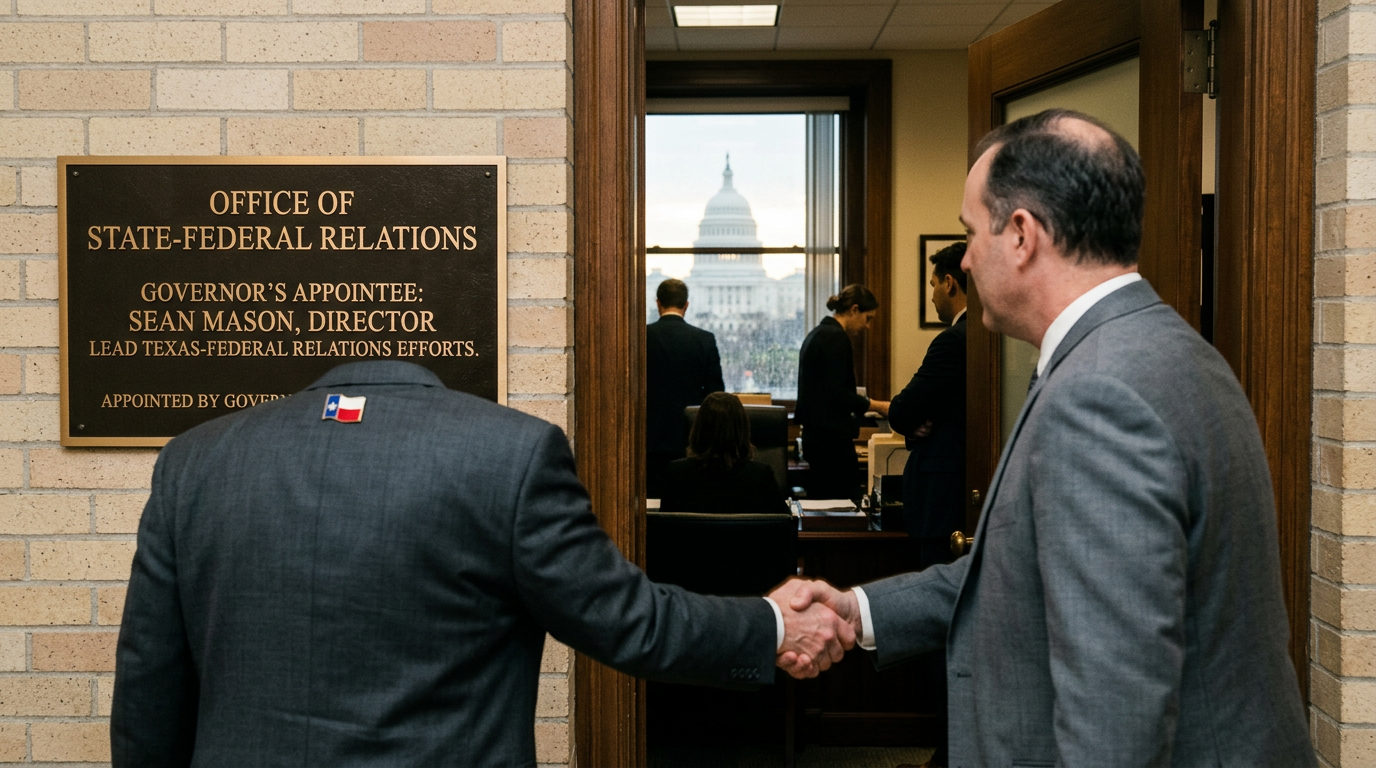
Governor Greg Abbott has officially designated Sean Mason as the new Director of the Office of State-Federal Relations (OSFR), a move that places a seasoned legislative strategist at the helm of the state's advocacy efforts in the nation's capital. Historically, the OSFR has served as the primary bridge between the Texas state government and the federal apparatus, ensuring that the diverse needs of nearly 30 million Texans are communicated directly to the White House, Congress, and various executive agencies. This appointment comes at a time when the relationship between state and federal authorities is increasingly complex, requiring a director who understands the nuances of both Austin policy-making and Washington bureaucracy. Mason, who has most recently served as the Deputy Director of the office, will now lead the team responsible for tracking federal legislation that impacts the Lone Star State. The Office of State-Federal Relations operates as the state's dedicated lobby in Washington, D.C., working to secure federal funding, shape regulatory language, and prevent federal overreach that could negatively impact Texas industries and citizens. Throughout various administrations, the OSFR has been a critical tool for Texas governors to project power beyond state lines. With Mason taking over, the office is expected to maintain its focus on key Texas priorities, including border security funding, energy independence, and infrastructure grants. His background spans both the state and federal legislative branches, providing a rare dual perspective on how laws passed in D.C. eventually find their way into the lives of Texans from El Paso to Beaumont. Mason's tenure begins immediately and continues at the discretion of the Governor. His promotion from deputy to director suggests a desire for continuity within the Governor's federal strategy. The OSFR serves as the central hub for state agencies when they interact with their federal counterparts, often acting as a clearinghouse for information regarding federal mandates and fiscal opportunities. By placing an experienced hand in this role, the Abbott administration continues its trend of elevating internally trusted advisors to high-stakes positions that require a deep understanding of the Governor's specific policy goals and the state's broader economic trajectory.
Texas relevance
Texas remains a dominant force in the national economy, and its relationship with the federal government is perhaps more significant than any other state in the union. The Office of State-Federal Relations is vital to Texas because it ensures that the state's unique interests—ranging from the massive energy sector to the logistics of the longest international border in the continental U.S.—are not overlooked by federal lawmakers. For residents in Austin and across the state, the work of this office can dictate the flow of federal highway dollars, the implementation of environmental regulations, and the state's ability to respond to natural disasters with federal assistance. Mason’s deep roots in the Texas legislative process mean he is uniquely equipped to translate the needs of rural and urban Texas communities into a language that resonates with federal decision-makers.
Professional Background and Administrative Experience
Sean Mason brings a comprehensive resume to the position, characterized by a mix of state-level service and high-level federal positioning. Before being named Deputy Director of the OSFR, Mason served as a key staffer for U.S. Representative Beth Van Duyne. His time in Van Duyne’s office likely provided him with significant exposure to the legislative priorities of North Texas, particularly regarding transportation and economic development. This federal experience is bolstered by his work with the U.S. House of Representatives Committee on House Administration, where he gained oversight into the operational and procedural mechanics of the federal legislature.
Crucially, Mason is not a newcomer to the Austin political landscape. His early career included time spent within the Texas House of Representatives, where he learned the intricacies of how the state budget is formed and how local representatives manage their district needs. This background allows him to serve as an effective liaison between state legislators in Austin and their counterparts in the Texas congressional delegation. Understanding the nuances of the Texas House is vital for an OSFR director, as the office must frequently report back to state leaders on how federal actions will require adjustments to state statutes or funding allocations.
Academically, Mason is well-prepared for the rigors of public policy. He holds a Bachelor of Science in Communication from Appalachian State University, a degree that likely informs his approach to the advocacy and public relations aspects of the OSFR. Furthermore, he earned a Master of Public Affairs from the prestigious University of Texas - LBJ School of Public Affairs. This specialized education provides a theoretical and practical foundation in governance, data analysis, and public management, all of which are necessary for overseeing a state office that must deal with complex federal data and multi-agency coordination.
The Strategic Role of the OSFR
The Office of State-Federal Relations is more than just a satellite office; it is a vital organ of the Texas executive branch. Its primary mandate is to advocate for the professional and political interests of the state government. This involves a daily grind of meeting with congressional staffers, attending agency briefings, and drafting memorandums that outline how proposed federal rules could help or hinder the state of Texas. For example, if a federal agency proposes new regulations on methane emissions, the OSFR is the entity that prepares the state’s formal response, highlighting the impact on Texas’s oil and gas industry.
Under Mason's leadership, the office will likely continue to focus on the 'Texas Model' of governance, which emphasizes limited regulation, fiscal responsibility, and state-led solutions. The OSFR serves as a watchdog, alerting the Governor to potential federal overreach before it becomes law. This proactive stance has become a hallmark of the current administration’s strategy, often leading to legal challenges or legislative maneuvers designed to protect Texas’s constitutional rights. Mason will be responsible for ensuring that the Governor’s voice is heard in the early stages of federal policy development, rather than merely responding after the fact.
The office also manages the state's relationship with the Texas congressional delegation, one of the largest and most influential groups in Washington. Coordination between the Governor’s office and these representatives is essential for passing laws that benefit the state. Mason will act as the point of contact for these representatives, providing them with state-level data and priorities that help them advocate for Texas during committee hearings and floor votes. This synergy is intended to create a unified front for Texas interests, regardless of the political climate in the capital.
Advocating for Texas Economic Interests
One of the most critical aspects of the OSFR’s mission is economic advocacy. Texas has one of the world's largest economies, and federal trade policies, tariffs, and international agreements have a direct impact on the state’s GDP. Mason will be tasked with representing the interests of Texas farmers, energy producers, and technology firms. Whether it is discussing the implications of the United States-Mexico-Canada Agreement (USMCA) or advocating for federal investment in the Port of Houston, the OSFR is the state's voice in these high-stakes economic discussions.
Taxation and federal grants also fall under the purview of the OSFR. The office works to ensure that Texas receives its fair share of federal tax dollars back in the form of grants and program funding. This includes everything from Medicaid reimbursements to Department of Education grants. Because Texas often pays more into the federal system than it receives in certain categories, the OSFR’s role in clawing back those funds is essential for maintaining the state’s fiscal health without placing an undue burden on local taxpayers.
Furthermore, the OSFR monitors federal moves that could affect the Texas workforce. This includes labor regulations, visa programs for skilled workers, and federal mandates on workplace safety. By engaging with agencies like the Department of Labor and the Small Business Administration, Mason and his team can work to ensure that federal policies do not stifle the entrepreneurial spirit that has led to such significant business migration to Texas in recent years.
Navigating Federal-State Friction
In recent years, the relationship between Austin and Washington has been marked by significant legal and political friction, particularly on issues such as energy and immigration. The OSFR is often at the center of these disputes, serving as the diplomatic arm that attempts to resolve conflicts before they reach the courtroom. Mason’s experience in both jurisdictions will be vital as he navigates these tense waters, seeking areas of cooperation where possible while firmly standing ground on the Governor’s core principles.
A major area of focus for the OSFR is the management of the Texas-Mexico border. While border security is primarily a federal responsibility, the state has invested billions of its own taxpayer dollars into Operation Lone Star. Mason will be responsible for communicating the real-world impact of federal border policies to Washington officials. This includes advocating for reimbursement of state expenses and pushing for federal policies that align with Texas’s security needs. The OSFR plays a critical role in framing the border situation not just as a local issue, but as a national security priority that requires federal action.
Environmental policy is another frequent flashpoint. As the federal government pushes for a transition to renewable energy, Texas—the nation’s leader in both oil and wind production—has a significant stake in how those policies are implemented. The OSFR works to protect the state’s energy independence by opposing mandates that would harm traditional energy sectors while also positioning Texas to capitalize on federal incentives for new energy technologies. Mason’s leadership will be key in maintaining this delicate balance.
Inter-Agency Coordination and Information Sharing
Beyond advocacy, the OSFR serves as an information clearinghouse for the entire Texas state government. Many state agencies, such as the Texas Education Agency (TEA) or the Texas Department of Transportation (TxDOT), rely on federal funding and must comply with federal regulations. The OSFR helps these agencies stay informed about upcoming changes in federal law, giving them time to adapt their operations and budgets. This internal coordination prevents surprises and allows the state to operate more efficiently.
Mason will oversee the dissemination of research and policy papers that inform state leaders. When a new federal bill is introduced, the OSFR analyzes it through the lens of Texas law and economic impact. This analysis is then shared with the Governor, Lieutenant Governor, and Speaker of the House. This ensures that the state’s leadership is always working from a position of knowledge when they make public statements or take legislative action in response to federal movements.
The office also facilitates visits between state officials and federal leaders. Whether it is a state senator traveling to D.C. to testify before a committee or a federal official visiting Texas to inspect infrastructure, the OSFR handles the logistics and ensures that the state's message is delivered consistently. This personal engagement is a critical component of the OSFR’s strategy, as it builds relationships that can be leveraged when Texas needs specific support from the federal government.
Long-Term Outlook for Texas-Federal Relations
As Texas continues to grow in population and political influence, the role of the OSFR will only become more significant. With the state gaining more congressional seats and its economy rivaling that of many sovereign nations, its interactions with the federal government carry weight across the globe. Sean Mason is taking the helm of an office that must manage a vast portfolio of issues, from aerospace and defense to agriculture and healthcare. His success will be measured by how well he secures Texas’s share of federal resources while protecting the state's right to self-govern.
The appointment of a director with strong ties to both the legislative and executive branches suggests that Governor Abbott is looking for a holistic approach to federal relations. The goal is to create a seamless feedback loop between the state's legislative priorities in Austin and its advocacy efforts in Washington. As Mason steps into this role, the eyes of the state's political and business leaders will be on him to see how he maneuvers through the complexities of the federal system to deliver results for the people of Texas.
In the coming months, Mason is expected to focus on the federal budget process and several key reauthorization acts that will impact Texas's infrastructure and energy sectors. By building on his experience as Deputy Director and his previous roles on Capitol Hill, Mason is positioned to hit the ground running. His leadership marks a new chapter in Texas's ongoing effort to remain a peerless leader among the states, asserting its influence in the halls of power in Washington.
Analysis
The promotion of Sean Mason signals Governor Abbott's preference for institutional knowledge over outside hires for high-level diplomatic roles. Mason’s transition from Deputy Director to Director provides a stable hand during a potentially volatile election cycle and shifting federal priorities. By selecting someone with experience in both the Texas House and the U.S. House, Abbott is ensuring that the state's primary advocate in D.C. understands the specific pressure points within the Republican caucus and the broader logistical challenges of federal administration. This appointment is less about a change in direction and more about reinforcing the existing 'Texas First' strategy that has defined Abbott's approach to federalism.
Source attribution
This story was reported using a public release from the Office of the Governor. Keep TX Red rewrote the coverage independently and links to the official statement for verification.
Frequently Asked Questions
- What is the primary mission of the Office of State-Federal Relations?
- The OSFR is the state’s advocate in Washington, D.C. It represents the interests of the Texas state government before the President's administration, Congress, and federal agencies. Its mission is to ensure that federal policies do not negatively impact Texas and that the state receives its appropriate share of federal funds and resources.
- Who does the Director of the OSFR report to?
- The Director is appointed by the Governor of Texas and serves at the pleasure of the Governor. This means the Director works directly for the Governor's office to execute the executive branch's federal priorities.
- How does this appointment affect the average Texan?
- While the OSFR operates in Washington, its work impacts everyday Texans by advocating for issues like border security funding, highway grants, and energy policies. By having an experienced director like Sean Mason, the state is better positioned to secure federal support that funds infrastructure and protects the Texas economy.
- What experience does Sean Mason bring to the role?
- Mason has a strong background in both state and federal government. He previously served as the Deputy Director of the OSFR, worked for U.S. Representative Beth Van Duyne, and held positions within the Texas House of Representatives. He holds a Master of Public Affairs from UT Austin.
- Where is the Office of State-Federal Relations located?
- The office maintains a presence in both Austin, Texas, and Washington, D.C., to effectively bridge the gap between the state and federal governments.
Official Sources
Take the next step
Browse the Newsroom →Read more about Keep Texas Red → Our full guide to what Keep Texas Red means and why Texans support it.
Get Texas updates delivered weekly.
Independent Texas reporting on politics, policy, and daily life. One email a week. Unsubscribe anytime.
Keep TX Red Newsroom
The Keep Texas Red Editorial Staff produces nonpartisan explainers, policy breakdowns, and educational resources to help Texans understand how their government works. All content is reviewed for accuracy and updated regularly.
About Keep TX Red →