State Board of Education Overhauls Texas History Standards with Chronological Alignment
Texas moves toward a linear history curriculum, prioritizing chronological context for millions of K-12 students starting in the new academic cycles.
Editorial disclaimer: Opinions and analysis on Keep TX Red are editorial content — not statements of fact. See our editorial standards.
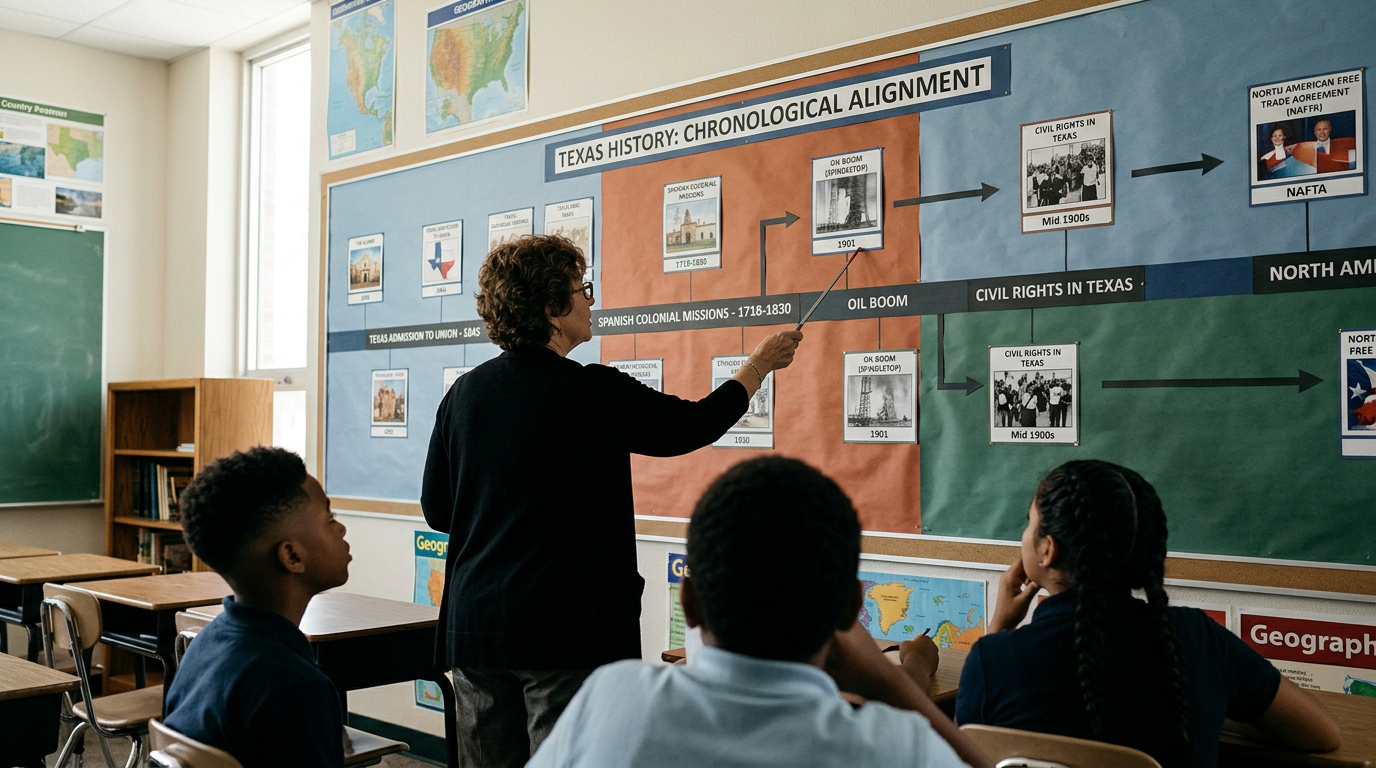
For decades, the teaching of Texas and American history in state classrooms has often been organized around thematic 'eras' or conceptual groupings rather than a strict timeline. This approach, while intended to highlight social and economic trends, often led to concerns that students lacked a coherent understanding of how one event directly caused or influenced the next. In a major shift in educational philosophy, the Texas State Board of Education (SBOE) has officially authorized a transition toward a chronological instructional model for social studies and history coursework across the state's public school system. This change is designed to simplify the learning process by following the natural progression of time, ensuring that students engage with the founding of the republic, the development of the frontier, and the modern industrial era in the order they occurred. Historically, Texas has been a battleground for curriculum standards, with debates often centering on the inclusion of specific figures or the narrative framing of the state’s past. By returning to a chronological framework, the SBOE aims to provide a more standardized and logical roadmap for teachers who have previously had to jump between centuries to satisfy thematic teaching requirements. This restructuring follows years of public hearings and expert testimony where parents and educators alike argued that a linear narrative is more intuitive for young learners.
Texas relevance
As the second-largest school system in the United States, Texas exerts a massive influence on the national publishing industry and educational trends. Changes made in Austin often dictate the content of textbooks sold across the country. Locally, this overhaul impacts more than 5 million students and hundreds of thousands of educators from the Rio Grande Valley to the Panhandle. By redefining the Texas Essential Knowledge and Skills (TEKS) for social studies, the state is making a definitive statement on the importance of sequential literacy in history. This shift directly affects how local school districts like Houston ISD, Dallas ISD, and Northside ISD will purchase materials and train their staff over the coming years.
Breaking Away from Thematic Eras
In the previous pedagogical model, a student might study the civil rights movement in a thematic block regarding 'Social Reform' and then wait weeks or months to study the Cold War in a block regarding 'Global Conflict,' despite these events happening simultaneously and influencing one another. This thematic approach was popularized in the late 20th century as a way to help students draw connections across different time periods, but it often came at the cost of temporal clarity.
The new chronological mandate requires that curricula follow a linear path. For example, eighth-grade U.S. history will now be structured so that the social changes of the 1800s are taught alongside the political upheavals of that same decade. The goal is to ensure that when a student graduates, they have a mental timeline that is consistent and uninterrupted, allowing them to better grasp the evolution of governance and cultural identity in the Lone Star State.
Impact on Textbook Manufacturers
Texas is a 'proclamation state,' meaning the SBOE sets the standards and then issues a call for materials that meet those specific criteria. Because the Texas market is so large, major publishers like Pearson, McGraw-Hill, and Houghton Mifflin Harcourt typically tailor their national editions to match the TEKS. This shift to chronological history will force a significant revision of existing digital and print assets currently used in classrooms.
Publishers will now need to re-index their content and develop new instructional modules that prioritize sequence over theme. This transition presents a financial opportunity for the industry but also a logistical challenge, as they must move quickly to keep pace with the state's rollout schedule. School districts, meanwhile, will be watching closely to see if the state legislature provides the necessary 'Allusion and Materials' funding to replace outgoing thematic-based books.
Teacher Training and Implementation
Transitioning several million students to a new way of learning is no small feat for the Texas education workforce. Educators across the state will need to participate in professional development sessions to learn how to restructure their lesson plans. Many teachers have developed extensive repositories of thematic resources over the years, and shifting to a linear model may require them to discard or heavily modify their current classroom activities.
Regional Education Service Centers (ESCs) will play a pivotal role in this rollout, providing workshops and guidance to rural and urban districts alike. The state expects that by teaching history as a continuous story, it will actually reduce the 're-teaching' burden often found in higher grades, where professors frequently complain that students arrive in college with huge gaps in their historical timelines.
Political and Cultural Context
The decision to move toward chronological history is not happening in a vacuum. It follows several years of heightened public interest in the content of Texas classrooms. Parents and advocacy groups have frequently petitioned the SBOE to ensure that history is taught in a way that is objective and comprehensive. Proponents of the change argue that a timeline-based approach is inherently more objective because it focuses on the 'when' and 'where' before diving into deeper analysis.
This shift also aligns with broader legislative efforts in Texas to emphasize 'foundational' learning. By focusing on the sequence of events, the board aims to minimize the potential for selective thematic groupings that can sometimes skew a student's perception of a specific era. The move is generally viewed as a return to 'the basics,' a sentiment that resonates strongly within the current political climate of the Texas executive and legislative branches.
Long-Term Student Outcomes
Educational experts who support chronological learning point to cognitive benefits for children. Humans are naturally wired for storytelling, and stories flow from beginning to middle to end. By presenting history as a narrative with a clear progression, the state hopes to increase student engagement and retention. When students understand the sequence of the Texas Revolution, for instance, the motivations behind the writing of the state constitution become much clearer.
Success will be measured through future iterations of the STAAR (State of Texas Assessments of Academic Readiness) exams. If the chronological model works as intended, social studies scores should stabilize as students gain a firmer grasp of how the past informs the present. The SBOE will likely monitor these data points over the next five to ten years to determine if further adjustments to the TEKS are necessary.
Analysis
The pivot back to chronological history can be seen as a victory for traditionalist educational perspectives that emphasize foundational knowledge and cause-and-effect relationships. Critics of thematic learning have long argued that a fragmented timeline prevents students from seeing the broader 'story' of Texas and America, often reducing history to a series of disconnected snapshots. By aligning the curriculum with the flow of time, the SBOE is likely attempting to reduce ideological friction by focusing on a factual, event-driven narrative rather than an interpretive one. However, the success of this transition will depend heavily on whether the state provides sufficient funding for updated textbooks and professional development, as many veteran teachers have spent their entire careers working within the thematic framework.
Source attribution
This story was reported using a public release from the Texas History Stories (Google News). Keep TX Red rewrote the coverage independently and links to the official statement for verification.
Frequently Asked Questions
- What is the difference between thematic and chronological history?
- Thematic history groups events by topic (e.g., all wars taught together, regardless of century), whereas chronological history teaches events in the order they happened (e.g., teaching the technology, politics, and wars of the 1920s together).
- When will Texas students see these changes in their classrooms?
- The rollout follows the standard TEKS revision cycle, which typically takes several years to move from board approval to full classroom implementation and textbook adoption.
- How does this affect teachers in Texas school districts?
- Teachers will need to reorganize their lesson plans and participate in state-mandated training to ensure their instruction aligns with the new linear requirements set by the SBOE.
Official Sources
Take the next step
Browse the Newsroom →Read more about Keep Texas Red → Our full guide to what Keep Texas Red means and why Texans support it.
Get Texas updates delivered weekly.
Independent Texas reporting on politics, policy, and daily life. One email a week. Unsubscribe anytime.
Keep TX Red Newsroom
The Keep Texas Red Editorial Staff produces nonpartisan explainers, policy breakdowns, and educational resources to help Texans understand how their government works. All content is reviewed for accuracy and updated regularly.
About Keep TX Red →